Selling a manufacturing business is one of the biggest decisions you’ll make as an owner. The process requires careful planning, honest financial records, and a clear understanding of what makes your operation valuable to buyers.
At Unbroker, we’ve guided manufacturers through successful exits. This guide walks you through the essential steps to position your business for the strongest possible sale.
What Makes Your Manufacturing Business Valuable to Buyers
Buyers of manufacturing businesses focus on three concrete value drivers, and understanding how yours stacks up matters far more than you might think.
Tangible Assets Command Real Value
Equipment, machinery, inventory, and facilities typically represent 30 to 50 percent of a company’s sale price, depending on the sector. A plastic injection molding operation with modern, well-maintained equipment in good working condition will command higher multiples than one with aging machinery requiring replacement. Buyers conduct detailed asset appraisals during due diligence, examining equipment age, maintenance records, and remaining useful life. If your facility has recently upgraded CNC machines, hydraulic presses, or production systems, that’s a concrete advantage. Conversely, if your equipment is 15 years old with inconsistent maintenance documentation, buyers will either discount the purchase price or factor in significant replacement costs.
Customer Loyalty Signals Stability
Manufacturing businesses with long-term customer agreements, repeat orders, and low customer concentration risk stand out sharply. A company generating 40 percent of revenue from five customers faces higher perceived risk than one with the same revenue spread across 30 customers. Buyers scrutinize accounts receivable aging, payment history, and contract terms to assess whether customer relationships will survive the ownership transition. If your largest customer has been with you for eight years and signed a three-year renewal before you listed the business, that’s a powerful signal of stability.
Documented Operations Justify Premium Pricing
Buyers want to understand how your business runs day-to-day and whether it can operate without you. A manufacturing operation with standardized production procedures documented quality control processes, and clear organizational charts is far more attractive than one where critical knowledge sits in the head of a long-time supervisor. During due diligence, buyers will ask for production schedules, standard operating procedures, supplier contracts, and employee manuals. If you maintain detailed maintenance logs for equipment, track defect rates by production line, and have written protocols for handling customer issues, you demonstrate a scalable operation that a new owner can confidently step into.
This operational clarity directly influences valuation multiples. Manufacturing companies with well-documented processes and strong management teams typically command multiples 0.5 to 1.5 points higher on EBITDA than those with ad-hoc operations. Two companies with identical $1 million adjusted EBITDA might be valued at $3.9 million and $5.4 million respectively, simply because one has cleaner processes and lower perceived operational risk.
Buyers pay for predictability and transferability. When your manufacturing business generates consistent earnings through reliable customer relationships, sits on valuable equipment, and operates through documented systems, you present a compelling acquisition target. This foundation positions you well as you move into the critical work of preparing your operation for sale.
Getting Your Manufacturing Business Sale-Ready
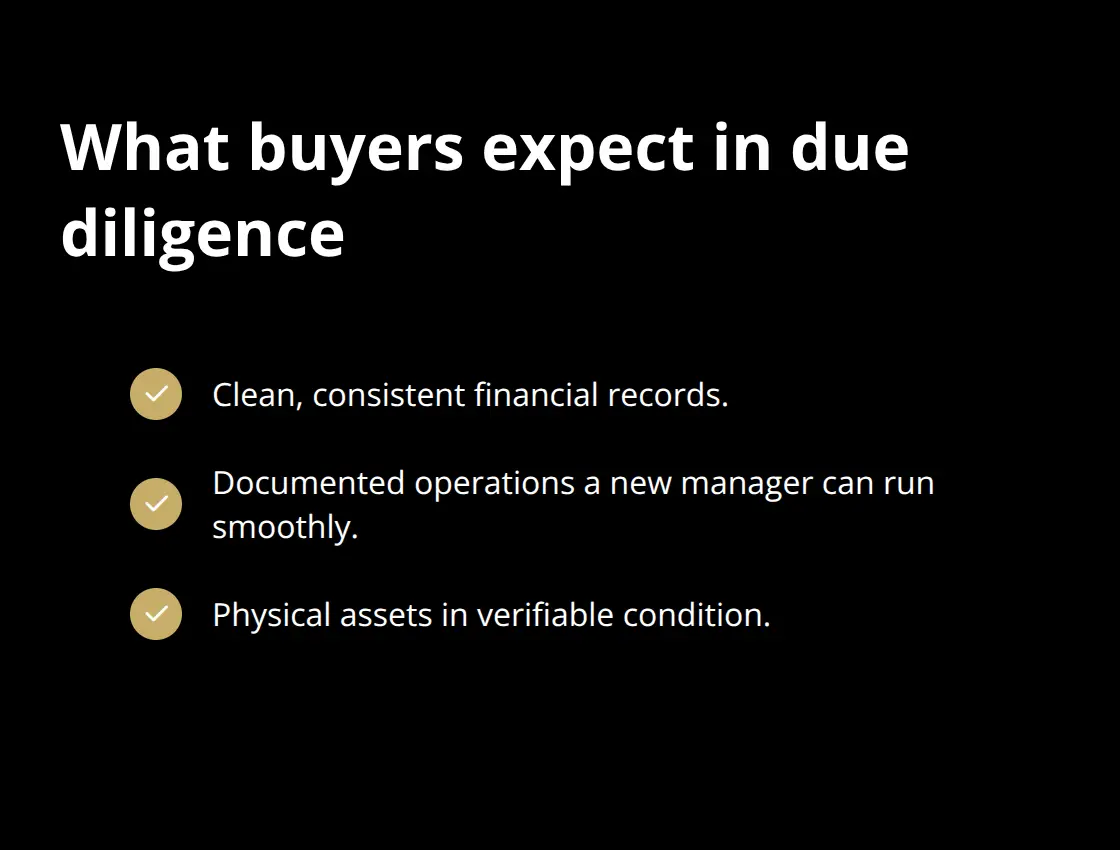
The gap between a manufacturing business that sells quickly at full price and one that languishes on the market often comes down to preparation. Buyers expect to find three things during due diligence: clean financial records that tell a consistent story, operations documented well enough that a new manager could run the business smoothly, and physical assets in verifiable condition.
Organize and Verify Your Financial Records
Start with your financials. Pull your last three to five years of tax returns, profit and loss statements, and balance sheets. Verify that everything matches. If your accountant has adjusted numbers between your tax return and what you show to vendors or customers, that inconsistency will surface immediately during buyer review and will destroy your credibility.
Normalize your cash flow by removing owner draws that a new owner won’t take and adding back discretionary expenses like your vehicle payment or home office. Adjust for one-time costs that won’t recur. A buyer paying for adjusted EBITDA needs to see exactly what expenses are truly necessary to run the operation. If you’ve run personal expenses through the business, document them clearly so they can be added back. Many manufacturing owners discover during this audit that their actual operating profitability is higher than they thought once personal items are separated out.
Document Your Critical Operations
Tackle your operational documentation next. Identify the critical processes that keep your business running: production scheduling, quality control, equipment maintenance, customer order fulfillment, and supplier management. For each process, write or update standard operating procedures. This doesn’t require a consultant or a thick manual-a clear, one-page description of how you handle a common task, who owns it, and what the expected timeline is will suffice.
Photograph and document the condition of your key equipment. Note the date of purchase, recent maintenance performed, and expected remaining useful life. If you’ve invested in upgrades over the past two years, gather those invoices and before-and-after photos. Equipment age and condition directly influence the multiple a buyer will pay. Modern, well-maintained machinery supports higher valuations. Aging equipment that needs replacement within a few years will reduce your asking price unless you’ve already factored major capital expenditures into your financial projections.
Resolve Compliance Issues Before Due Diligence
Verify compliance with all regulatory requirements. Check that your business licenses are current, environmental permits are valid, and payroll taxes have been paid on time. Review any outstanding litigation, worker compensation claims, or regulatory violations. Resolve what you can now rather than letting a buyer discover problems during due diligence.
If there’s a lingering legal issue or a customer dispute, address it. A clean slate accelerates closing and prevents last-minute deal friction that could cost you money or derail the sale entirely. Once you’ve tightened your financial story, documented your operations, and cleared your compliance record, you’re ready to determine what your business is actually worth-and that valuation will drive every conversation with potential buyers.
What Your Manufacturing Business Is Actually Worth
Calculate Your Adjusted EBITDA
Determining your asking price separates owners who sell quickly from those who languish on the market for months. The most reliable method for manufacturing businesses is the adjusted EBITDA multiple approach, which starts with your net income and adds back discretionary expenses and non-cash items to show what a buyer is truly acquiring. Calculate your adjusted EBITDA for the past three years. Add back your officer’s salary if you’re not actively involved in daily operations, your health insurance, 401(k) contributions, depreciation, amortization, interest, charitable donations, and any large one-time expenses that won’t recur. If your business spent $50,000 on a facility upgrade or $30,000 on litigation unrelated to operations, those come back into the calculation. Once you’ve normalized your earnings across three years, you have the foundation for your valuation.
Apply Industry Multiples to Your Earnings
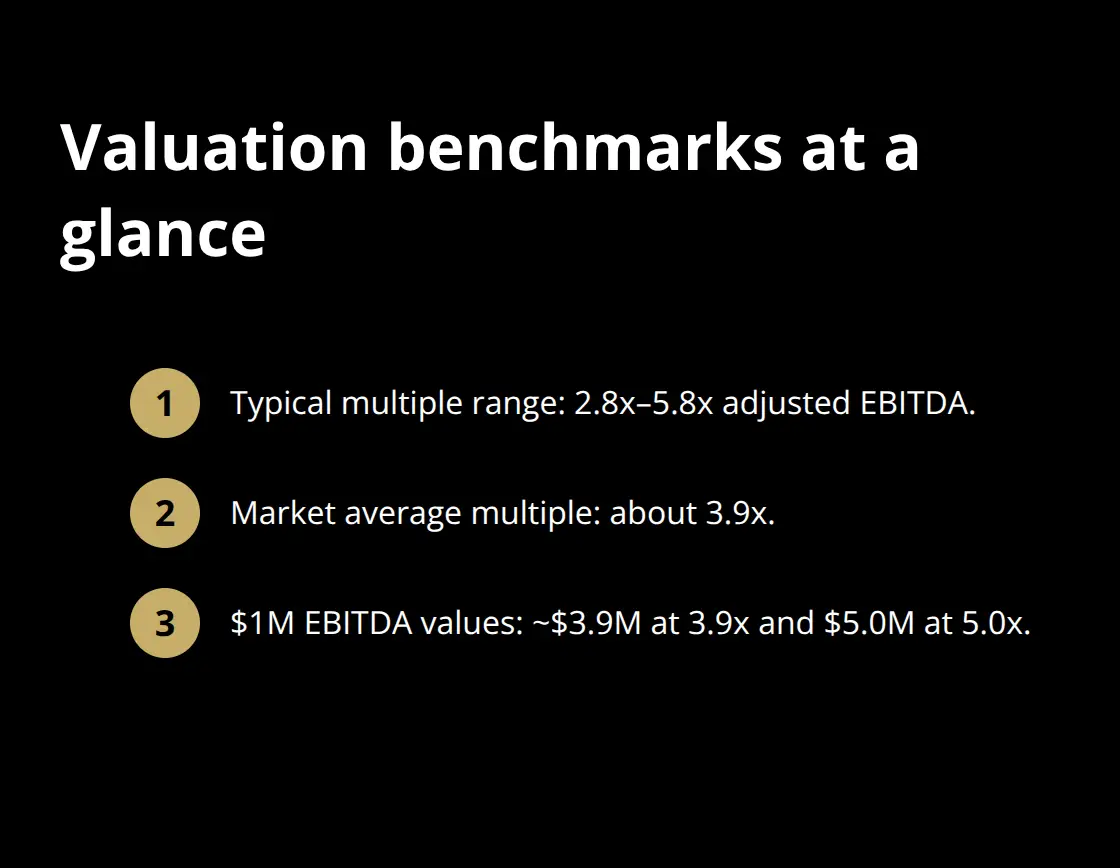
Once you’ve normalized your earnings across three years, apply an industry multiple. Plastic injection molding companies typically trade between 2.8x and 5.8x adjusted EBITDA, with an average around 3.9x according to comparable deal data. A manufacturing business with $1 million in adjusted EBITDA valued at 3.9x yields approximately $3.9 million, while the same EBITDA at 5.0x reaches $5 million. The multiple itself depends on risk factors: companies with concentrated customer bases, aging equipment, or inconsistent margins command lower multiples than those with diversified revenue, modern assets, and documented growth.
Understand How Equipment Age Affects Your Price
Equipment age directly impacts valuation. A facility with CNC machines installed within the past five years will support a higher multiple than one where the same equipment is 20 years old and requires replacement within two years. Buyers factor replacement capital expenditures into their offer, so older equipment reduces your asking price unless your financial projections already account for those costs. Professional valuation matters. A formal valuation from someone experienced in manufacturing exits provides credibility during negotiations and prevents you from leaving money on the table or pricing so high that qualified buyers walk away.
Position Your Competitive Strengths to Buyers
Your competitive position and market visibility determine whether buyers find you at all. Manufacturing business sales succeed when you clearly articulate what makes your operation defensible against competitors. If you hold long-term customer contracts, document those prominently-they reduce buyer risk around revenue retention. If your operation serves a specialized niche like medical device components or aerospace-grade fasteners, emphasize the barriers to entry and customer switching costs. Buyers pay premiums for recurring revenue and customer loyalty.
Control Your Marketing and Maintain Confidentiality
Most manufacturing business sales happen through business brokers with manufacturing experience or through platforms designed for business transactions. Specialized networks reach serious acquirers far more effectively than generic business marketplaces. Private equity firms, strategic competitors, and cash-rich family offices actively hunt for manufacturing acquisitions right now. Confidentiality matters intensely during marketing. If your employees, customers, or suppliers learn the business is for sale before you’ve secured a buyer, you risk losing key staff, inviting competitor poaching of customers, and disrupting supplier relationships. Use a confidentiality agreement with any serious prospect. Prepare a one-page executive summary highlighting your EBITDA, customer concentration metrics, equipment value, and growth trajectory-nothing more. Once a buyer signs the NDA and shows genuine interest, provide detailed financials and operational data. Controlled exposure to qualified prospects works far better than broadcasting your sale across the market.
Final Thoughts
Selling a manufacturing business demands more than hope-it requires clean financials, documented operations, and a realistic valuation grounded in actual market data. Your adjusted EBITDA, equipment condition, and customer concentration metrics directly determine whether a buyer sees your operation as a stable acquisition or a risky bet. A manufacturing business sale succeeds when you normalize your earnings across three years, document your critical processes, and resolve compliance issues before due diligence begins.
The market for manufacturing acquisitions remains active right now. Private equity firms, strategic competitors, and cash-rich family offices actively hunt for operations with strong fundamentals and documented growth potential. Your competitive advantages-whether long-term customer contracts, specialized capabilities, or modern equipment-matter only if you communicate them clearly to qualified prospects, and confidentiality protects your business during the sale process.
Timing your exit matters far more than waiting for perfect market conditions. We at Unbroker have helped manufacturing owners navigate this process with transparent, straightforward support, and Unbroker offers modern solutions designed specifically for business sellers with no hidden fees or inflated commissions. Start now with your financials, your operations, and your valuation-the sooner you prepare, the sooner you’ll be ready to close.