Selling your business is one of the biggest financial decisions you’ll make. Most owners wait too long to start planning, which costs them money and creates unnecessary stress.
We at Unbroker believe exit planning strategies should start years before you actually sell. The difference between a rushed exit and a smooth one often comes down to preparation and choosing the right approach from the start.
Know What Your Business Is Actually Worth
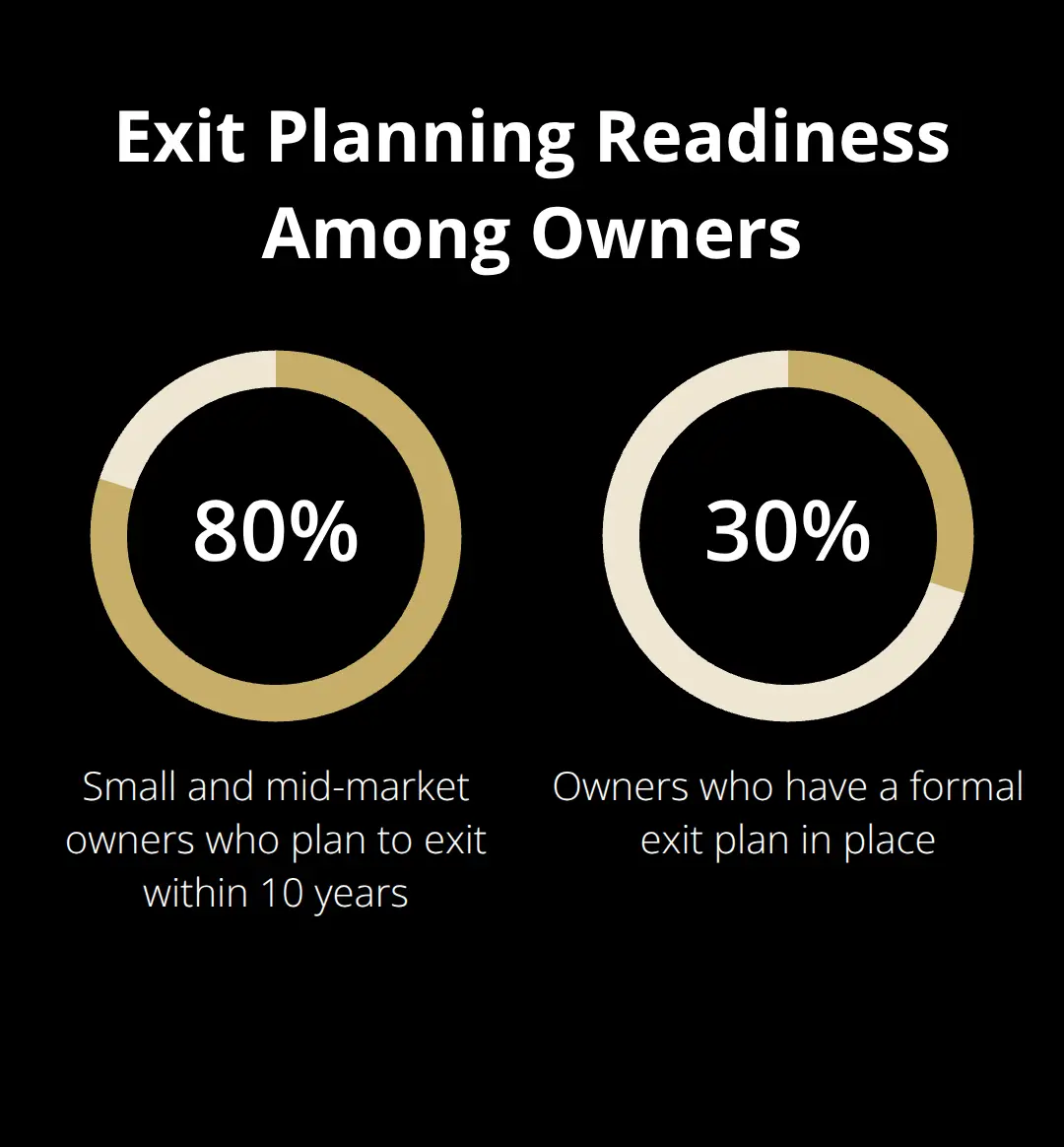
Understanding your business value is the foundation of any exit strategy, yet most owners operate blind. According to the Business Enterprise Institute, 80% of small and mid-market business owners plan to exit within 10 years, but only 30% have a formal plan. That gap exists partly because owners skip valuation entirely or rely on outdated guesses.
A professional valuation shapes every decision that follows, from how you invest in improvements to which buyers you target. It tells you whether you’re three years away from a strong exit or ten years away, and it reveals which operational changes will actually move the needle on price. Most business valuations use earnings multiples for service and tech companies, asset-based approaches for manufacturing and real estate, or market comparables based on recent sales in your sector. When you have a CFO or valuation expert behind your number, buyers take it seriously and negotiate faster.
Pinpoint what drives your value
Your strongest assets and revenue streams are often hiding in plain sight. Recurring revenue-whether from contracts, subscriptions, or retainer arrangements-commands higher valuation multiples than one-off sales because it’s predictable and transfers cleanly to a buyer. If 40% of your revenue comes from recurring sources, that segment might fetch 8–10 times EBITDA while project-based work sits at 4–6 times. Customer loyalty matters too. A Net Promoter Score above 50 signals strong relationships and reduces buyer risk, while a score below 20 flags retention problems that kill valuations. Your management team’s depth also affects price significantly: buyers pay premiums for businesses that don’t depend on the owner to run. Document your operating procedures, train middle managers, and reduce owner reliance before valuation happens. Industry positioning shapes everything as well. If you operate in a growing sector with consolidation activity, strategic buyers compete harder and pay more. If your industry is contracting, you may need to exit sooner or position yourself as a bolt-on acquisition for a larger player seeking your customer base or technology.
Structure your financial records to attract buyers
Buyers and their advisors will scrutinize your financials for months during due diligence. Clean, normalized financial statements-ones that separate one-time expenses from operating costs-demonstrate profitability and reduce red flags. If your business had unusual expenses in recent years, document them separately and show what normalized earnings would look like. Working capital management signals operational discipline: buyers want to see strong cash flow forecasting, disciplined budgeting, and KPI dashboards that prove you’ve managed the business professionally. Organize a data room now with accurate financials, vendor contracts, customer agreements, and employee documentation. The more organized you are, the faster deals close and the higher confidence buyers have in pricing.
Prepare your documentation for due diligence
Buyers expect comprehensive records that tell a clear story about your business. Organize customer contracts, vendor agreements, employee records, and intellectual property documentation in a secure, accessible format. This preparation accelerates the entire sales process and eliminates delays that cost you money. When you present organized, verified information upfront, potential buyers move through evaluation stages faster and develop confidence in your asking price. The next step involves preparing your operations and team for the transition ahead.
Ready Your Business for the Sale Process
Getting your business sale-ready means fixing the operational and structural problems that buyers will uncover during due diligence. Most owners underestimate how much work this takes, and many skip it entirely to save time, which backfires when buyers demand price cuts to offset the cleanup costs.
Clean Up Your Financial Records First
Start with your financial records because buyers examine them first. Deloitte’s May 2024 report on due diligence trends found that buyers demand more documentation than ever, with rising scrutiny on normalized earnings, tax filings, and working capital calculations. Your financials must tell a clean story: separate owner perks from true operating expenses, document any one-time costs that won’t recur, and prove your cash flow with bank statements and accounting records spanning at least three years.
If your business carries owner-paid personal expenses like vehicles, travel, or insurance that a new owner won’t need, normalize those out and show what actual operating costs look like. Organize your data room now with customer contracts, vendor agreements, employee records, intellectual property documentation, and tax returns in a secure, accessible format. The faster you hand over organized information, the faster buyers move through evaluation and the higher their confidence in your asking price.
Strengthen Operations and Cut Costs
McKinsey & Company research shows that operational improvements directly boost profitability and reduce due diligence risk. Tighten your supply chain, automate repetitive processes, and cut unnecessary costs before sale conversations begin. These changes signal to buyers that you’ve run a disciplined operation and that they won’t inherit hidden inefficiencies.
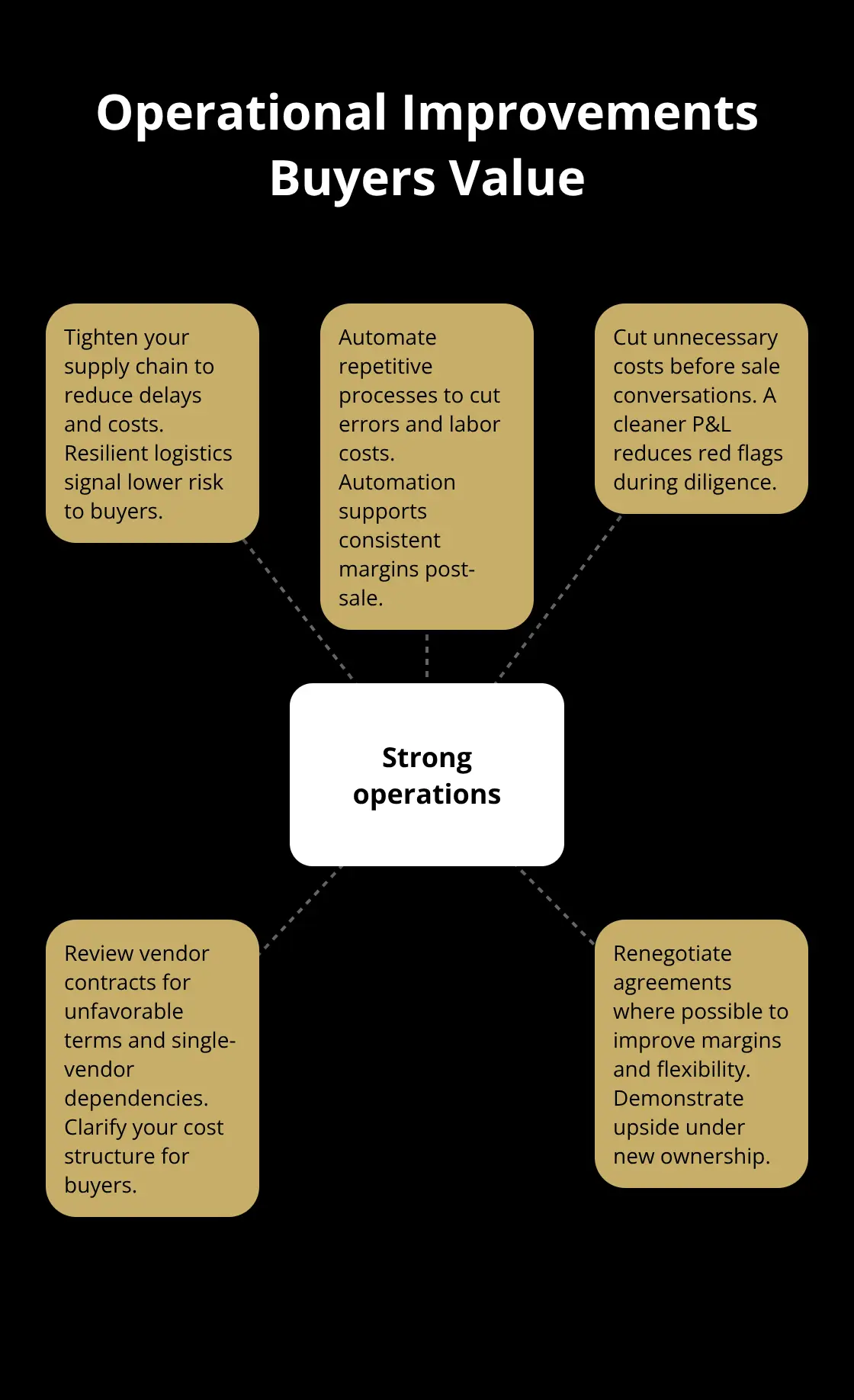
Vendors and suppliers represent another area where buyers scrutinize heavily. Review your contracts to identify unfavorable terms, long-term commitments that lock in high costs, or single-vendor dependencies that create risk. Renegotiate where possible and document your cost structure clearly so buyers understand your margins and see room for improvement under their ownership.
Build a Management Team That Operates Without You
If your business depends heavily on you to win deals or manage key relationships, that dependency will tank your valuation because buyers fear you’ll leave after closing. Build a management team that can run operations without you, document your procedures in writing, and train middle managers to own their functions. Cross-train staff on critical roles so no single person is irreplaceable.
Buyers pay premiums for businesses that operate independently of the founder-founder-dependent businesses often receive valuations 30–50% below market comparables. Create an organizational chart that shows clear reporting lines and decision-making authority. Write standard operating procedures for your core processes so a new owner can hand them to incoming managers and expect consistent execution. Identify your top three to five key employees and develop retention plans that keep them through the transition.
Organize Your Data Room for Speed and Confidence
Buyers expect comprehensive records that tell a clear story about your business. Organize customer contracts, vendor agreements, employee records, and intellectual property documentation in a secure, accessible format. This preparation accelerates the entire sales process and eliminates delays that cost you money. When you present organized, verified information upfront, potential buyers move through evaluation stages faster and develop confidence in your asking price.
With your operations tightened and your team strengthened, you’re ready to evaluate which exit strategy and sales platform will get your business in front of the right buyers at the right price.
Find the Right Platform Without Overpaying
The exit strategy you choose matters far less than the platform you use to execute it. Traditional business brokers charge between 5% and 10% of the sale price as commission, which means selling a $5 million business could cost you $250,000 to $500,000 in fees. That’s money that could go directly to you or fund your post-exit plans. Most owners accept these fees as inevitable, but they’re not. Modern platforms have fundamentally disrupted how businesses sell, offering transparent pricing structures that eliminate the financial bleeding that brokers have normalized for decades.
Why Broker Commissions Cost You Hundreds of Thousands
The choice between a traditional broker and a modern alternative determines not just what you pay, but how much control you maintain over the process, how quickly your business sells, and whether you actually reach qualified buyers or just whoever the broker has on speed dial. Traditional brokers excel at one thing: they have established relationships with a network of buyers they’ve cultivated over years. That sounds valuable until you realize most of those buyers are other brokers looking to flip businesses for a quick profit.
Brokers also control information flow, which means they decide which offers you see and which you don’t. If a buyer approaches you directly, the broker still demands their full commission, which creates perverse incentives where brokers discourage direct connections and push you toward their preferred contacts. Their fee structure also means they’re incentivized to close deals fast rather than at the highest price. A 10% commission on a $4.5 million sale versus a $5 million sale is only $50,000 difference to the broker, but it’s $500,000 to you.
How Modern Platforms Align Incentives With Your Goals
Modern platforms flip this dynamic entirely. Unbroker built its platform specifically to eliminate these conflicts. The Full Service Business Sale charges a 6% success fee, paid only when your business sells.
A success-fee structure means the platform is incentivized to maximize your sale price because it only gets paid when you do. An Assisted Business Sale gives DIY sellers expert support without broker overhead. Both options include access to a buyer network, premium marketing tools, legal templates, and negotiation assistance with complete confidentiality and no hidden fees. You maintain control over every decision while accessing institutional-quality resources.
Speed Advantages That Compound Your Returns
The speed difference is measurable. Traditional brokers typically take 6–12 months to sell a business because they work through their limited network and move methodically. Modern platforms accelerate the timeline by exposing your business to a vastly larger pool of qualified buyers simultaneously. More buyers means more competition for your business, which drives price up.
The cost difference compounds over time. If a traditional broker takes nine months to close a $4 million deal at 10% commission, you’ve paid $400,000 in fees plus opportunity cost from the extended timeline. A modern platform closes the same deal in 3–4 months at under $5,000 in total costs while your business spends less time in limbo and you reach your post-exit life faster.
Choosing the Right Approach for Your Situation
The real decision hinges on your timeline and comfort level. If you need hands-off selling and want professional representation throughout negotiations, a full-service option makes sense. If you understand your business value, can manage some of the process yourself, and want maximum cost efficiency, an assisted approach gives you expert guidance without the premium pricing. Either way, you avoid the broker trap that costs most owners hundreds of thousands in unnecessary fees while delivering slower results and less transparency about who’s actually interested in your business.
Final Thoughts
Your exit planning strategies succeed when you act on them today. The three steps outlined above-valuing your business accurately, preparing operations for buyer scrutiny, and choosing a cost-effective sales platform-form the foundation of a smooth exit. Most owners understand these steps matter but delay implementation because the work feels overwhelming or they’re uncertain where to start, which costs them hundreds of thousands in lost value over time.
A professional valuation today reveals exactly what improvements will move your sale price and by how much. Strengthening your management team and cleaning up operations takes time, but each month of delay costs you money in lost value and extended uncertainty. The platform you select determines whether you keep hundreds of thousands in fees or hand them to a traditional broker who moves slowly and controls your buyer access.
We at Unbroker built our platform specifically to eliminate the friction and cost that plague traditional exits. The Full Service Business Sale charges a 6% success fee, paid when your business sells, while the Assisted Business Sale supports DIY sellers who want expert guidance without premium pricing. Visit Unbroker to explore how a modern platform can accelerate your exit while keeping more money in your pocket.