Selling your business at the right moment can mean the difference between a mediocre exit and a life-changing one. The market sends clear signals when conditions align in your favor, but most owners miss them.
At Unbroker, we’ve seen countless founders leave millions on the table simply because they didn’t recognize the exit timing clues staring them in the face. This guide shows you exactly what to watch for and how to act when the moment arrives.
Market Signals That Indicate It’s Time to Sell
When Your Market Gets Hungry for Deals
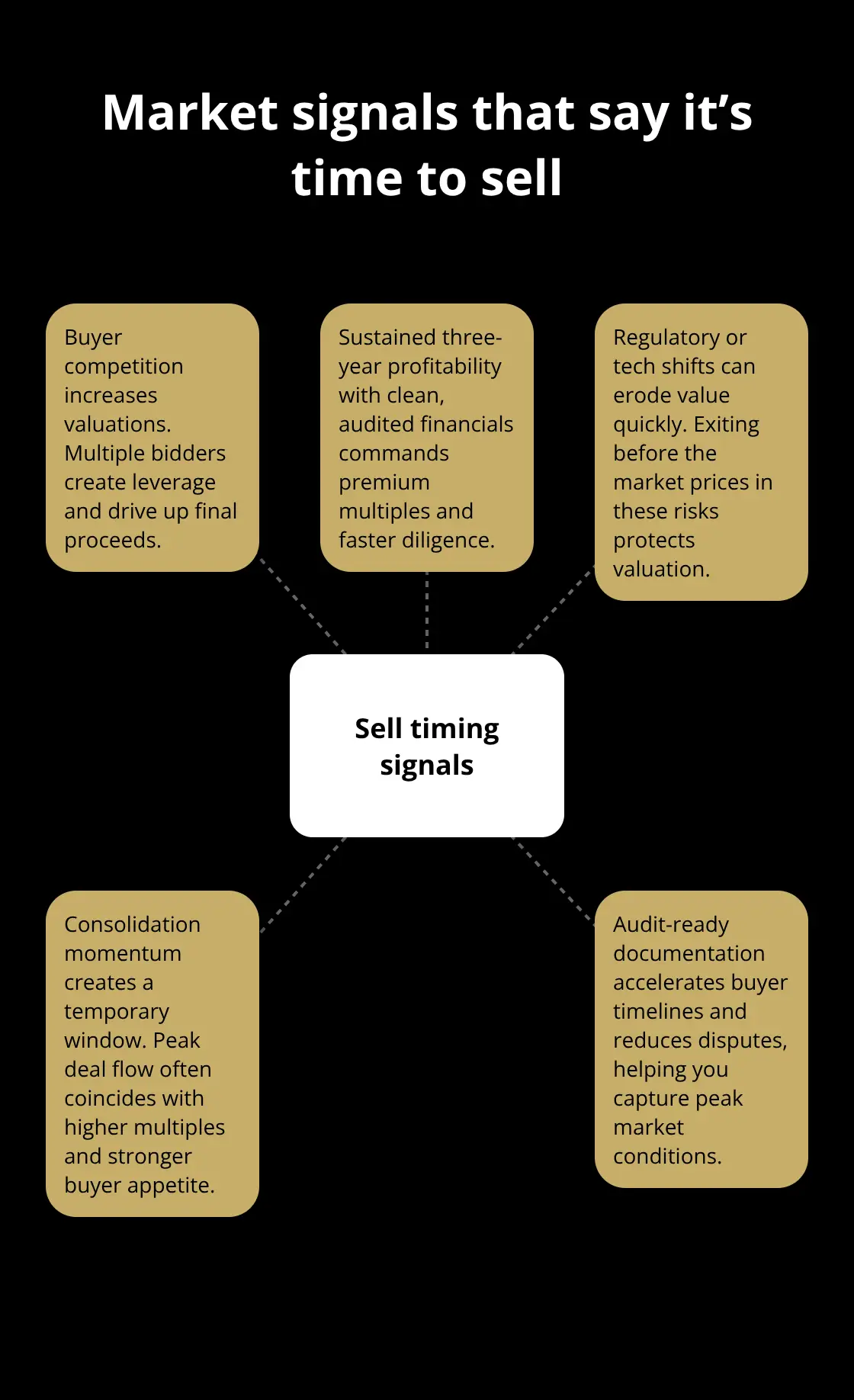
The best time to sell isn’t when you need to sell-it’s when buyers compete to buy. Right now, M&A activity is accelerating across multiple sectors. Companies with strong fundamentals attract multiple bidders, which drives valuations up and gives you negotiating leverage. If potential acquirers contact you or you hear about consolidation in your industry, that’s a market signal worth taking seriously. The difference between selling when one buyer shows interest versus three often amounts to millions of dollars in final proceeds. Industry consolidation typically creates a window where valuations spike because larger players hunt for targets to expand market share or eliminate competition. When your sector heats up with M&A activity, exit timing becomes critical-wait too long and the wave passes, leaving you with a single buyer or worse, no buyers at all.
Watch for Sustained Profitability Over Three Years
Buyers pay premium multiples for businesses showing consistent earnings over a three-year period. If your revenue grows steadily and your profit margins stay stable or improve over the last 36 months, you occupy a strong negotiating position. You must document this performance rigorously-clean, audited financial statements matter far more than verbal claims about business performance. Buyers scrutinize every number, so organized records from the past three years accelerate due diligence and prevent valuation disputes. The moment your business reaches this milestone of sustained profitability is when you should seriously evaluate exit options.
Regulatory and Competitive Pressures Signal Now or Never
New regulations that increase your compliance costs or technological shifts that threaten your competitive edge are red flags suggesting you sell sooner rather than later. If a major competitor launches a superior product or artificial intelligence disrupts your industry, waiting another 18 months could mean a significant valuation impact. These market shifts move fast. You must exit before the market recognizes the problem, not after. Similarly, if new regulations arrive that will inflate your operating costs, buyers will price that risk into their offers. Selling before regulatory headwinds fully materialize protects your valuation. Strong cash flow and market position today won’t matter if tomorrow brings a technology or regulatory shock that erodes both.
Consolidation Trends Create Your Exit Window
Sector consolidation accelerates when larger players acquire smaller competitors to strengthen their position. You gain significant leverage when multiple potential acquirers compete for your business simultaneously. Track M&A announcements in your industry-when deal flow increases, valuations typically rise alongside buyer appetite. The window doesn’t stay open forever. Once consolidation slows, buyer interest drops and valuations compress. Positioning your exit during peak consolidation activity (rather than waiting for the trend to reverse) can add substantial value to your final proceeds. Monitor your sector’s deal activity closely and prepare your business for sale when acquisition momentum peaks.
Financial Documentation Accelerates Your Path to Sale
Buyers move faster when your financial records are organized and audit-ready. Prepare three years of tax returns, profit-and-loss statements, balance sheets, and cash flow documentation now-don’t wait until you receive an offer. Clean financials reduce due diligence timelines by weeks and eliminate valuation disputes that could cost you money. When market conditions align and buyers circle, you’ll be ready to move immediately rather than scrambling to gather documents. This preparation advantage often determines whether you capture peak valuations or miss the window entirely.
Preparing Your Business for Buyers
Buyers move fastest when your business operates like a well-oiled machine independent of you. Most owners underestimate how much preparation separates a quick sale at peak valuation from a drawn-out negotiation that erodes value. Your bulletproof financials for business sale must be in order, your operations must function without constant founder involvement, and your team must demonstrate stability that survives ownership transition.
Get Your Financials Sale-Ready Now
Start with your financials immediately-not when an offer arrives. Gather three years of tax returns, profit-and-loss statements, balance sheets, and monthly cash flow records. Have a CPA review everything for consistency and accuracy. Buyers demand audited or reviewed financials, and even smaller deals benefit from professional financial preparation. Organize your records in a digital data room with clear folder structure: tax documents in one section, contracts in another, customer agreements in a third, payroll records in a fourth. Clean data reduces due diligence timelines by weeks and prevents valuation disputes that cost you thousands. When buyers see organized, professional documentation, they move forward confidently. Scattered spreadsheets and handwritten notes signal hidden problems and trigger automatic offer discounts.
Document Every Critical Process
Your business value collapses if it depends entirely on your personal involvement. Document every critical process-how you acquire customers, how you deliver your product or service, how you manage cash flow, how you handle customer support. Create standard operating procedures documentation for your top revenue-generating activities and your most time-consuming tasks. Buyers specifically assess whether the business can function under new ownership, and vague processes raise red flags. If you spend 40 hours weekly on tasks that nobody else understands, that’s a massive valuation killer. Systematize your operations so that a new owner or manager could step in and maintain revenue within 30 days. This doesn’t require a 500-page manual-it means documenting your actual workflow in enough detail that someone competent could follow it. Additionally, reduce your personal dependencies in customer relationships. If 60% of your revenue comes from relationships you personally manage, buyers will demand a significant discount or walk away entirely. Transition key customer relationships to trusted team members now, before you sell.
Build Team Stability and Reduce Key Person Risk
Buyers worry about losing key employees after acquisition, so demonstrate that your team is stable and motivated to stay. If you’ve experienced high turnover or key departures in the past two years, that’s a serious red flag for buyers. Conversely, if your top three employees have been with you for 3+ years and understand their roles deeply, that’s a major valuation advantage. Document your team’s capabilities, tenure, and compensation. Show that you’ve invested in their development and that they have clear career paths. During due diligence, buyers will interview your key team members, so prepare them for these conversations and ensure they’re comfortable discussing their roles and the business’s future. Consider retention agreements for critical staff-offer modest bonuses that pay out 6-12 months post-sale if they remain employed. This signals to buyers that your team won’t abandon ship the moment ownership changes. Key person risk valuation discount concerns can significantly impact your sale price, so eliminating this risk through team stability directly increases your proceeds. A capable team that functions independently of you solves one of the biggest concerns that keeps buyers up at night. When you’ve addressed these three preparation areas-bulletproof financials, documented operations, and stable team-you’re ready to navigate the actual sales process and valuation discussions that determine your final proceeds.
Navigating Your Business Valuation and the Sales Process
Your business valuation determines everything that follows, yet most owners approach this backward. They either accept the first number a buyer suggests or waste months arguing about vague valuations based on gut feeling rather than market data. The reality is blunt: your valuation depends on what buyers in your specific market will actually pay right now, not what you think the business is worth or what it might be worth in an imagined perfect scenario.
Understanding How Buyers Value Your Business
Buyers use three primary methods to value a business. Revenue multiples apply a standard multiplier to your annual revenue based on industry benchmarks, typically ranging from 0.5x to 3x depending on your sector and growth rate. EBITDA multiples are more common for profitable businesses and generally range from 4x to 6x, with most private company transactions falling in this range. Discounted cash flow analysis projects your future cash generation and discounts it to present value, which works best for stable, predictable businesses with clear growth patterns.
Most mid-market business sales rely on EBITDA multiples because they reward profitability directly. If your business generates $500,000 in EBITDA and your industry trades at 6x multiples, expect valuations around $3 million, though actual offers will vary based on growth rate, customer concentration, and competitive position. The harsh truth is that buyers pay premiums for businesses showing consistent growth and discounts for those showing stagnation or decline. A business growing 30% annually commands significantly higher multiples than one growing 5%, sometimes 2x or 3x higher depending on market conditions.
Identifying and Approaching the Right Buyers
Finding qualified buyers matters far more than casting the widest net possible. Most owners make the mistake of trying to reach every potential acquirer, which dilutes your message and leaks confidentiality. Instead, identify strategic buyers in your industry who have demonstrated acquisition appetite through recent deals, and approach them directly through a structured process.
Work with an advisor who has existing relationships with these buyers rather than cold-calling or using generic broker networks. Your advisor should understand your business deeply enough to position it against buyer priorities, not just list features and financials. When you have multiple offers on the table, you hold the leverage that separates a mediocre deal from an exceptional one.
Negotiating Offers and Deal Structure
Never anchor on your desired price first. Let buyers make the opening offer, which reveals their true valuation ceiling and gives you negotiating room. All-cash offers at lower prices often beat stock-heavy offers at higher prices because cash certainty matters more than paper promises.
Earnouts, where you receive additional payment based on post-sale performance, can mitigate risk for the buyer while giving you an opportunity to enhance the aggregate consideration. However, avoid earnouts unless the difference is substantial and the buyer has a clear track record of paying them. The structure you choose directly impacts your final proceeds and your financial security after the sale closes.
Maximizing Tax Efficiency in Your Sale
Tax efficiency in deal structuring can preserve hundreds of thousands of dollars in proceeds. Asset sales and stock sales have dramatically different tax consequences, and the right structure depends on your specific situation. Consult with a tax professional before accepting any offer structure, as this decision often determines whether you keep 60% or 75% of your proceeds after taxes. The difference between a tax-optimized sale and a poorly structured one can amount to more money than you’ll make in the next five years of operations.
Final Thoughts
Exit timing clues matter far less than execution. You’ve now seen the signals that indicate peak valuation windows, the preparation steps that separate successful exits from mediocre ones, and the valuation methods that determine your final proceeds. The gap between knowing this information and acting on it determines whether you capture millions or leave them behind.
Most business owners recognize market signals too late. Consolidation peaks and buyer interest surges while they scramble to organize financials and document processes. The owners who win prepare during calm periods, so when market conditions align, they move immediately. Your three-year financial documentation, operational systems, and team stability aren’t nice-to-haves-they’re the foundation that lets you capitalize on peak valuations when they arrive.
Buyers exist right now, and market momentum exists right now. Your preparation determines whether you’re ready to seize this moment or watch it pass. We at Unbroker built our modern business sale platform specifically for this moment, eliminating traditional broker fees that eat into your proceeds while connecting you with qualified buyers through AI-driven processes. Start organizing your financials today, document your processes this month, and when a qualified buyer appears or your sector heats up with acquisition activity, you’ll negotiate from strength rather than desperation.