Selling your business without professional guidance often leads to costly mistakes. At Unbroker, we’ve seen DIY mistakes derail deals that should have closed-from inflated valuations to disorganized records that scare off buyers.
The difference between a successful sale and a failed one often comes down to preparation. This post covers the three biggest errors that tank business sales and how to avoid them.
What Price Should You Actually Ask For Your Business
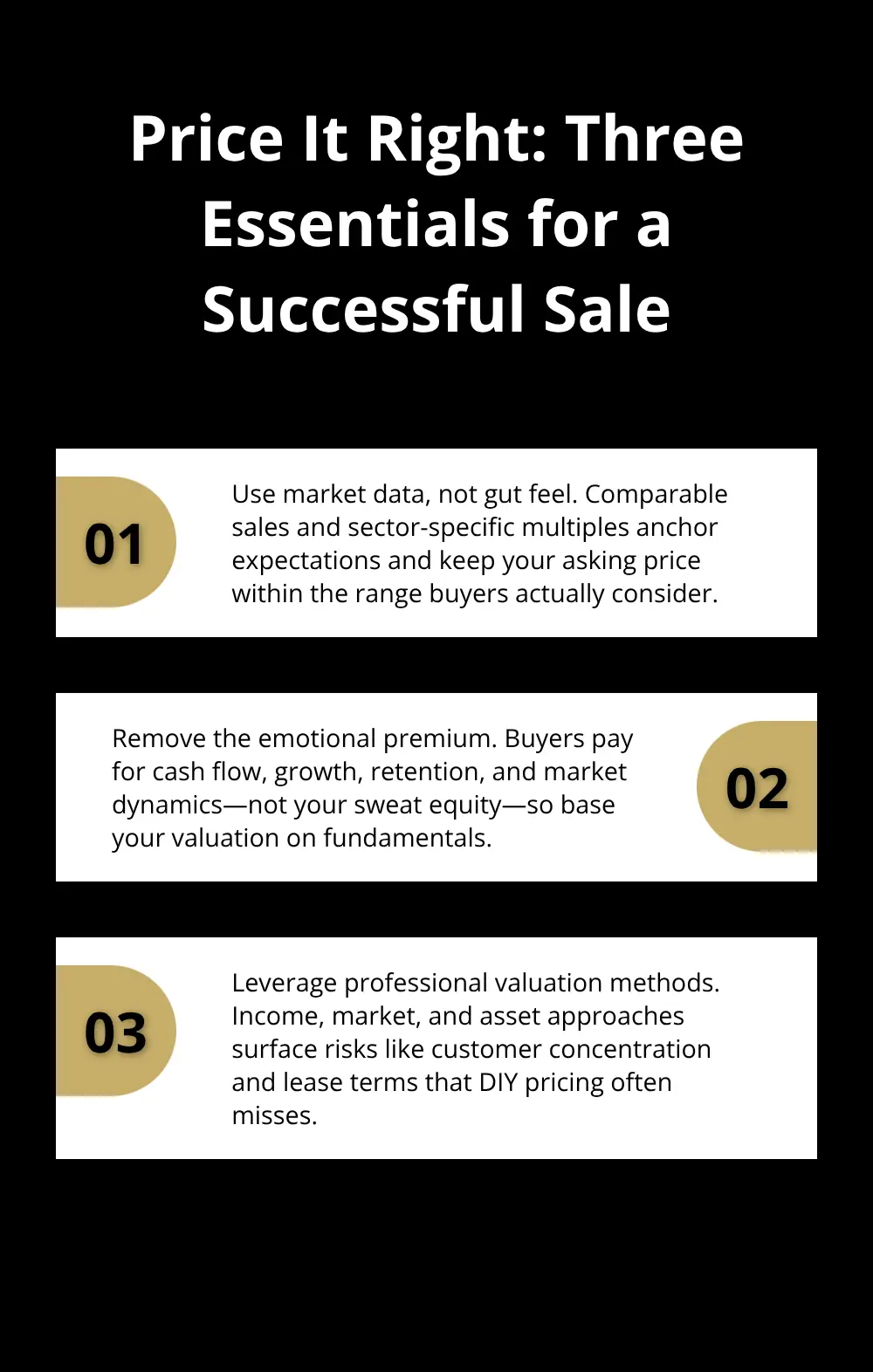
Most DIY sellers price their businesses based on gut feeling rather than market data, and it costs them dearly. Overpricing shrinks your buyer pool significantly. A business priced 20 percent above market value receives half the inquiries compared to one priced correctly. Comparable sales data in your industry tells you exactly what similar businesses sold for, yet many sellers ignore this information entirely.
Know Your Industry’s Real Numbers
If you operate a service business generating $500,000 in annual revenue, you need to know what comparable service businesses at that revenue level actually sold for in the past 12 to 24 months. Without this data, you’re essentially guessing. Industry multiples vary based on the size of your company, its profitability, its growth prospects, and the industry in which it works. A SaaS company might sell for 5 to 8 times EBITDA, while a local retail business might fetch only 2 to 3 times EBITDA. These differences matter enormously when you’re calculating your asking price.
Emotional Attachment Distorts Your Judgment
You’ve poured years into building your business, so naturally you feel it’s worth more than the market says it is. This emotional premium doesn’t translate into buyer willingness to pay. Buyers care about cash flow, growth trajectory, customer retention, and market conditions. They don’t care about your sweat equity or the sacrifices you made. Separating emotion from valuation is one of the hardest parts of selling a business, yet it’s absolutely necessary.
Professional Valuations Reveal What You Miss
A professional valuation costs between $2,000 and $10,000 depending on business complexity, but it typically saves you far more than it costs. Valuation experts use three approaches: the income approach (based on cash flow), the market approach (based on comparable sales), and the asset approach (based on tangible and intangible assets). They account for factors you won’t think of alone, like customer concentration risk, lease terms, supplier dependencies, and competitive threats.
Professional valuators have access to databases of actual sales in your industry. They see real numbers, not theoretical ones. This market intelligence is invaluable. Online calculators use generic formulas that don’t account for your specific situation. A business with declining customer retention rates shouldn’t be valued the same as one with growing retention, yet many online tools treat them identically.
The Cost of Getting the Price Wrong
Underpricing hurts equally. If you ask $800,000 when the market says $1.2 million, you’ve left $400,000 on the table. That’s not being reasonable or eager to close. That’s being uninformed. The right price attracts serious buyers who can actually afford your business and are motivated to move forward. The wrong price either attracts tire-kickers with no real purchasing power or repels qualified buyers entirely.
Once you’ve nailed your valuation, the next challenge emerges: buyers want proof that your business is actually worth what you’re asking. That proof comes from your financial records and documentation.
Your Financial Records Are Your Strongest Selling Tool
Buyers don’t trust what you tell them. They trust what your numbers prove. Missing or disorganized financial records kill more deals than any other single factor because they force buyers to assume the worst. When a potential buyer requests three years of tax returns and bank statements, and you scramble to piece them together from scattered spreadsheets and folders, that hesitation signals trouble. If your financial records aren’t already organized and GAAP-compliant, you add months to your timeline while buyers lose confidence. Most DIY sellers underestimate how thoroughly buyers will examine their financial history. They cross-reference your claimed revenue against bank deposits, verify expenses through credit card statements, and trace customer payments. Discrepancies between what you claim and what the records show don’t just reduce your asking price-they often end negotiations entirely. A buyer who spots inconsistencies starts wondering what else you’re hiding, and at that point, trust vanishes.
Document Every Revenue Stream With Specificity
Generic revenue figures mean nothing without backup documentation. If you claim $750,000 in annual revenue, buyers need to see exactly where that money came from. Did it come from ten major clients or three hundred small ones? Are those revenue streams recurring or one-time sales? Customer concentration risk directly impacts valuation because a business dependent on a few large clients is riskier than one with diversified revenue.
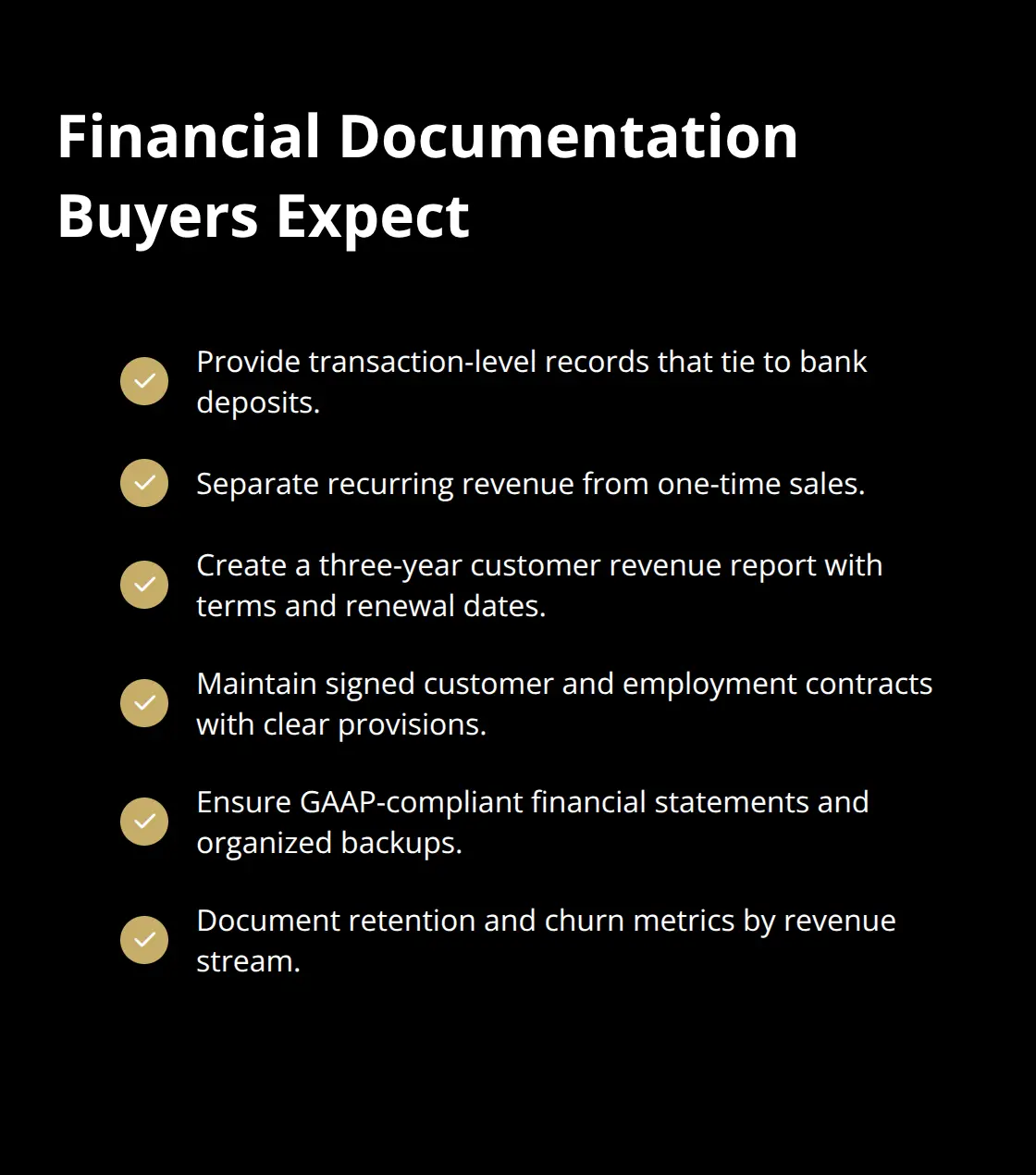
You need transaction records, customer contracts showing payment terms, and evidence of ongoing relationships. If you invoiced clients but haven’t documented their payment history or contract renewal dates, buyers can’t assess whether that revenue will continue under new ownership. Many DIY sellers also fail to track recurring versus one-time revenue separately, making it impossible for buyers to project future cash flow accurately. Create a customer revenue report showing the last three years of payments by client, contract terms, and renewal dates. This single document transforms vague claims into verifiable facts. Similarly, if you generate revenue from multiple sources-subscriptions, services, products, licensing-separate documentation for each stream is non-negotiable. Buyers analyze retention rates and churn because they need to know if customers will stay after you leave.
Employment and Customer Contracts Require Complete Transparency
Incomplete or missing contracts create legal liability that scares buyers away. If key employees lack written agreements, buyers worry about whether those employees will stay post-acquisition. If customer relationships rest on informal handshakes rather than documented contracts, the buyer assumes those customers will leave. Employment agreements should clearly specify roles, compensation, non-compete clauses, and what happens if the business changes hands. Many DIY sellers never formalized these arrangements because the business ran smoothly without paperwork, but buyers see missing documentation as a red flag indicating the business depends heavily on personal relationships rather than institutional strength. Customer contracts matter equally. Buyers need to see evidence that your major clients have committed to ongoing relationships. If your largest customer represents twenty percent of revenue but has no written contract, that relationship is essentially at-will and could evaporate. You should compile a complete list of all active customer contracts with renewal dates, pricing terms, and any exclusivity or non-compete provisions. If contracts are missing or expired, start documenting current relationships immediately. Get your major clients to sign updated agreements before you market the business. This transforms uncertainty into certainty and protects your valuation.
What Happens When You Skip This Step
Buyers who encounter incomplete contracts or missing documentation don’t negotiate harder-they walk away. The cost of reconstructing your business history during due diligence far exceeds the effort of organizing it beforehand. A single missing customer contract can tank a deal if that customer represents significant revenue. The buyer can’t verify the relationship will survive the ownership transition, so they discount your valuation or pull out entirely. You’ve now spent weeks or months marketing your business only to lose qualified buyers because your paperwork wasn’t ready.
With your financial records and contracts in order, you’ve solved half the problem. The other half involves making sure the right buyers actually find your business in the first place.
Poor Marketing and Buyer Targeting Strategies
Most DIY sellers list their business on BizBuySell, Flippa, or similar generic marketplaces and assume that’s enough. It’s not. Generic platforms attract tire-kickers, competitors doing market research, and casual browsers with no serious intent to purchase. A business selling for $500,000 needs to reach qualified buyers with actual capital and decision-making authority, not everyone with an internet connection. Listing on a single generic platform is like posting a help-wanted ad on a community bulletin board and expecting to hire an executive. The right buyers for your specific business operate in your industry, understand your market, and already know the value proposition you’re selling. They don’t randomly browse marketplace listings. They search industry-specific forums, attend trade shows, join professional networks, and work with brokers who specialize in their sector.
If you’re selling a digital marketing agency, posting on BizBuySell reaches the same audience as a manufacturing firm or a fitness studio. There’s no targeting. There’s no relevance. Your competitive advantages disappear into a sea of unrelated businesses, and serious buyers in your niche never see your listing.
Why Your Business Description Fails to Attract Qualified Buyers
The second critical failure is treating your business description like a resume instead of a sales document. DIY sellers typically write something like: “Established digital marketing agency. Founded 2015. Serves small to mid-market clients. EBITDA $120,000.” That’s generic, forgettable, and tells buyers nothing about why they should care. Competitive advantages matter enormously in buyer evaluations, yet most DIY sellers bury them or don’t mention them at all.
What proprietary processes do you have? What intellectual property sets you apart? Do you hold exclusive contracts with major clients? Do you have recurring revenue that competitors can’t replicate? These details drive valuation, but they only work if you articulate them clearly. A buyer evaluating multiple agencies won’t choose yours unless they understand exactly what makes it different and defensible.
Your marketing materials should answer specific questions: What customer segments do you dominate? What’s your customer retention rate compared to industry averages? What’s your growth trajectory over the past three years? Do you have any exclusive partnerships or certifications that competitors lack? These specifics transform your listing from a generic description into a compelling investment thesis. Qualified buyers read your materials and immediately recognize whether your business fits their acquisition strategy. Unqualified buyers skip to the next listing because they don’t understand the value. That’s exactly what you want.
Reach Qualified Buyers Through Industry-Specific Channels
Generic marketplaces cast a wide net, but wide nets catch mostly worthless fish. Your energy should focus on channels where qualified buyers in your industry actually congregate. If you’re selling a B2B software company, that means reaching out to larger software firms, private equity investors focused on software, and strategic acquirers in your vertical. These buyers don’t browse BizBuySell. They work with investment bankers, attend industry conferences, or maintain acquisition teams that monitor competitors and complementary businesses. You need to be visible in those channels.
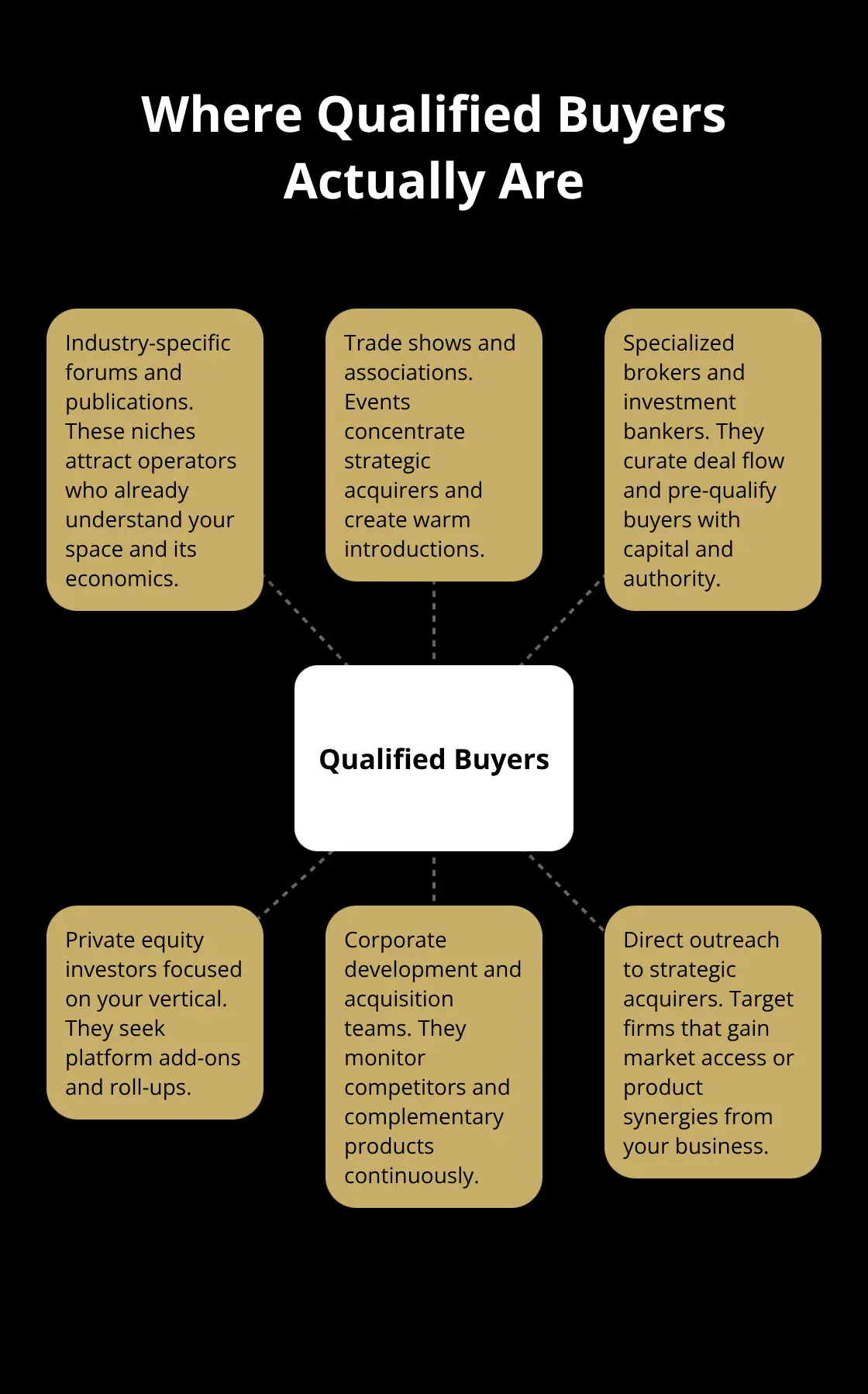
Industry-specific publications sometimes run acquisition profiles or case studies. LinkedIn groups for your sector often feature acquisition discussions. Trade associations in your field maintain networks of potential buyers. If you operate in a niche market, reaching five qualified buyers is infinitely more valuable than reaching five thousand unqualified ones. One qualified buyer who understands your business model and sees immediate strategic value can close a deal in months. Five thousand tire-kickers waste your time with lowball offers and endless questions about why you can’t accept cryptocurrency as payment.
Align Your Business Story With Buyer Motivations
Buyers acquire businesses for specific reasons. Some want to roll up multiple competitors into a larger platform. Others seek complementary products or services to add to their existing portfolio. Still others look for cash-flowing assets to stabilize other investments. Your marketing materials should address these different buyer motivations explicitly.
If your business has recurring revenue and predictable customer churn, emphasize that stability to financial buyers seeking cash flow. If your business operates in a growing market segment or serves a customer base that larger competitors are trying to penetrate, emphasize that to strategic buyers seeking market access. If your business has operational inefficiencies that a larger organization can fix, highlight the improvement opportunity to operators focused on value creation through optimization. The same business appeals differently to different buyers depending on what they value. A vague listing appeals to nobody. A targeted narrative appeals to exactly the buyers who should be making offers.
Final Thoughts
Three categories of DIY mistakes consistently kill business sales, and they all stem from insufficient preparation. Overpricing based on emotion rather than market data shrinks your buyer pool and signals that you misunderstand your own business value. Disorganized financial records and incomplete contracts force buyers to assume the worst about your operations, destroying trust before negotiations even begin. Poor marketing that relies on generic platforms means qualified buyers never see your listing, leaving you fielding offers from tire-kickers instead of serious acquirers.
Buyers expect to see organized financials, professional valuations, and targeted marketing that demonstrates you’ve done your homework. When they encounter scattered records, inflated asking prices, and vague business descriptions, they conclude you’re either unprepared or hiding something-and they move on to the next opportunity. A professional valuation costs a few thousand dollars but prevents you from leaving hundreds of thousands on the table through underpricing or losing qualified buyers through overpricing. Organized financial records that are GAAP-compliant eliminate months of due diligence delays and keep buyer confidence high.
We at Unbroker built our platform specifically to help DIY sellers avoid these pitfalls by providing legal document templates, premium marketing tools, and expert negotiation assistance. Our Full Service option handles the entire process for a 6% success fee, paid only when your business sells. Unbroker offers lower fees than traditional brokers charge while giving you access to a vast buyer network enhanced by AI-driven processes.