Selling a business is hard. Finding the right buyer is even harder. We at Unbroker built an AI buyer matching platform to solve this problem, connecting sellers with qualified buyers in days instead of months.
Traditional methods waste time and money. Our platform uses real-time analysis to match your business with serious, qualified buyers who actually fit your sale.
How AI Matching Analyzes and Ranks Buyers
Data-Driven Ranking Replaces Personal Networks
AI buyer matching operates on a fundamentally different principle than traditional brokerage networks. Instead of relying on a broker’s personal relationships and memory, modern platforms analyze dozens of measurable dimensions simultaneously. Revenue range, growth rate, technology stack, customer concentration, geography, regulatory status, management tenure, and competitive positioning all feed into a ranking system that surfaces the highest-fit buyers first.
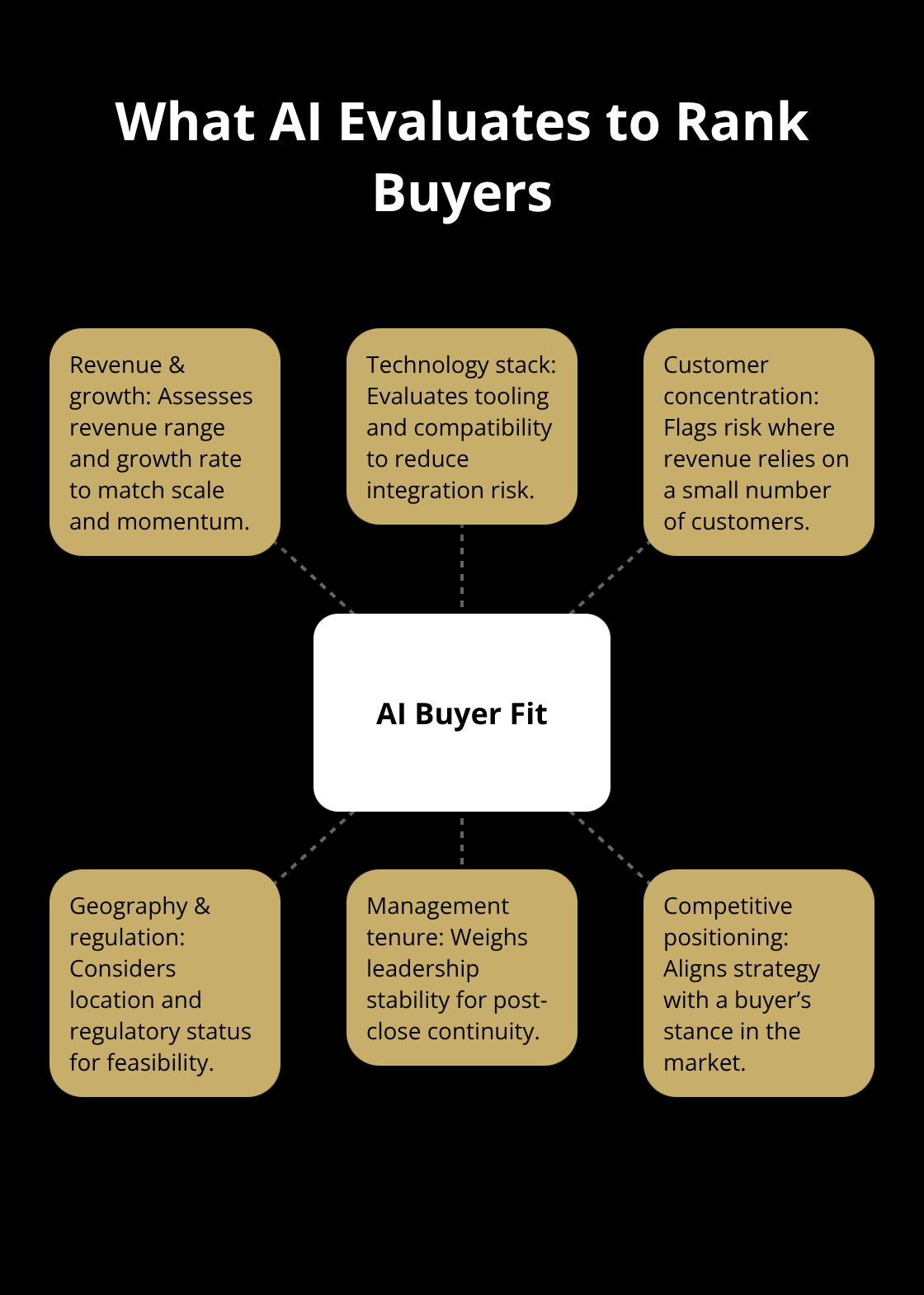
This data-driven ranking approach eliminates the guesswork. When you list your business, the platform extracts structured and unstructured data from your company profile, then runs similarity scoring across multiple dimensions to identify buyers whose strategic intent actually aligns with what you’re selling. The result is a ranked list with explainable breakdowns showing exactly why each buyer surfaced-not a generic database export of hundreds of tire-kickers.
Continuous Learning Improves Match Quality Over Time
Real-time feedback loops make the matching smarter over time. As deals progress through LOI, due diligence, and closing stages, the system learns which buyers you engaged with and which ones fell away, then uses those signals to refine future recommendations. A buyer who previously passed on logistics add-ons but showed strong interest in fintech acquisitions becomes weighted differently in the next round of matching. This continuous learning feedback loops in buyer matching means the platform gets better at surfacing ready-to-engage buyers with each transaction. The system captures signals that traditional databases cannot: whether a buyer is actually serious right now, whether their board has approved new acquisitions, or whether their cultural values align with yours. Machine learning models improve with more training data and more time observing outcomes, synthesizing engagement patterns, transaction histories, and relationship mapping to surface buyers who are both qualified and motivated.
Surfacing Hidden Opportunities in Fragmented Markets
For sellers in fragmented markets or emerging regions, AI matching reveals hidden opportunities that static databases would never surface. The platform synthesizes data from news, regulatory filings, registries, and industry reports to identify buyers that traditional sources miss. AI can analyze vast amounts of data to uncover market trends, competitor strategies, and historical deal outcomes and enable more informed decisions. Tools like PitchBook and Capital IQ let you filter by basic criteria, but they cannot capture buyer readiness or strategic alignment. AI systems go deeper, uncovering which buyers have the budget, board approval, and cultural fit for your specific business. This advantage compounds when you operate across multiple geographies or niche sectors where relationship opacity makes manual research nearly impossible. The next section explores why traditional buyer search methods consistently fail to deliver these results.
Why Traditional Buyer Search Methods Fall Short
Personal Networks Create Artificial Scarcity
Brokers rely on personal networks, and personal networks have hard limits. When you list your company, your sale competes for attention against dozens of other mandates in that broker’s pipeline. This constraint means most qualified buyers never hear about your business. The broker’s rolodex becomes the ceiling on your opportunity set. Meanwhile, thousands of buyers actively seeking acquisitions in your sector remain completely unaware that your company is for sale. Traditional databases let you filter by revenue, industry, and geography, but they stop there. You receive a list of 500 companies that match your criteria on paper, then spend weeks manually vetting which ones actually have budget, board approval, and strategic intent to acquire.
Manual Vetting Consumes Weeks of Wasted Effort
The manual vetting process drains resources. Each outreach requires custom research-checking recent funding announcements, scanning LinkedIn for acquisition activity, reading earnings calls for M&A guidance. A single qualification round consumes 40 to 60 hours of work before you identify even five genuinely interested buyers. Traditional databases show what companies are, not what they want or whether they can move now. You send generic teasers to hundreds of prospects and hope engagement follows.
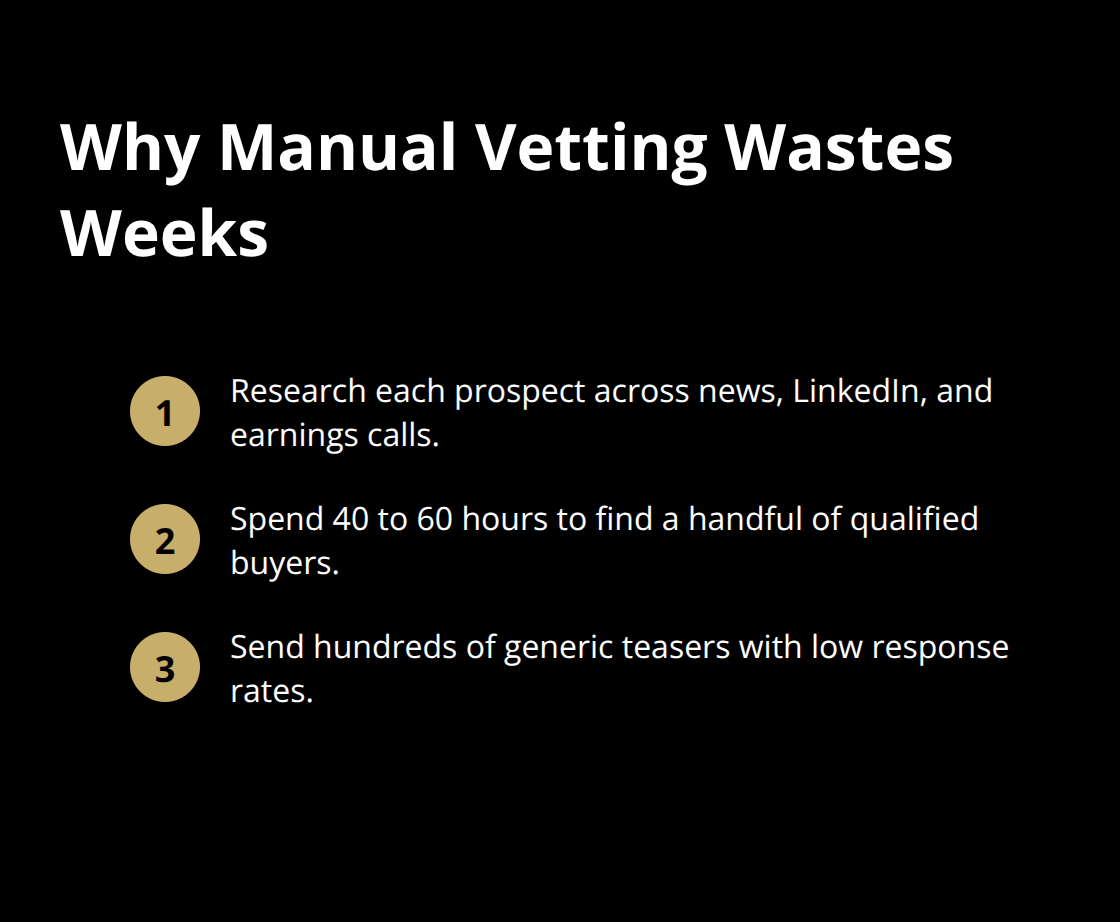
Most never respond. The ones who do often lack real budget or board approval. You waste time on tire-kickers while the actual buyers who would move fast remain buried in your outreach list.
Mismatches Destroy Deals in Final Stages
The real damage appears when mismatches close. A buyer who looked qualified on paper turns out to have different cultural values, incompatible technology stacks, or unrealistic return expectations. Due diligence stalls. Negotiations drag for months. Deals collapse in the final stages, wasting everyone’s time and leaving your business in limbo. These late-stage failures cost far more than early screening ever could-you’ve invested months in a process that yields nothing.
AI Matching Shifts from Quantity to Quality
Modern AI platforms analyze buyer behavior signals-recent acquisitions, investment announcements, management changes, board composition-to surface only buyers with genuine fit and readiness right now. Rather than sending generic teasers to 500 prospects and hoping for engagement, the platform ranks and presents your business to 10 to 15 highly qualified buyers who actually match your profile. That shift from quantity to quality cuts your time on market dramatically and increases the odds that the buyer who closes is one you genuinely want to work with. The next section explores how AI-driven matching delivers these advantages and what separates high-quality platforms from outdated approaches.
What Results Can You Actually Expect from AI Matching
Speed Transforms Your Financial Timeline
AI buyer matching platforms deliver measurable speed advantages that directly impact your bottom line. Traditional brokerage networks average four to six months from listing to close. AI-driven matching compresses that significantly. The platform identifies and ranks qualified buyers within days, not weeks. You move from initial outreach to qualified buyer introductions in two to four weeks rather than two to four months. This speed matters financially. Every month your business remains unsold, you lose revenue and face ongoing operational costs while market conditions shift against you. A business generating $500,000 in annual profit costs you roughly $41,000 per month while waiting for buyers to emerge from a broker’s personal network. Faster matching means faster exits and lower carrying costs.
Quality Filtering Eliminates Tire-Kickers
The quality improvement compounds the benefit. Traditional approaches surface hundreds of prospects, but most lack genuine budget or board approval for acquisitions right now. AI systems filter ruthlessly, presenting your business to qualified buyers who actually have the capital, decision-making authority, and strategic alignment to move forward. This narrower pool converts faster. Fewer tire-kickers means fewer failed negotiations and fewer deals that collapse in due diligence because cultural values or operational expectations never aligned from the start. You spend your energy on serious buyers instead of chasing prospects who were never ready to acquire.
Transparent Pricing Aligns Incentives
Cost transparency separates modern platforms from outdated brokers. Traditional business brokers charge five to ten percent of sale value as commission, plus hidden costs for legal work, marketing materials, and escrow services. A $5 million sale at six percent costs you $300,000 in brokerage fees alone. Unbroker built its pricing around transparency and fairness. The Full Service Business Sale charges a 6% success fee, paid only when your business sells, keeping our interests aligned with yours. No hidden fees. No surprise charges. That cost structure matters because it aligns incentives. Traditional brokers earn more when they close you faster at any price. Modern platforms succeed only when you do, so they focus on matching you with buyers who offer genuine value, not just the first offer that lands.
Strategic Alignment Produces Better Outcomes
Better matches produce better outcomes. Research from M&A advisory firms shows that deals with strong strategic alignment close faster and command higher valuations than mismatched transactions. When buyer and seller share compatible operational philosophies, technology stacks, and growth objectives, negotiations move smoothly. When they clash on fundamentals, deals stall and often fail entirely. AI matching identifies that alignment upfront, not after months of relationship building. You avoid wasting time on buyers whose vision for your company contradicts your own, and you attract buyers who will actually value what you built.
Final Thoughts
AI buyer matching platforms transform how businesses sell by replacing broker networks with data-driven precision. The shift eliminates months of wasted effort and surfaces qualified buyers within weeks instead of months. Traditional methods rely on personal relationships and manual vetting, both of which fail to identify the right buyers at the right time, while modern platforms analyze buyer behavior, financial readiness, and strategic alignment to present your business to genuinely motivated prospects.
Speed and quality filtering compound the advantage. Faster exits reduce carrying costs and financial exposure while market conditions shift, and quality screening removes tire-kickers so you focus energy on serious buyers who can actually move forward. Strategic alignment identified upfront prevents late-stage failures that waste months of work and leave your business in limbo-research consistently shows that aligned transactions command higher valuations and close with fewer complications than mismatched deals.
We at Unbroker built our platform around these principles, offering transparent pricing that aligns incentives with your success. The Full Service Business Sale charges a 6% success fee, paid when your business sells. Start your sale with Unbroker and experience how modern matching accelerates your exit while protecting your interests.