Selling a business shouldn’t require paying 10% in commissions just to access a buyer. Yet traditional brokers have built their entire model around high fees that eat directly into what you walk away with.
At Unbroker, we’ve seen thousands of sellers realize there are better ways. Affordable platform options now exist that strip away unnecessary costs while keeping the support you actually need.
What Traditional Brokers Really Cost You
The Commission Trap
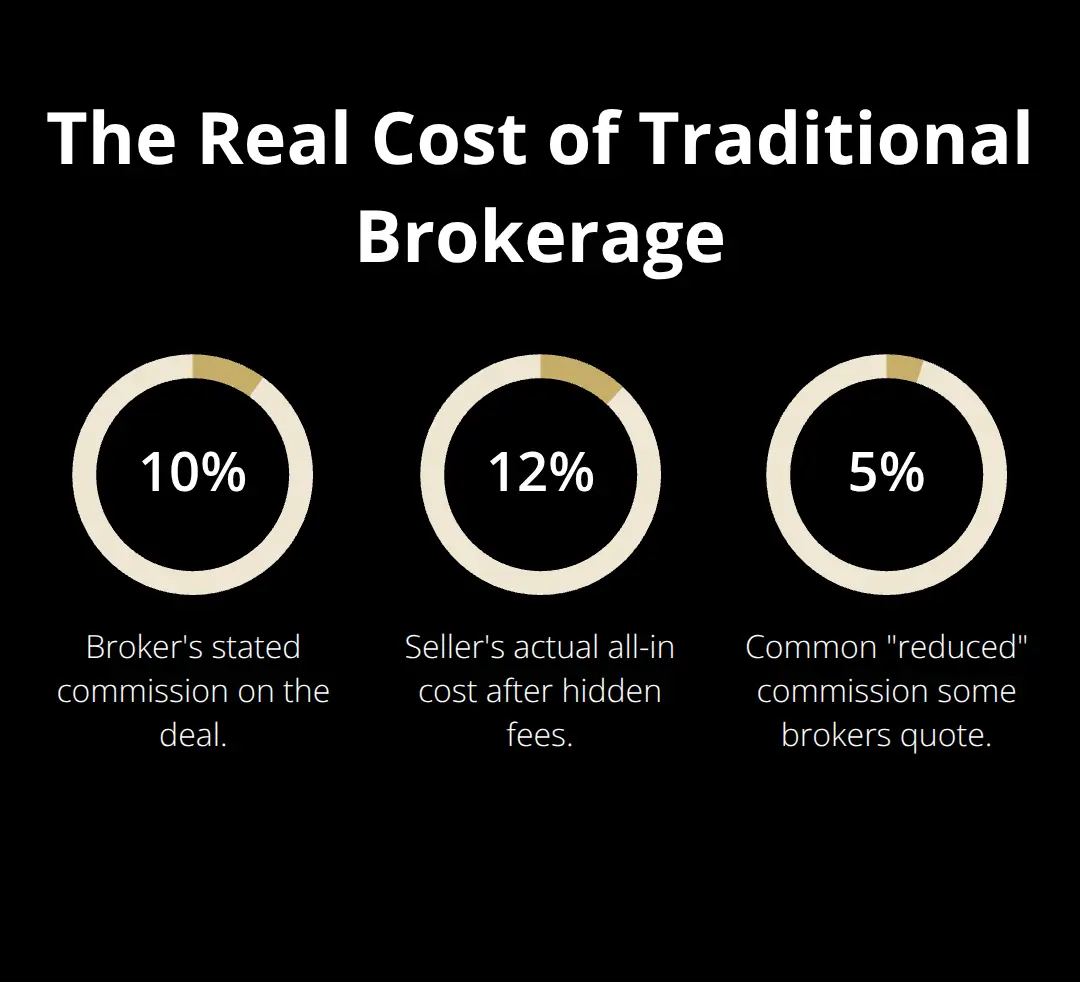
When you work with a traditional business broker, the math works against you from day one. A standard commission on a $500,000 sale means significant money walks out the door before you see a penny. That’s not the worst part-many brokers layer on additional costs that aren’t obvious upfront: legal review fees ranging from $2,000 to $5,000, transaction coordination charges, escrow fees, and markup on third-party services. One seller paid a broker $48,000 in commission plus another $12,000 in hidden costs on a $600,000 transaction. The broker’s total take was 10%, but the seller’s actual cost reached closer to 12% when everything was tallied.
Why Overhead Costs You
These fees exist because traditional brokers operate with high overhead. They maintain physical offices, employ large teams, and spend heavily on marketing to find buyers. That infrastructure gets passed directly to you through commission structures that haven’t changed in decades. Modern platforms eliminate much of this overhead, which is why they can offer transparent pricing without surprise charges.
The Timeline Penalty
The timeline problem compounds the financial damage significantly. Traditional brokerage sales take 6 to 12 months on average, sometimes longer. During that period, exclusivity agreements prevent you from exploring other options. Your business runs under uncertainty while the broker slowly markets it to their network. Months drag into quarters, and quarters into years for complex deals.
That extended timeline costs you real money. You lose revenue from reduced decision-making speed, experience employee turnover as staff worry about the sale, and face opportunity costs from capital tied up waiting for closure. A business generating $100,000 in annual profit loses $50,000 to $100,000 in value simply waiting out a broker’s slow process. Sellers who switched to modern platforms completed their sales in 60 to 90 days, reclaiming those lost months and the income they represent.
The Real Price of Waiting
The combination of excessive fees and drawn-out timelines makes traditional brokerage an expensive luxury most sellers can no longer afford. Modern alternatives now offer a different path-one that strips away unnecessary costs while keeping the support you actually need. Understanding what these alternatives provide is the first step toward a faster, more profitable exit.
What Modern Platforms Actually Offer
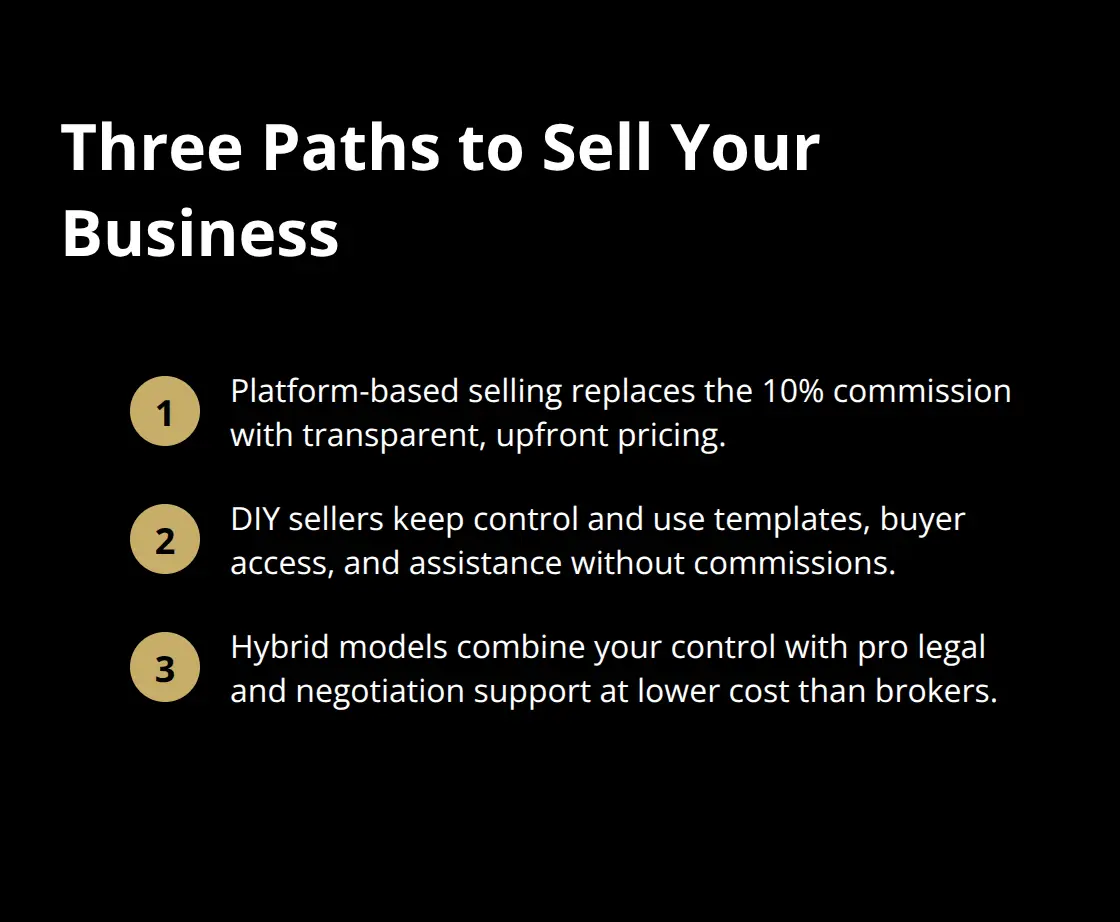
The shift away from traditional brokers has created three distinct paths forward, each with real cost savings and different levels of involvement. Platform-based selling strips away the traditional 10% commission and replaces it with transparent, upfront pricing that doesn’t hide behind legal fees or coordination charges. A seller moving a $500,000 business to Unbroker’s Full Service pays a 6% success fee-just $30,000-when the sale closes, instead of the $50,000 to $60,000 a traditional broker would demand. That difference funds your next venture or strengthens your personal finances without requiring you to sacrifice support or buyer access.
Transparent Pricing Changes the Equation
Modern platforms have moved away from the traditional broker model, where you don’t know the final cost until legal fees, escrow charges, and service markups get tallied. Instead, they charge a small, transparent success fee that’s disclosed upfront with no surprises, due only when the sale closes. A seller working with a broker on a $1,000,000 sale pays roughly $100,000 in commission plus $15,000 to $25,000 in hidden costs. The same seller using Unbroker’s 6% success fee pays $60,000 total, due only when the sale closes. That roughly $55,000 to $65,000 difference represents real money that stays in your pocket.
DIY Sellers Control Their Process
Sellers who prefer control over their process don’t need to abandon professional support. Modern platforms provide legal document templates, buyer network access, and negotiation assistance without charging commission on the final price. This approach works best if you have time to manage marketing, buyer communications, and due diligence coordination yourself.
The monthly subscription model means you only pay for the months you actually need the platform, unlike broker agreements that lock you in for the entire sales process. Selling without a broker typically takes 12-18 months from initial prep to closing, while using a broker can compress that timeline to 6-10 months. The time investment was real, but the financial outcome justified it.
Hybrid Models Offer Balance
The hybrid approach combining control with professional support balances both needs. You maintain control over marketing and initial buyer interactions while outsourcing legal review, document preparation, and complex negotiations to professionals. This model costs more than pure DIY but far less than traditional brokerage. Sellers choosing this path report faster closing timelines than traditional brokers because the platform’s streamlined process eliminates unnecessary delays while keeping expert eyes on critical details.
Each path delivers what traditional brokers promised but failed to provide: speed, affordability, and genuine support. The question isn’t whether modern platforms work-it’s which structure aligns with your situation and how much involvement you want in the sales process.
What Smart Sellers Should Look for in a Platform
Platforms worth your time operate nothing like traditional brokers. They publish their fees upfront, which means no surprises when you reach closing. Transparent fee disclosure ensures you know exactly what legal documents you’ll receive, what buyer access looks like, and what support you’ll have during negotiations. The key question becomes: what specific services justify the fee, and do those services actually accelerate your sale or reduce your risk?
Fee Structure Determines Your Bottom Line
Platforms charge in predictable ways. Some use flat post-sale fees, which favors sellers with higher valuations since the percentage drops as your sale amount increases. Others charge monthly subscriptions, which works best if you sell quickly or already have buyer interest. A few use hybrid models that combine fees with post-sale charges. The math matters significantly. Unbroker’s Full Service charges a straightforward 6% success fee, paid only when your business sells. On a $300,000 sale, that’s $18,000, versus $30,000 for a traditional 10% commission. On a $1,000,000 sale, that’s $60,000, versus $100,000 for the same traditional commission. Platforms that disclose these costs let you calculate your exact net proceeds before you commit. Your cash flow situation and expected timeline determine which structure makes sense.
Buyer Networks Determine Deal Flow
A platform only delivers value if qualified buyers actually see your business. Ask platforms directly: how many active buyers use their network, and what’s the typical time-to-first-offer? Some platforms claim thousands of buyers but rarely produce serious inquiries because those buyers lack genuine interest in your industry or price range. The best platforms segment their networks by business type, revenue range, and geography so your listing reaches relevant buyers rather than getting buried in a massive, unfocused database. AI-driven matching systems now identify buyers whose acquisition criteria align with your business profile, which accelerates serious conversations and reduces tire-kickers. Verify whether the platform provides buyer profile data so you understand who’s actually viewing your business. Some platforms offer marketing across multiple channels (email to their buyer base, direct outreach to qualified prospects, and syndication to partner networks). This multi-channel approach generates more inquiries than platforms relying solely on passive listings.
Support Services Determine Sale Speed
The services included matter as much as the fee structure. Legal document templates save you $2,000 to $5,000 in attorney fees if they’re comprehensive and jurisdiction-specific. Negotiation assistance prevents costly mistakes during deal terms. Marketing tools help you present your business professionally without hiring a consultant.
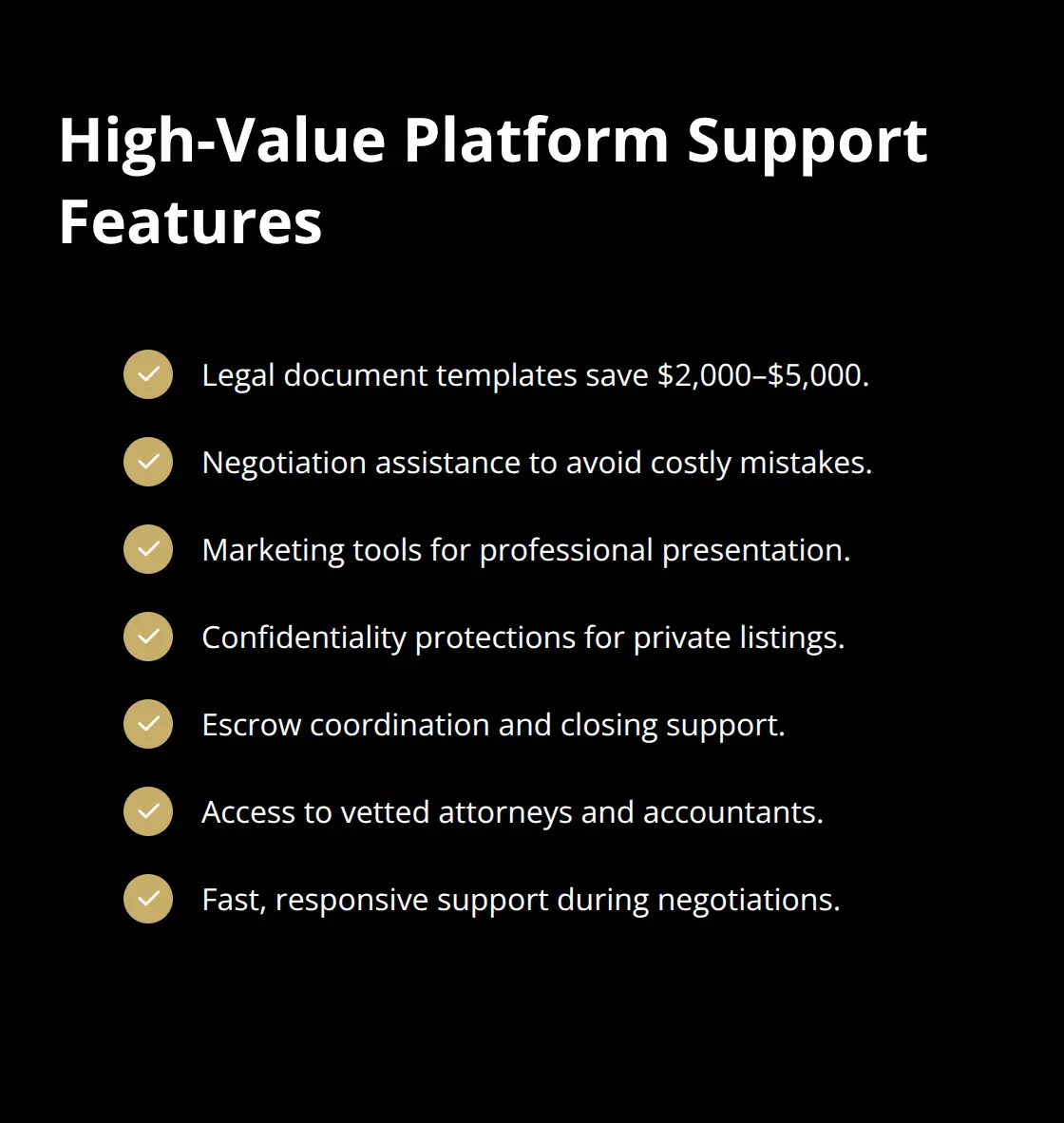
Platforms offering all three at low cost outperform those charging premium fees for basic support. The best platforms also provide confidentiality protections, which prevent your sale from becoming public knowledge before you’re ready. Escrow coordination and closing support reduce the friction that extends timelines. Some platforms connect you with vetted attorneys and accountants at negotiated rates, cutting professional service costs compared to finding specialists independently. Test a platform’s responsiveness before committing. Contact their support team with questions and track response time. A platform that answers within hours differs significantly from one that responds in days when you navigate complex negotiations.
Final Thoughts
Affordability in business sales isn’t a luxury-it’s the difference between walking away with real proceeds and watching unnecessary fees drain your exit value. Traditional brokers built their model on the assumption that sellers have no choice, but modern affordable platform options have proven that assumption wrong. You now have genuine alternatives that cost a fraction of what brokers demand while delivering faster timelines and transparent pricing.
The best platforms publish fees upfront so you know your exact net proceeds before committing, maintain active buyer networks segmented by industry and price range, and provide legal templates and negotiation support that would cost thousands if purchased separately. They protect your confidentiality so your sale doesn’t become public knowledge prematurely, and they eliminate the hidden costs that turn a 10% commission into 12% or more when everything gets tallied. Evaluate platforms based on their actual fee structure, the quality of their buyer network, and the specific support services they include before you list.
Unbroker offers affordable platform options designed exactly for this purpose, with Full Service charging a simple 6% success fee-paid only when your business sells-for hands-off selling. It includes confidentiality protections, no hidden fees, AI-driven buyer matching, and premium marketing tools. Your business deserves a sale process that respects both your timeline and your bottom line.