Most owners spend months negotiating a headline price and almost no time on how that price gets divided. In an asset sale, the division matters. Each dollar lands in a bucket, and the buckets can be taxed differently. Two deals with the same price can leave you with different amounts after tax.
This guide shows what to agree on before you sign, what Form 8594 asks for, how the seven asset classes work in plain English, and which 2026 capital gain thresholds to keep in mind when you model your proceeds. It is general education, not tax or legal advice. Your entity type, your records and your deal terms all change the answer, so plan to review the allocation with a tax adviser or attorney.
Why the price tag is only half of the deal
When a buyer purchases the assets of your business, the purchase price is not one lump. The law treats the sale as a sale of individual assets: cash, receivables, inventory, equipment, permits, customer relationships and goodwill. Your tax result depends on how much of the price is assigned to each one.
Some of that value can be taxed as ordinary income. Some can qualify for long-term capital gain treatment. The difference between those two categories is the reason allocation is worth a real conversation instead of a line item added at the last minute.
Buyers care about allocation too, but for different reasons. A buyer generally wants more of the price tied to assets they can recover through deductions quickly, and you generally want more tied to assets that produce a better result for you. Because your interests pull against theirs, the allocation is a negotiation. If you leave it blank, you may find the buyer’s preferred version waiting at closing.
Allocation matters most in asset purchases and in transactions treated as asset purchases for tax purposes. If you are still deciding between deal structures, read our guides on the asset sale approach and how to structure your sale as an asset purchase first.
When Form 8594 applies to an asset sale
Form 8594 is the Asset Acquisition Statement under section 1060. Under the IRS instructions for Form 8594 (Rev. December 2012), both the seller and the purchaser of a group of assets that makes up a trade or business must use the form to report the sale if two conditions are met:
- Goodwill or going concern value attaches, or could attach, to the assets.
- The purchaser’s basis in the assets is determined only by the amount paid for them.
Most small business asset sales meet both conditions, since a running business usually carries at least some goodwill. Whether yours does is a question to confirm with your adviser.
Exceptions to know about
The same instructions list exceptions to filing. Two of them matter to small business owners:
- Like-kind exchanges. A group of assets exchanged for like-kind property in a transaction to which section 1031 applies is an exception. Form 8594 is still required for any part of the group to which section 1031 does not apply.
- Partnership interests. A transfer of a partnership interest is generally an exception. However, a purchase of a partnership interest that is treated for federal income tax purposes as a purchase of partnership assets constituting a trade or business is subject to section 1060, and the purchaser must file.
The instructions we cite are the December 2012 revision, and they point readers to the IRS page for Form 8594 for later developments. Before you rely on any detail here, confirm the current form and instructions with your tax adviser.
The seven asset classes in plain English
Form 8594 sorts everything you are selling into seven classes. The Form 8594 instructions (Rev. December 2012) define them like this, and here is what each means for a typical small business.
Class I: cash and general deposit accounts
This is cash and money in general deposit accounts. In many small deals, the cash stays with you and is not part of the sale, but if it transfers, it sits here.
Class II: actively traded personal property
Think U.S. government securities and publicly traded stock, plus certificates of deposit and foreign currency. Most owner-operated businesses have little or nothing here.
Class III: marked-to-market assets and debt instruments
This class covers assets marked to market at least annually and debt instruments, including accounts receivable. If your business is owed money by customers and the buyer takes over those receivables, they belong here.
Class IV: inventory-type property
Inventory and similar property for sale to customers. A retailer, restaurant or distributor may have meaningful value in this class.
Class V: everything not in another class
Class V is the catch-all. The instructions say it generally includes furniture and fixtures, buildings, land, vehicles and equipment. For a trucking company, landscaper or shop owner, a large share of the tangible value lands here.
Class VI: section 197 intangibles other than goodwill
These are the intangible assets that are not goodwill or going concern value. The instructions list:
- Workforce in place, business books and records, and know-how
- Customer-based and supplier-based intangibles
- Licenses and permits granted by a government unit
- Any covenant not to compete entered into in connection with the acquisition of an interest in a trade or business
- Franchises, trademarks and trade names
Note that the noncompete lands in this class. We come back to that below.
Class VII: goodwill and going concern value
Goodwill is the value of your reputation, your customer relationships and the fact that the business is already running. It is often the biggest piece of a small business sale, and it is determined by what is left over, as the next section explains.
How the residual method pushes value toward goodwill
The IRS does not let the parties assign values in any order they like. Under the residual method described in the Form 8594 instructions (Rev. December 2012), the process works in steps:
- The consideration is first reduced by Class I assets.
- What remains is allocated to Class II, then Class III, IV, V and VI, in that order.
- Within each class, the allocation is in proportion to fair market value on the purchase date.
- Whatever remains goes to Class VII, goodwill and going concern value.
One more rule shapes negotiations: the amount allocated to any asset other than a Class VII asset cannot exceed its fair market value on the purchase date.
In practice, this means every class before goodwill is filled up to fair market value first, and goodwill takes the remainder. If you can support a defensible fair market value for your equipment, inventory and intangibles, you have a better view of what is left for goodwill. If you cannot, the discussion tends to become guesswork. That is why equipment appraisals, an up-to-date fixed asset list and clean financial records are worth gathering before the buyer asks.
Where sellers and buyers pull in opposite directions
Different classes can produce different tax character for you. Here is the general picture. Your adviser should confirm how it applies to your entity type and facts.
Ordinary income
Some allocations can produce ordinary income for the seller. Inventory and, depending on your accounting method, receivables are common examples to ask about. Amounts allocated to a covenant not to compete are another one to raise with your adviser, because payments for a noncompete are generally not treated like payments for the business itself.
Depreciation recapture
Equipment you have depreciated is where many sellers get surprised. IRS Publication 544 (2025 edition) says gain on the disposition of section 1245 property is treated as ordinary income to the extent of depreciation allowed or allowable on the property. Any gain beyond that amount is generally a section 1231 gain.
The same publication says that if the sale is reported under the installment method, depreciation recapture under section 1245 or 1250 is taxable as ordinary income in the year of sale. So a seller-financed deal does not let you spread that portion over the payment period. If you plan to take a note from the buyer, ask your adviser to model this specifically.
Capital gain
Value allocated to goodwill, and gain on some other assets beyond the recapture amount, may qualify for long-term capital gain treatment. Whether yours does depends on the type of asset, how long you held it, and your entity type. Confirm these conditions with your adviser rather than assuming.
The tension
Put it together and you can see the conflict. A buyer who wants quicker deductions may push value toward equipment and other assets that are recovered faster. A seller with heavily depreciated equipment may see more ordinary income when value moves there. Neither side is wrong. The right answer is a number both sides can support with records and fair market value evidence.
What to put in the purchase agreement
The Form 8594 you file comes after the deal. The conversation that matters happens before signing. Three areas deserve deliberate drafting.
An allocation clause
Many purchase agreements include an allocation schedule, or a clause that commits both parties to an agreed method and to reporting consistently with it. Ask your attorney how the clause binds each side, what happens if the price changes, and whether the schedule is attached to the agreement or left to be decided after closing. Leaving it open invites a dispute at the worst moment.
A covenant not to compete
Buyers often want a noncompete, and the Form 8594 instructions place it in Class VI. If the agreement assigns a separate payment to it, that amount is part of the allocation, and the character of that income to you may differ from payments for goodwill. Have your adviser weigh the tradeoff before you agree to a specific amount for it, and before you accept language that is broader than the buyer needs.
Earnouts and contingent payments
If part of the price depends on future performance, the allocation does not stop at closing. The instructions say that if the price changes after the sale year, for example through a contingent payment, the seller and/or purchaser must allocate the increase or decrease among the assets. A decrease is applied first to Class VII, then to Class VI, V, IV, III and II. You can read more about the tradeoffs in our guide to earnouts.
Draft the agreement so it says how later increases or decreases will be allocated. That way, a payment two years from now does not restart an argument you thought you had settled.
Filing details: timing, matching forms and supplemental statements
The Form 8594 instructions (Rev. December 2012) say both purchaser and seller generally attach the form to their own income tax returns, for example Forms 1040, 1065, 1120 or 1120S. This applies whether the assets constitute a trade or business in the hands of the seller, the purchaser, or both. Generally the form is attached to the return for the year in which the sale date occurred.
A few practical points follow from that:
- Both parties file, separately. You and the buyer each attach your own form. The IRS can compare them, so the figures should match your agreed allocation.
- Line 6 looks ahead. It asks both parties to state the maximum consideration, assuming any contingencies in the agreement are met. If you have an earnout, you need a number for this.
- Later changes need a supplemental statement. If the price changes after the sale year, the instructions call for a supplemental statement (Parts I and III) filed with the return for the year in which the change is taken into account.
- Errors carry penalties. The instructions state that a taxpayer who does not file a correct Form 8594 by the due date of the return and cannot show reasonable cause may be subject to penalties under sections 6721 through 6724.
Because the form follows the sale year, put a reminder on your calendar for the filing season after closing and give your tax preparer the signed allocation schedule early.
2026 capital gain thresholds to keep in mind when modeling proceeds
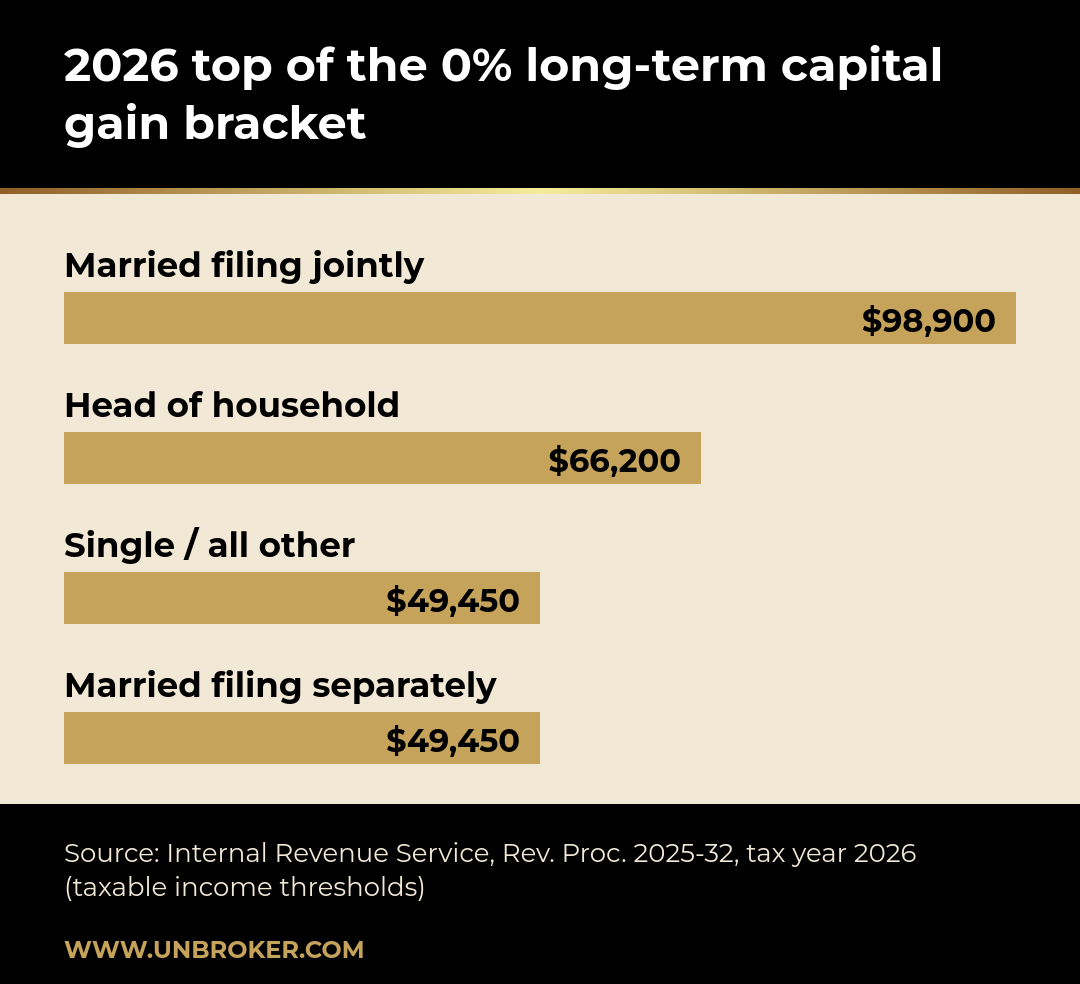
Once you know roughly how much of the price could be taxed as long-term capital gain, the next question is which rate applies. For taxable years beginning in 2026, Revenue Procedure 2025-32 sets the maximum 0% long-term capital gain rate amounts at $98,900 for married individuals filing jointly and surviving spouses, $66,200 for heads of household, and $49,450 for married individuals filing separately and for all other individuals.
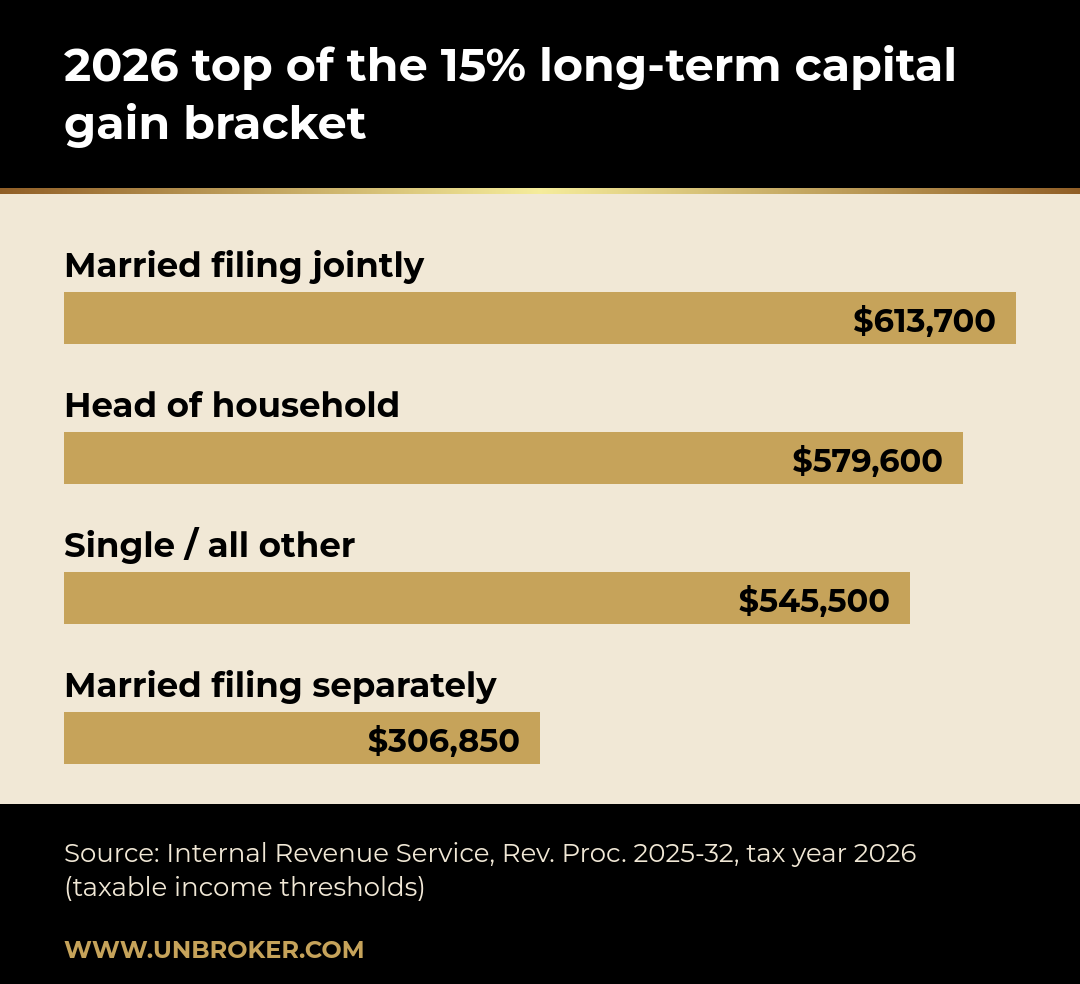
The 15% rate applies above those amounts and up to the next set of thresholds. For taxable years beginning in 2026, the maximum 15% rate amounts are $613,700 for married individuals filing jointly, $579,600 for heads of household, $545,500 for single and all other individuals, and $306,850 for married individuals filing separately. A 20% rate applies above the 15% amounts, according to the same Revenue Procedure 2025-32.
Two cautions when you use these figures. First, they are taxable income thresholds, so a large business sale can push gain into higher brackets, especially when it stacks on top of your other income that year. Second, the thresholds do not apply to ordinary income such as depreciation recapture, which is taxed differently. A model that treats the entire price as capital gain will overstate your net proceeds.
Your filing status, the year the sale closes and whether you take payments over time can all move these numbers. If tax planning is a major part of your exit, our guide on minimizing capital gains tax when selling your business covers additional ideas to raise with your adviser.
A pre-signing allocation checklist
Bring this list to your tax adviser and attorney before you sign a letter of intent or a purchase agreement. Several items are easier to settle early, when you still have leverage.
- Confirm the deal structure. Is it an asset sale, a stock sale, or an entity sale that is treated as an asset sale for tax purposes? Does Form 8594 apply, and does any exception apply, such as a like-kind exchange or a partnership interest transfer?
- List what is being sold. Walk through each class: cash, receivables, inventory, equipment, vehicles, real property, permits, trade names, customer lists and goodwill. Note what is excluded.
- Gather fair market value support. Equipment appraisals, an asset ledger with depreciation history, and inventory counts help you defend values for classes before goodwill.
- Ask for a depreciation recapture estimate. Have your adviser estimate how much of your gain may be ordinary income, including the effect of the installment method if you plan to carry a note.
- Draft the allocation clause. Decide whether the schedule is attached at signing, and require both parties to report consistently with it.
- Price the noncompete deliberately. Decide whether any separate amount is assigned to it, and keep its scope and duration reasonable.
- Plan for contingent payments. If there is an earnout or price adjustment, agree in writing how increases and decreases are allocated and what maximum consideration to report on Line 6.
- Model net proceeds under more than one allocation. Use the 2026 capital gain thresholds for your filing status, and keep ordinary income items separate from capital gain.
- Calendar the filing. Plan for the return for the year of the sale date, and for supplemental statements in later years if the price changes.
- Confirm current forms. Make sure your preparer uses the latest Form 8594 and instructions.
When should you bring in a tax adviser? Early, ideally before the letter of intent is signed. After signing, the price and structure are usually set, and the allocation becomes harder to change. Sellers with significant equipment, installment notes, earnouts or a multi-owner entity should treat professional review as part of the process rather than an optional extra.
Unbroker pairs expert advisors with legal document templates and negotiation assistance, so you can go into purchase agreement talks with organized records and a clearer picture of what you may keep after tax. The Full Service Business Sale carries a 6% success fee, paid when the business sells, and the process stays confidential from start to finish. To see how it works, visit Unbroker.