If you have heard that you can sell your business to employees through an ESOP and defer capital gains tax, you have heard part of the story. The deferral is real, but it comes with conditions on your entity type, your ownership stake, your timing and what you do with the proceeds. Many owners do not meet them, and some who do would still be better served by a different buyer.
This post lays out what an ESOP sale is, who qualifies for the Section 1042 deferral, what changes for S corporation owners after 2027, and what size and shape of company tends to work. It then gives you a practical way to compare an ESOP with a sale to an outside buyer, plus a list of questions to take to your tax adviser and attorney before you commit to either path.
What an ESOP sale is, and how common it is
An employee stock ownership plan (ESOP) is a retirement-type plan that buys stock in the company that sponsors it. In a sale to an ESOP, you sell some or all of your shares to a trust that holds them for your employees. The company typically funds the purchase through contributions and borrowing, and employees build ownership accounts over time rather than writing a check.
That structure is why ESOPs appeal to owners who care about legacy. Your team stays intact, the company keeps its name and location, and you are not handing the keys to a stranger. It is also why an ESOP is a long-term financing and governance decision, not just a different buyer.
ESOPs are not rare. Using 2023 data, the most recent available as of 2026, the National Center for Employee Ownership (NCEO) estimates there are 6,609 ESOPs at 6,411 U.S. companies, covering 15.1 million participants and holding over $2.1 trillion in assets. Those figures cover all ESOPs, public and private.
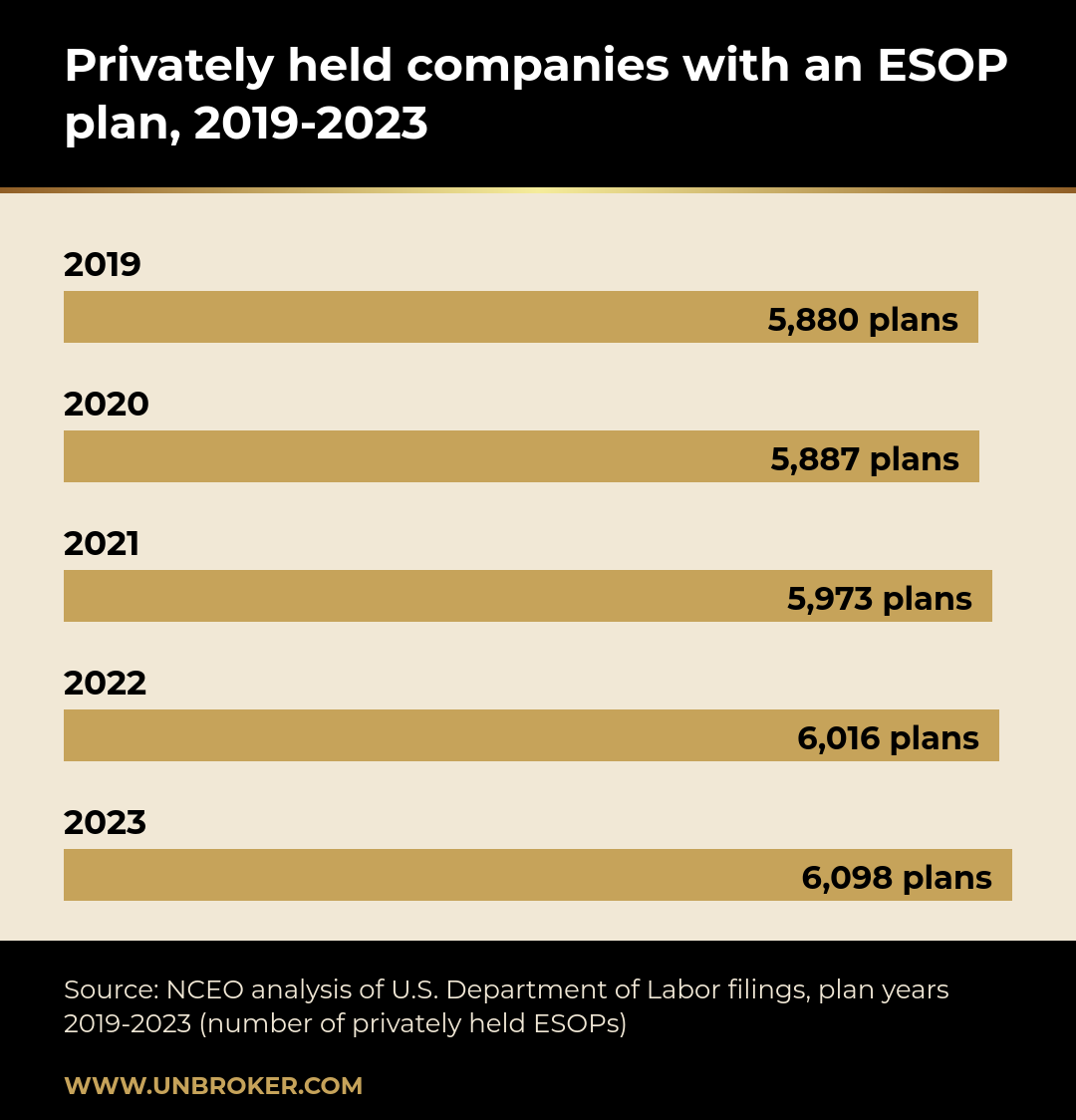
For owners of closely held companies, the more relevant number is the private segment. Per NCEO’s analysis of Department of Labor filings, privately held companies sponsored 6,098 ESOPs in plan year 2023, up from 5,880 in 2019. The count rose each year in between: 5,887 in 2020, 5,973 in 2021 and 6,016 in 2022.
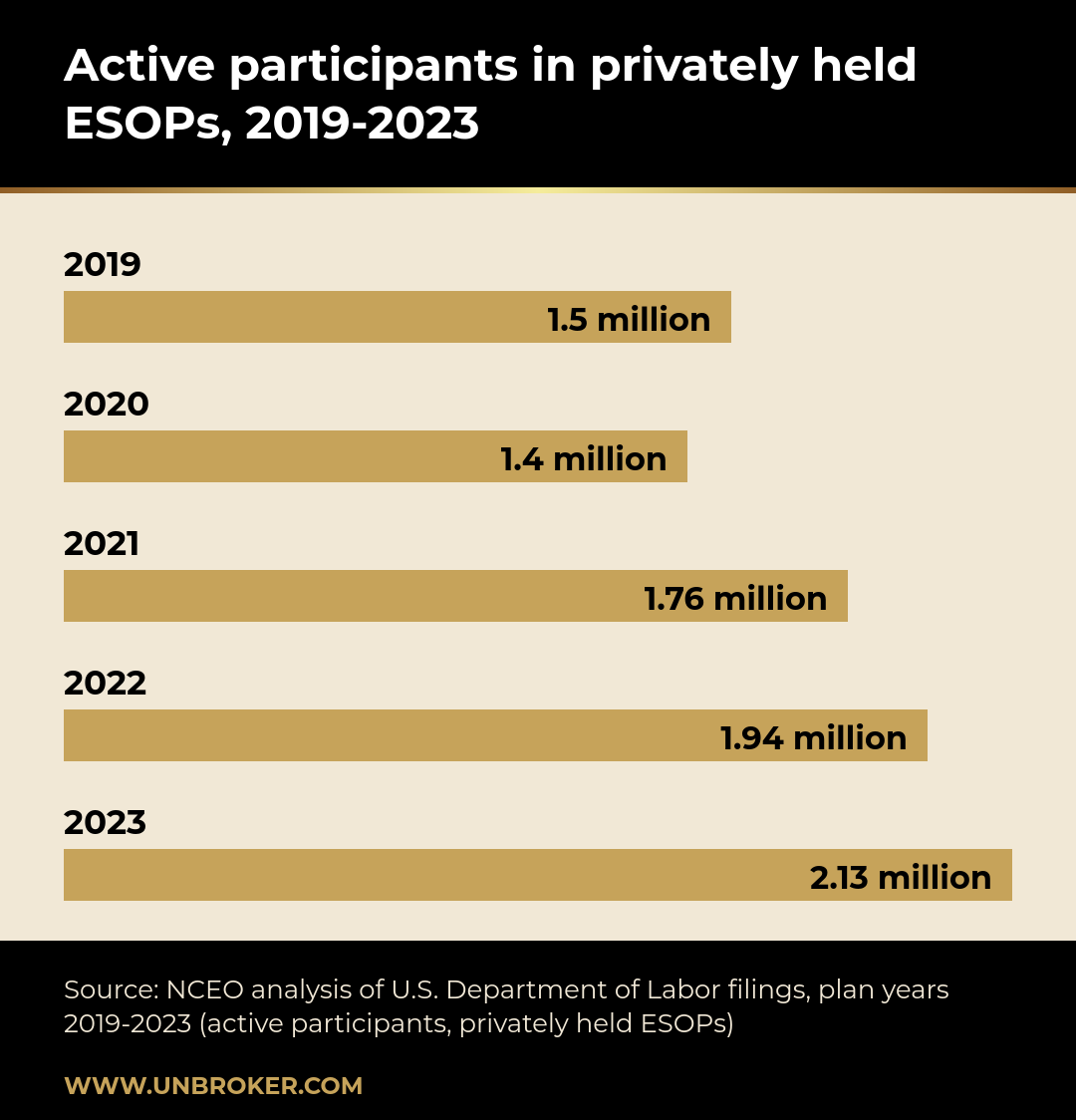
Participation grew faster than the plan count. In the same NCEO analysis, active participants in privately held ESOPs were 1.5 million in 2019, 1.4 million in 2020, 1.76 million in 2021, 1.94 million in 2022 and 2.13 million in 2023.
One more data point helps you picture a typical private ESOP company. NCEO data for 2021 show that the median privately held ESOP had 57 active participants (current employees), and 42% of private ESOPs had more than 100 active participants. These are companies with real payrolls, not one-person shops.
The Section 1042 tax deferral: conditions you must meet
The tax benefit most owners are asking about comes from Internal Revenue Code Section 1042. It is an election, not an automatic result of selling to an ESOP, and it only works when several conditions line up. Treat the following as a screening list, not a promise.
The company must be the right kind of corporation
Under Section 1042, a selling shareholder can elect to defer tax on capital gain from selling stock of a non-publicly traded C corporation to an ESOP. That is the core rule. If your company is an LLC taxed as a partnership, a sole proprietorship or an S corporation, the traditional version of this deferral is not available to you. The S corporation change coming after 2027 is covered in the next section.
The ESOP must own at least 30% after the sale
The same RSM summary notes that the ESOP must own at least 30% of the company’s stock immediately after the sale. If you want to sell a smaller slice now and more later, the first transaction still has to get the ESOP to that threshold if you want the election to be available for it.
Who can be the seller
Per RSM, qualifying sellers include individuals, partnerships, estates and trusts. Note the difference between the seller and the company: a partnership can be a selling shareholder, but the company being sold has to be a corporation that fits the rules above.
Holding period and reinvestment window
According to the Wagner Law Group, to use the deferral the seller must have held the stock for at least three years. The seller must also reinvest the proceeds in qualified replacement property within a 15-month window that starts three months before and ends 12 months after the sale to the ESOP.
Qualified replacement property generally means securities of U.S. operating companies that meet passive-income limits. That is a general description only. Whether a specific stock or bond qualifies is a question for a tax adviser, and it should be answered before any deal is signed, not after. Because the window begins before the sale closes, some owners start reinvesting early, and that only works if the plan is in place well ahead of closing.
What deferral actually means
Deferral is not forgiveness. You are postponing the tax, not erasing it, and what happens later depends on what you do with the replacement property. If you sell it, the deferred gain may come due. Some owners hold the property for the long term and plan their estates around it, but that is a decision for you and your advisers. If you want a broader look at tax planning around a sale, see our guide on how to minimize capital gains tax when selling your business.
S corporation owners: what changes for sales after 2027
Most small businesses are not C corporations. Many are S corporations, and for years that put the Section 1042 deferral out of reach. NCEO’s guide to how an ESOP works says that S corporation ESOPs do not qualify for the rollover treatment it describes, though that guide predates the 2027 change below.
The law has since changed, with a delayed start. SECURE 2.0 (Section 114) extends Section 1042 to S corporation owners for sales to ESOPs after December 31, 2027. The extension is limited: it covers only up to 10% of the amount realized on the sale, versus up to 100% of the gain for C corporation sellers. NCEO notes that the change applies to sales after 2027, not before.
The ESOP Association describes it the same way: limited to no more than 10% and not effective until after December 31, 2027. It also means the other Section 1042 conditions still apply to S corporation sellers, including that the ESOP own at least 30% of the company after the sale.
Here is what that means in practice for an S corporation owner:
- A sale before the effective date does not get this treatment. As of today, November 2026, the extension has not taken effect. A sale closing before the change does not qualify under it.
- Even after the change, the benefit is partial. A deferral limited to a fraction of the amount realized is a much smaller lever than the C corporation version.
- Waiting has its own costs. Delaying a sale for a tax feature can cost you in other ways: market conditions, your health, key-employee risk and buyer interest all move on their own timelines. Weigh them together with your advisers.
- Conversion questions are for specialists. Whether it makes sense to change entity type is a tax and legal question with long-lasting consequences. Do not act on a blog post, including this one.
Is your company the right size and shape for an ESOP?
Eligibility under the tax code is one test. Practical fit is another, and it is where many small-business owners find that an ESOP is not the right tool.
Entity type
NCEO says the law does not allow ESOPs in partnerships and most professional corporations. If you run a practice organized as a professional corporation, or a business structured as a partnership, an ESOP may be off the table or require restructuring. Confirm with an attorney early.
Headcount and profitability
NCEO also says setting up an ESOP for a business transition costs about 2% to 4% of the total transaction. It adds that companies with fewer than 20 to 30 employees and $1 million in EBITDA are generally not good candidates. A separate NCEO piece says that for very small companies, typically fewer than 10 to 15 employees, set-up costs may outweigh potential tax benefits.
An American University law clinic info sheet offers a similar rule of thumb: ESOPs work best for companies with over 20 employees. These are rules of thumb from different sources, not bright lines, but they point the same direction. If you have a handful of employees and an owner-dependent operation, an ESOP is likely to be a poor fit.
Financial health
NCEO states that ESOPs are not usually good choices for struggling companies. When an ESOP buys out an owner, the cost is a non-productive expense the company must be able to fund from earnings. In plain terms, the business pays for your exit out of its own cash flow. A company that is already stretched may not be able to do that and still invest in growth.
The American University info sheet says a feasibility study should look at available cash, whether payroll is adequate for contributions to be deductible, and the expected repurchase obligation. That is a useful checklist even before you hire anyone: how much cash does the business generate, how big is the payroll relative to the purchase, and how many people might leave and cash out over time?
Management depth
An ESOP company is owned by employees but still has to be run by someone. If the business depends on you personally for customers, pricing, licensing or technical know-how, an ESOP does not solve that. You may need to stay on through a transition, and you may need to build or hire a management team first. If your leadership bench is the real question, see our look at selling to your management team.
The repurchase obligation and the independent price test
Two features of ESOPs surprise owners more than any others: the company’s obligation to buy back shares later, and the requirement that the price be independently supported.
The repurchase obligation
Private companies must repurchase shares from departing ESOP participants. NCEO says this can become a major expense that must be modeled against future cash flows. It adds that the obligation is almost always manageable with planning, but without planning it can limit growth investment and, in extreme cases, make the ESOP unsustainable.
This matters to you as a seller even though it lands after you are paid, for two reasons. If you are paid over time, or you keep some stock, your own outcome is tied to how healthy the company stays. And if you care about your employees and legacy, a poorly modeled repurchase obligation can undercut the very thing you were trying to protect. Ask any ESOP adviser to show you the repurchase projections under conservative assumptions, not just the base case.
The independent price test
You cannot simply agree on a number with your own employees. Under ERISA Section 408(e), an ESOP’s purchase of its sponsor company’s stock is exempt from the prohibited-transaction rules only if the ESOP pays no more than adequate consideration. That is why an independent valuation and a trustee are part of an ESOP sale.
For a seller, that cuts both ways. It protects the plan and the employees from overpaying, and it gives the price a documented basis. But it also means the price is set by a valuation process on the ESOP’s side of the table. It is not set by competing bidders. If you want to know what the open market might pay, an ESOP process will not tell you.
ESOP or outside buyer: how to compare the two paths
The comparison is not “tax savings versus no tax savings.” It is about total outcome, certainty, control and what you want to happen to the business after you leave. Work through these questions.
- After-tax proceeds. Ask your tax adviser to model both paths side by side. For an ESOP sale, include set-up costs, whether the deferral conditions are met, and what you plan to hold as replacement property. For an outside sale, model the deal structure and your likely tax picture.
- Price discovery. An outside sale can put your business in front of several interested parties at once. An ESOP price comes from an independent valuation, which may or may not match what a strategic buyer would pay. Neither is guaranteed to be higher.
- Cash at closing. An ESOP purchase is often financed by the company, so some of your proceeds may come over time through notes. An outside buyer may pay more in cash at closing, though structure varies by deal.
- Your ongoing role. ESOP sales often involve the owner staying involved through the transition. Outside buyers range from wanting you gone quickly to wanting a defined handover period.
- Legacy and employees. An ESOP keeps the business in-house and gives employees a stake. An outside buyer may keep the team and the name, or may not. If employee outcomes matter to you, you can negotiate for them in an outside sale, but you do not control what happens afterward the way you might with an ESOP.
- Complexity and cost. ESOPs require a trustee, an independent valuation, plan documents and ongoing administration. A smaller company may find the fixed overhead heavy relative to the deal.
- Confidentiality. Setting up an ESOP generally means telling employees and a group of advisers. A confidential outside sale can be run with far fewer people knowing. If you are weighing when and how to share the news, read should you tell employees you’re selling.
When a regular sale usually fits better
An outside-buyer sale tends to be the more practical route when one or more of these is true:
- Your company is an S corporation, an LLC taxed as a partnership or a professional corporation, and the sale is likely to close before the 2027 change takes effect or you do not want to wait.
- You have a small team, or fall under the headcount and profit levels NCEO flags as generally not good candidates.
- The business is struggling, or its cash flow is not strong enough to fund your buyout and still invest in growth.
- You want most of your money at closing, or want a clean break.
- You want competitive tension on price rather than a single independently valued number.
- The business depends heavily on you, and no internal team could step into your role.
When an ESOP may be worth a serious look
An ESOP is more likely to merit a feasibility study if your company is a C corporation, has a meaningful payroll and steady earnings, has a management team that can run it without you, and you place a high value on keeping the business independent and rewarding employees. Even then, a study should confirm the numbers. The 30% threshold, the holding period and the reinvestment window all have to work for your situation.
How to keep both options open
You do not have to decide between an ESOP and an outside buyer on day one. A practical approach is to run a feasibility review for the ESOP while quietly testing the outside market. The two efforts inform each other: an outside indication of interest gives you a reference point to compare against an ESOP valuation, and an ESOP analysis tells you how much you would need from a buyer to match the after-tax result.
Here is how to do that without disrupting the business:
- Get the entity facts straight. Confirm your corporate form, ownership history and how long each owner has held their stock. These facts drive the Section 1042 analysis.
- Commission an ESOP feasibility review. Ask for the repurchase projections and the cash-flow impact, not only the headline tax benefit.
- Prepare your financials for outside eyes. Clean books and clear documentation help under either path, since an ESOP valuation and a buyer’s diligence both start there.
- Reach buyers confidentially. Anonymous outreach lets you gauge interest without naming your company or alerting employees and customers. Our guide to anonymous buyer outreach explains how that works.
- Compare after-tax, risk-adjusted outcomes. Put both offers, or an offer and a feasibility result, in front of your tax adviser and attorney with the same assumptions.
- Set your timeline against the tax calendar. If an S corporation extension matters to you, plan around the December 31, 2027 line. If a C corporation election matters, plan around the reinvestment window, which opens before closing.
Testing the market does not commit you to selling. It gives you real information, and it keeps you from deciding based on a tax feature that may or may not apply to you.
Questions to take to your tax adviser and attorney
Bring these to your first meeting. Each one maps to a condition or risk covered above.
- What is my company’s entity type for tax purposes, and does it allow an ESOP at all?
- If we are a C corporation, do I meet the three-year holding period for my stock, and can the ESOP own at least 30% immediately after the sale?
- What would count as qualified replacement property for me, and how do I plan reinvestment inside the 15-month window?
- If we are an S corporation, how would the sales-after-2027 extension apply to my facts, and how much of the amount realized could it cover?
- Do the headcount, payroll and earnings of my business fit what a feasibility study would look for?
- What does the repurchase obligation look like under cautious assumptions, and what could it do to growth spending?
- Who would serve as trustee, who would perform the independent valuation, and how would they be chosen?
- How much of my proceeds would be cash at closing versus notes paid over time, and what happens to those notes if the company struggles?
- What would my after-tax proceeds be under an ESOP sale compared with a sale to an outside buyer?
- What role would I play after closing, and how would my employment, any retained stock and non-compete terms be handled?
Selling to employees can be a good outcome for the right company and the right owner. It is a narrow path, with conditions that must be met in a specific order and a company that must be able to carry the cost. If your business does not fit, a well-run sale to an outside buyer can still protect what you built. If you want to test the market quietly while you work through the ESOP question, Unbroker offers a confidential sale process with AI-driven buyer matching and expert advisors. Our Full Service Business Sale charges a 6% success fee, paid when the business sells.