If you own an independent repair shop and are thinking about selling, this guide shows you what buyers weigh before they make an offer. You will see how the demand story looks, how your earnings may be measured, and why your technicians matter as much as your bays.
You will also get a practical checklist for certifications, equipment, the lease or real estate, and the environmental review that can come with them. Use it to organize your records early, so a buyer’s questions find answers instead of gaps.
Why buyers still look at independent repair shops
Buyers like businesses with steady, need-based demand, and cars that keep getting older fit that description. According to S&P Global Mobility analysis released in May 2025, the average age of U.S. light vehicles (cars and light trucks) rose to 12.8 years in 2025, an increase of two months for the second consecutive year. In the same analysis, the average age of passenger cars was 14.5 years and the average age of light trucks was 11.9 years. Vehicles in operation grew to 289 million with a steady 4.5% scrappage rate (data for 2024, published 2025).
Older vehicles generally mean more repair needs and more years outside a new-car warranty. That is a useful backdrop for your sale story, but do not oversell it. S&P Global Mobility also noted that regional aging rates can vary significantly, so the national average may not match what consumers see in their own community. A buyer will care about your trade area: the vehicles your customers actually drive, the competition nearby and how your shop is positioned within it.
The labor side supports the story too, with a caveat. The Bureau of Labor Statistics projects employment of automotive service technicians and mechanics to grow 5 percent from 2025 to 2035, faster than the 3 percent average for all occupations. The occupation held about 825,800 jobs in 2025. That is a national occupation figure, not a forecast for any one shop. It shows a field that is not shrinking, and it hints at the staffing challenge a buyer will think about next.
What buyers examine first: car count, repair orders and technician depth
Most buyers start with a few operating questions, and you can answer them before anyone asks. Pull together the following:
- Car count and repair orders: monthly volume over several years, so a buyer can see trends and seasonality rather than one good quarter.
- Average repair order and mix of work: routine maintenance, brakes, diagnostics, air conditioning, fleet accounts and any specialty work.
- Customer base: how much comes from repeat customers and referrals, and whether any fleet or commercial account is large enough to worry a buyer.
- Labor and capacity: bays, technician headcount, how many bays sit idle for lack of a technician, and who handles estimates and the service counter.
- Systems: shop management software, customer history, reminders and online reviews.
The last two items matter more than owners expect. A shop whose customer history lives in software, with a service advisor who knows the regulars, looks transferable. A shop where every customer relationship runs through the owner’s cell phone looks risky. If that describes you, start documenting and delegating now. Our guide to telling employees you’re selling, and when covers the people side of that handoff.
Pricing your shop: SDE or adjusted EBITDA
Buyers do not price a shop on gross revenue alone. They look at normalized earnings, and the measure used changes how your own pay is treated. This matters a great deal if you work in the shop as a technician or service writer.
Seller’s discretionary earnings (SDE)
SDE is the usual measure for owner-operated shops where one owner works in the business. Personal expenses and one-time costs are added back, and so is one owner-operator’s full pay, whatever its level. The logic is that the next owner-operator will take the same role and decide their own compensation. If you run the shop and a buyer plans to do the same, SDE is likely the starting point. Our explainer on seller’s discretionary earnings walks through the calculation.
Adjusted EBITDA
Adjusted EBITDA is more common when the shop is larger, has a manager in place, or will be bought by an investor or multi-shop group who will not work the tools. Personal expenses and one-time costs are still added back, but owner pay is reset to a market rate. Pay above market is added back. Pay below market is a deduction that lowers EBITDA, because a buyer who is not turning wrenches has to pay a replacement the market rate.
Here is where owner-technicians get surprised. If you take modest pay and cover a technician’s work yourself, an investor-style buyer may reduce your earnings to reflect what it costs to hire someone for that role. The same shop can look different under SDE and under adjusted EBITDA, so know which measure your likely buyer will use.
Multiples vary by market, by shop size and by the base they are applied to, whether that is SDE, EBITDA or revenue. A multiple of SDE for a single-location, owner-operated shop is not comparable to a multiple of EBITDA for a multi-shop operation. Ask a valuation adviser which base fits your shop and which comparable sales they are using. Our guides on applying valuation add-backs can help you prepare a clean schedule before that conversation.
Keeping technicians in place through the sale
For many buyers, the technicians are the business. A shop with empty bays and a thin bench is hard to run, however good the customer list looks. The labor market is part of the reason. BLS projects about 66,200 openings per year, on average, for automotive service technicians and mechanics over 2025 to 2035. Many of those openings are expected to come from workers who transfer to other occupations or leave the labor force, such as to retire. In plain terms, technicians will always be in demand somewhere, and a buyer knows it.
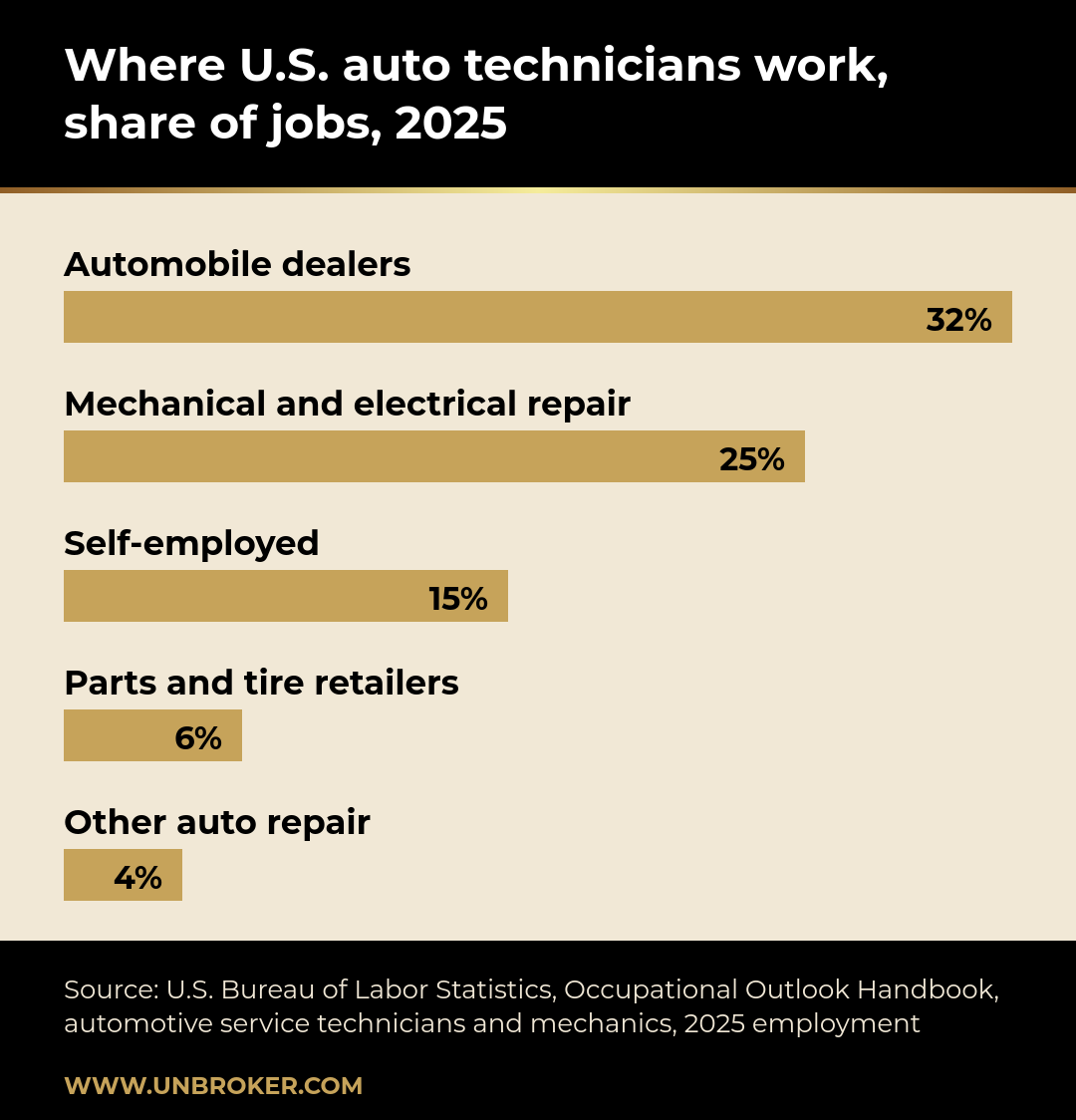
It also helps to know where technicians work. BLS reports that in 2025, 32% of automotive technician jobs were at automobile dealers, 25% in mechanical and electrical repair and maintenance, 15% were held by self-employed workers, 6% at parts, accessories and tire retailers and 4% in other automotive repair and maintenance. Dealers are the largest single group, so your staff have options that include dealership employers.
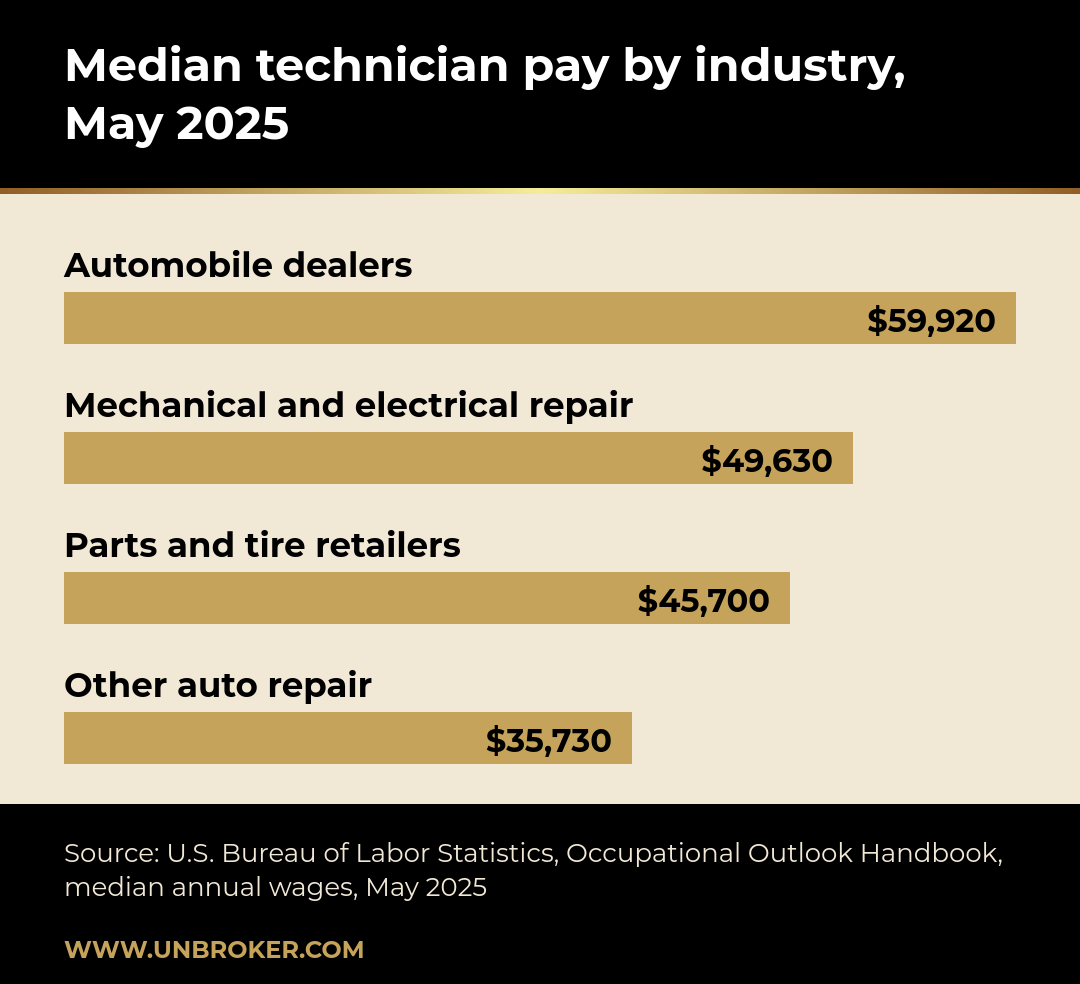
Pay is another point of comparison. BLS reports a median annual wage of $50,620 for automotive service technicians and mechanics in May 2025. By industry, the median was $59,920 at automobile dealers, $49,630 in automotive mechanical and electrical repair and maintenance, $45,700 at automotive parts, accessories and tire retailers and $35,730 in other automotive repair and maintenance. These BLS wage figures cover wage-and-salary workers and exclude the self-employed. Treat them as a reference point for the market, not as proof of what your own technicians earn or what a buyer must pay.
To keep your team steady through a sale, prepare these items:
- Pay plans in writing. BLS notes that some repair shops pay technicians hourly while others pay based on the amount of work completed. A buyer will want to see exactly how each person is paid, including any bonuses or guarantees.
- Tool ownership. Employers usually own the large shop tools, while technicians typically own their common hand tools. List what the shop owns and what belongs to each technician, so nothing is disputed at closing.
- Tenure and training. A simple roster with roles, years of service and certifications gives a buyer a clear picture of bench depth.
- Retention conversations. Decide, with your attorney, which employees need to know about the sale and when, and whether any should be offered a stay incentive.
Do not make promises on a buyer’s behalf. Employment terms after closing are for the buyer to set, so keep your messages factual and let the buyer introduce their own plans.
Certifications, equipment and compliance records to organize
Compliance is an area where small gaps can slow a deal. The EPA requires all technicians who buy or work with refrigerants to be certified in proper refrigerant handling, and BLS notes that technicians must follow environmental regulations such as those for disposing of oil and other hazardous materials. Both points are covered in the BLS occupational outlook for automotive technicians.
Put together a compliance folder that a buyer can review without chasing you:
- Refrigerant handling certification records for every technician who services air-conditioning systems.
- Records showing how used oil, filters, coolant, batteries, tires and other waste are stored, picked up and disposed of, including hauler and recycler paperwork.
- Any permits, licenses and registrations your state or city requires for repair shops, since these vary by location.
- Inspection reports, notices of violation and proof of how any issue was resolved.
- Technician training and manufacturer or industry certifications, with expiration dates.
- An equipment list with age, condition, ownership and any liens or leases: lifts, alignment racks, scan tools, A/C recovery machines and diagnostic software subscriptions.
Software and scan-tool subscriptions deserve a note. Some may not transfer automatically, and updates may be tied to a specific owner or account. Check the terms so you can tell a buyer what carries over and what needs a new agreement.
Real estate, lease and environmental review: what buyers may ask for
Few businesses get more attention on the property side than a repair shop. Buyers may ask whether you own the building or lease it, and either answer opens questions about the condition of the site.
If you lease
The lease is part of what the buyer is acquiring, so it needs to work for them. Gather the lease and all amendments, and review the term, renewal options, rent escalations, assignment or subletting rules and any landlord consent requirement. Read the environmental and hazardous materials sections too, since some leases assign responsibility for contamination and require records or notice. A buyer’s attorney will read these closely, and an attorney can tell you whether your lease allows a transfer and what the landlord may need to approve.
If you own the real estate
If the building and land are part of the sale, expect a buyer to look at the property’s environmental condition. Under the EPA’s All Appropriate Inquiries rule, a buyer of real property who wants to seek certain federal (CERCLA) landowner liability protections, such as bona fide prospective purchaser status, must have the property’s environmental conditions evaluated. According to the EPA’s fact sheet on the rule, some aspects must be conducted or updated within one year before the acquisition date, and others within 180 days before it. The inquiry is overseen by an environmental professional, and a Phase I environmental site assessment is a common way to meet it.
Those protections carry further conditions, so a buyer is not covered just because an assessment exists. If you own the real estate, confirm the details with an attorney or an environmental professional before you list. Because of the timing windows, the assessment is typically scheduled close to the acquisition rather than years ahead. You can still pull your own records early: past site assessments, tank registrations or removal records, spill or remediation history, floor drain and oil-water separator details and waste hauler contracts.
If something questionable shows up, it is usually better to learn it before a buyer does. Talk to an environmental professional about what it means and how it could be handled in the deal, rather than hoping it goes unnoticed. Some owners separate the operating business from the property and sell or lease the real estate on its own terms, which is another reason to get advice early.
Asset sale basics and what usually transfers with the shop
Many small shop sales are structured as asset sales, where the buyer purchases specific assets and assumes only specific obligations. That is different from a stock or equity sale, where the buyer takes over the entity itself, including its history. Which structure fits depends on your entity type, your tax position and the buyer’s lender and risk preferences. Because the tax and legal consequences differ by structure and by your circumstances, review the options with a tax adviser and an attorney before you accept a letter of intent. For a primer, see our guide to structuring a sale as an asset purchase.
In an asset sale of a repair shop, the purchase agreement typically spells out items such as:
- Equipment and tools: lifts, diagnostic equipment, shop-owned tools and fixtures, with an itemized schedule that excludes technician-owned hand tools.
- Inventory: parts and supplies, usually counted and valued near closing.
- Customer records and goodwill: service history, phone number, website, social accounts and business name.
- Contracts: the lease, fleet agreements, parts supplier accounts and software agreements, subject to any required consents.
- Employees: how staff move over and how accrued time off and pay plans are handled.
- Open work: vehicles in the shop on the closing date, warranties on past repairs and customer deposits.
Warranty work is easy to forget. Decide in advance who stands behind repairs completed before closing, and put the answer in writing.
Keeping the sale confidential from customers and staff
A repair shop depends on local trust, and rumors can spook both customers and technicians. Keep the sale confidential until there is a reason to share it. In practice, that means:
- Marketing the business without naming it or its address, and sharing identifying details only with buyers who have signed a confidentiality agreement.
- Screening buyers for financial capability and genuine interest before they get your numbers or visit the shop.
- Scheduling buyer visits outside peak hours or presenting them as vendors or consultants, if appropriate to your situation.
- Limiting who on your team knows, and agreeing with your adviser on a plan for when and how to tell the rest.
Competitors, suppliers and landlords can all learn about a sale through the grapevine, so control the flow of information. Our guide to keeping a sale secret while attracting buyers goes deeper on the tactics.
Choosing how to sell: professionally managed or hands-on
You can sell in two broad ways, and the right one depends on your time, your comfort with negotiation and how complex the deal looks.
A professionally managed sale suits owners who are busy running the shop and want advisers to handle valuation support, buyer outreach, screening, negotiation and paperwork. It makes sense if you own the real estate, have several technicians or expect a complicated lease transfer. A hands-on approach suits owners who want to stay involved, control costs and are comfortable preparing documents and talking with buyers directly. Even then, plan to use a tax adviser and an attorney for the pieces they are best placed to handle.
Whichever path you choose, the same preparation applies: clean financials, a clear earnings measure, technician records, a compliance folder and a lease or property file ready for review. The better organized you are, the easier it is for a buyer to say yes to a fair deal, though no one can promise a price or a timeline.
If you would like help taking your shop to market, Unbroker combines expert advisors, AI-driven buyer matching and national marketing in a confidential process. Our Full Service Business Sale charges a 6% success fee, paid when the business sells. Learn more at Unbroker.