Business valuation isn’t one-size-fits-all. The method you choose depends on your business type, industry, and what you’re trying to accomplish.
At Unbroker, we’ve seen too many business owners pick the wrong valuation approach and end up with inflated or undervalued results. This guide walks you through three proven methods that actually work in practice.
Asset-Based Valuation: What Your Business Actually Owns
Understanding Total Assets and Liabilities
Asset-based valuation starts with a straightforward premise: add up what your business owns, subtract what it owes, and that number represents your baseline value. The math seems simple, but the execution trips up most business owners. Your balance sheet lists assets at historical cost, not current market value. Equipment purchased five years ago might be worth far less today. Real estate could be worth significantly more. Inventory sits somewhere in between.
Many owners rely solely on book value and face a harsh reality when a buyer conducts proper due diligence. The gap exists because accounting rules prioritize conservatism over accuracy. A building acquired for $500,000 a decade ago still appears at that price on your books, even if it’s now worth $750,000 or $300,000 depending on market conditions and location. You need to adjust these figures to reflect what assets would actually sell for in today’s market.
Tangible Assets Versus Intangible Assets
Tangible assets are straightforward: equipment, inventory, vehicles, furniture, and real estate. These appear on your balance sheet and have a clear replacement or resale value.
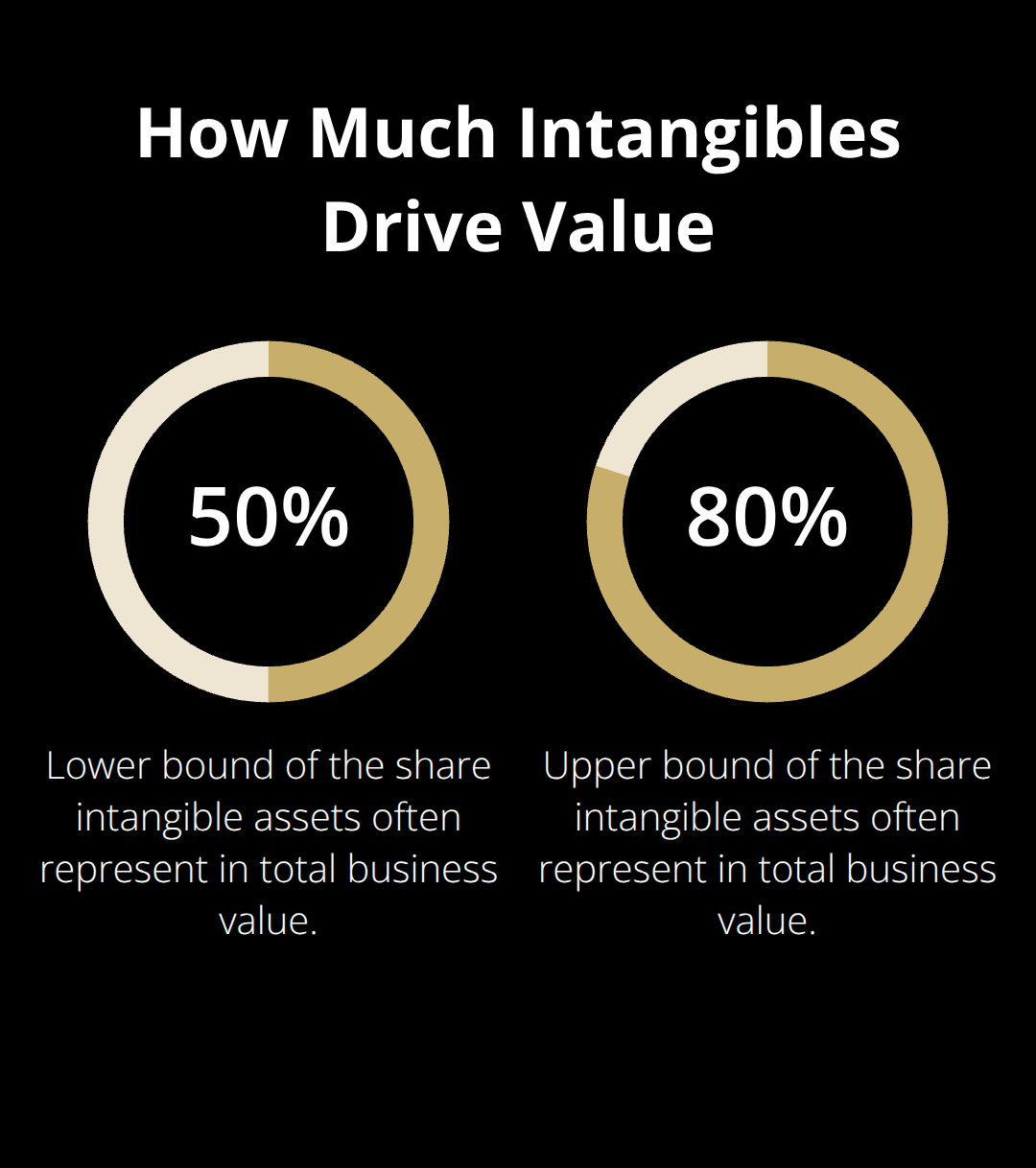
Intangible assets create the real complication. Your customer relationships, brand reputation, employee knowledge, proprietary processes, and market position don’t appear anywhere on a balance sheet, yet they often account for 50 to 80 percent of your business’s actual worth.
A buyer pays premium prices for businesses with strong customer retention, established supplier relationships, and proven systems. Conversely, a business with excellent equipment but deteriorating customer loyalty commands a lower valuation. Two identical manufacturing facilities in the same industry can sell for vastly different prices. One has a decade of long-term contracts with creditworthy clients; the other relies on transactional, spot-market sales. The American Society of Appraisers recommends adjusting balance sheet values upward for intangible assets when calculating fair market value, yet many owners ignore this entirely and undervalue their own business.
When Asset-Based Valuation Delivers Accurate Results
Asset-based valuation works best for capital-intensive businesses with substantial physical assets and minimal intangible value. Manufacturers, construction companies, and real estate-holding entities fit this profile well. If your business generates profit primarily from machinery, inventory, and property rather than customer relationships or intellectual property, this approach provides reliable answers. It also works when a business is in distress or approaching liquidation, since you’re essentially calculating what you’d recover if you sold everything today.
For service firms, consulting practices, or technology companies, asset-based valuation alone is dangerously misleading. A software company with $2 million in computers and office furniture but $20 million in annual recurring revenue shouldn’t be valued at $2 million. Asset-based methods also fail when your balance sheet is heavily adjusted for accounting purposes. If you’ve written off goodwill, capitalized expenses differently than competitors, or held assets off-balance-sheet, comparisons become unreliable.
Test whether this method fits your situation by asking whether a buyer would acquire your business primarily for its physical assets or for the cash flows those assets generate. If cash flows matter more than the equipment itself, you’ll need income-based or market-based methods to capture the true picture. These approaches account for what your business actually produces, not just what sits on your balance sheet.
Income-Based Valuation Methods
Asset-based valuation tells you what your business owns. Income-based valuation tells you what that business produces, and this distinction matters enormously when you price accurately. Most serious buyers focus on income-based methods because they care about the cash your business generates, not the equipment on your balance sheet. The three primary income approaches-earnings multiples, discounted cash flow, and revenue multiples-each suit different business types and situations.
Earnings Multiples: The Foundation of Small-Business Valuations
Earnings multiples form the foundation of most small-business valuations. You take your business’s earnings, multiply by an industry-standard factor, and arrive at value. For small businesses under $5 million in revenue, you typically use Seller’s Discretionary Earnings, which equals net profit plus owner salary and legitimate business perks.
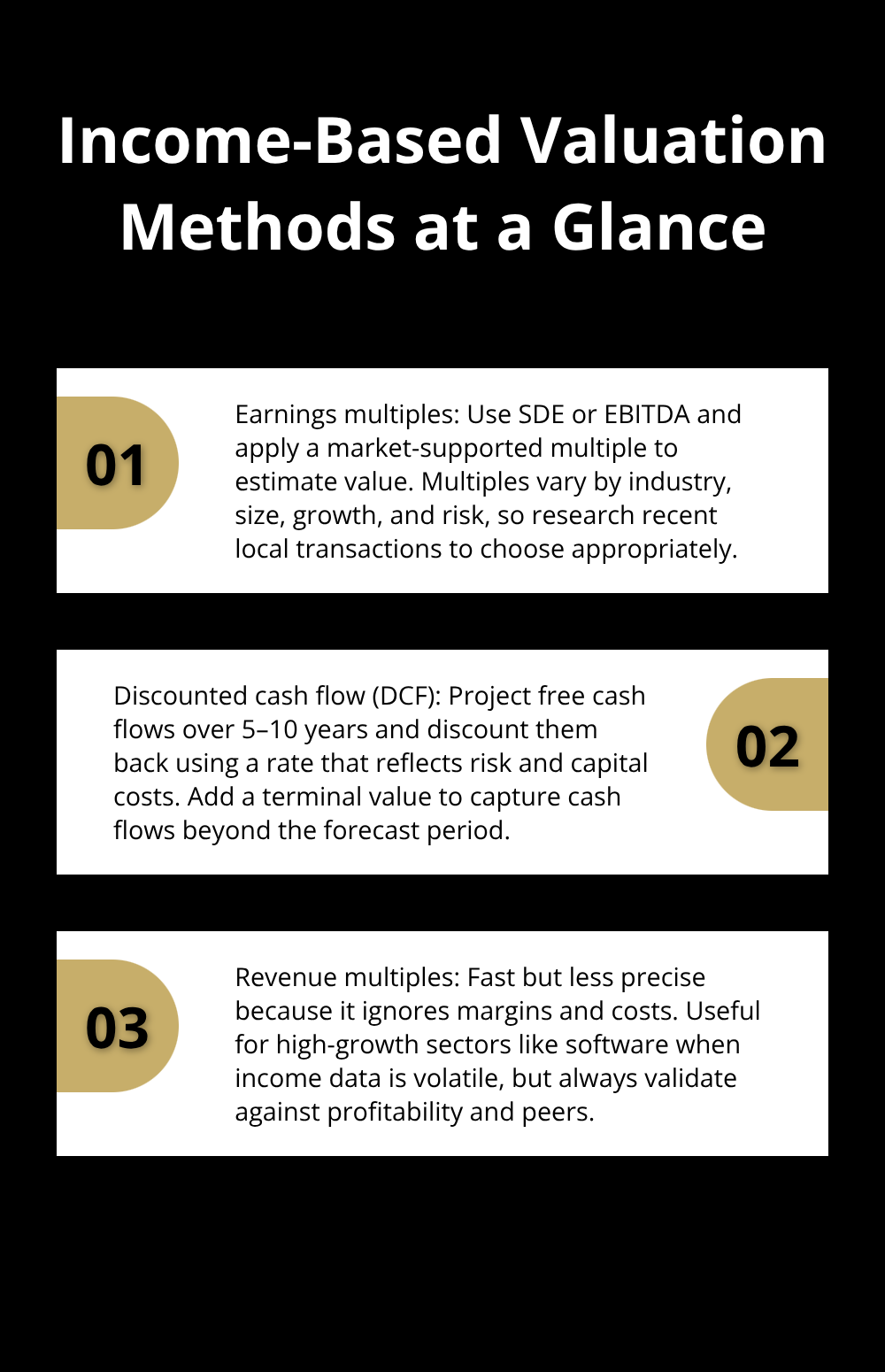
A plumbing company earning $150,000 in net profit with an owner taking $80,000 in salary has SDE of $230,000. Apply a typical multiple of 2.5x for a service business, and you get $575,000 as your baseline valuation.
The multiple varies by industry and risk profile. Grocery stores average around 3.5x EBITDA according to market data from business brokers, while service firms typically command 2x to 3x multiples. Your job involves finding the right multiple for your specific situation by researching actual sales in your industry and geography, not relying on generic online calculators that ignore local market conditions.
Discounted Cash Flow: The Gold Standard
Discounted cash flow analysis represents the gold standard for valuation because it forces you to be honest about the future. You project your business’s free cash flows for five to ten years, discount those flows back to today’s dollars using a rate that reflects your cost of capital and risk, then add a terminal value for years beyond your projection period. The discount rate typically ranges from 8 to 12 percent depending on business risk and market conditions.
A business projecting $200,000 in annual free cash flow for five years, then discounted at 10 percent, yields roughly $758,000 in present value from those flows alone, before accounting for terminal value. The challenge isn’t the math-any financial calculator handles this-but the forecasts. Most owners overestimate growth rates. Market conditions shift. Customer concentration creates vulnerability. Conservative assumptions beat aggressive ones every time.
Revenue Multiples: Speed Versus Accuracy
Revenue multiples offer a faster but riskier approach. Software companies might trade at 8x revenue while a local service firm trades at 0.5x revenue because investors expect completely different growth trajectories and margins. Using revenue multiples without understanding why your industry commands a particular multiple leads to serious mispricing.
Geography, customer quality, contract duration, and competitive positioning all compress or expand these multiples. A consulting firm with five-year contracts and Fortune 500 clients justifies a higher multiple than one relying on month-to-month engagements with small businesses. If you’re selling your business, a buyer will scrutinize your cash flow projections ruthlessly and compare your metrics against industry benchmarks.
Triangulating Your True Value
Triangulating across all three methods-earnings multiples, DCF, and revenue multiples-provides the most reliable picture. If asset-based valuation gave you a floor, income-based methods reveal your actual ceiling by proving what your business can produce. Each approach illuminates different aspects of value, and when they converge around a similar range, you’ve found solid ground for negotiation.
Market-based valuation methods take this analysis further by anchoring your numbers to what actual buyers paid for comparable businesses in your sector.
Market-Based Valuation: What Real Buyers Actually Pay
Market-based valuation cuts through theory by showing what actual businesses sold for in your industry. This approach grounds your valuation in observable market data rather than spreadsheet projections. You identify comparable companies that sold recently, extract the multiples paid, and apply those multiples to your own financials. The challenge isn’t finding data-it’s finding truly comparable sales and adjusting for the differences that separate your business from those transactions. A plumbing company in Austin doesn’t sell for the same multiple as one in rural Montana, even with identical revenue and profit. Customer concentration, lease terms, employee retention, and local market saturation all shift the needle.
Finding Real Transaction Data in Your Market
Start by researching actual transaction data in your industry. Business brokers track sales in their sectors and can provide recent multiples. For grocery stores, market data from business brokers consistently shows sales around 3.5x EBITDA, while service businesses typically range from 2x to 3x depending on stability and growth outlook. If you operate in an industry with public comparables like software or manufacturing, databases like Capital IQ provide EV/EBITDA multiples for public companies that can inform your range, though private businesses typically sell at discounts to public valuations. Don’t rely on generic online valuation tools that claim to average across all industries-they’ll produce numbers that miss your specific market reality. A business with strong customer retention and long-term contracts commands premium multiples, sometimes 30 to 50 percent higher than industry averages. Conversely, heavy customer concentration with one or two major clients triggers discounts because buyers face revenue risk if those relationships end.
Adjusting for Factors That Distinguish Your Business
Once you’ve identified comparable sales, adjust for factors that distinguish your business from the transactions you’re analyzing. A competitor’s business might have sold at 3x EBITDA, but if they had a five-year lease at below-market rates and you operate month-to-month, that’s a significant adjustment downward. Employee turnover matters enormously.
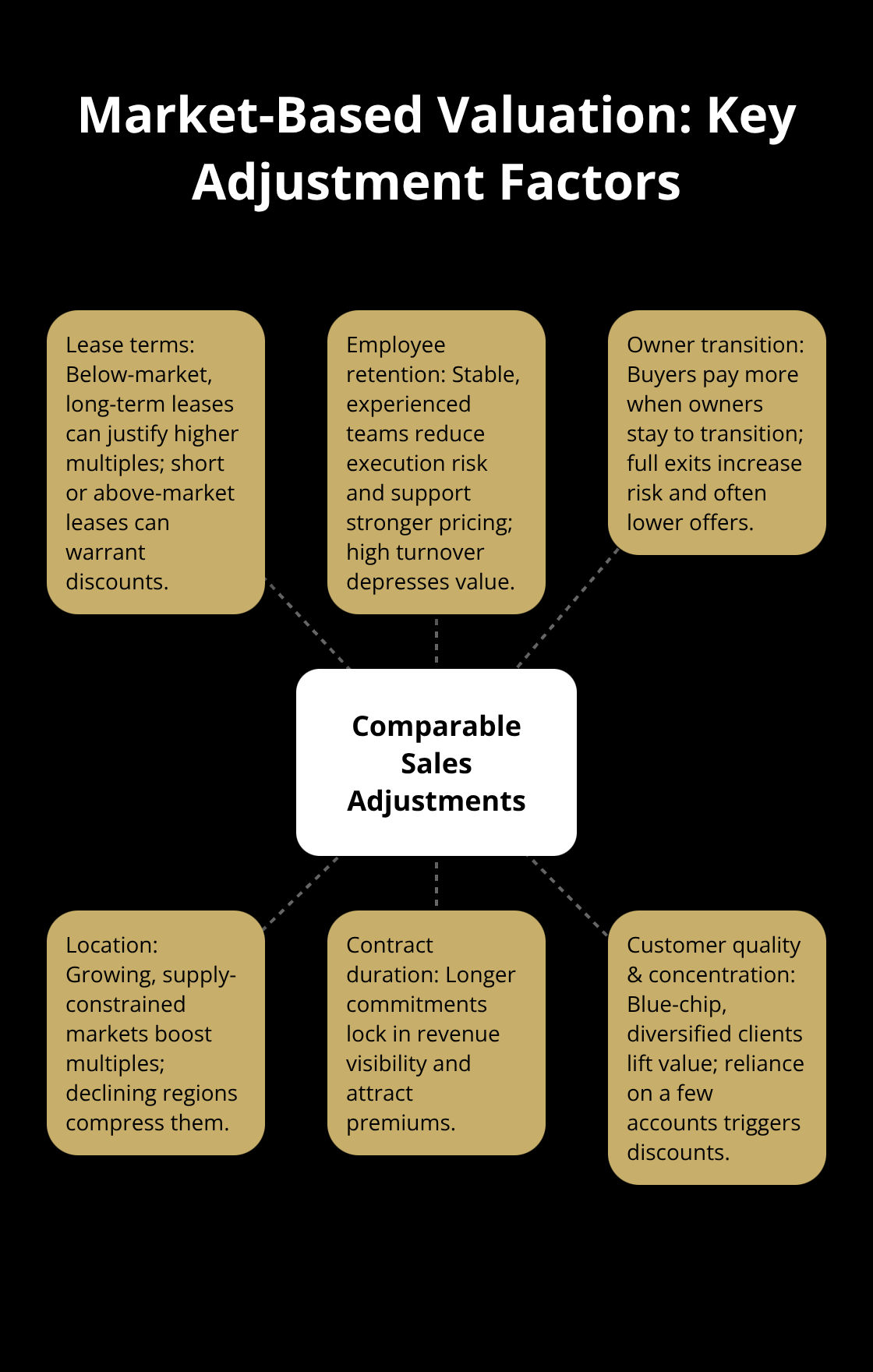
If comparable sales involved founders who stayed on in management roles and you plan to exit completely, buyers face execution risk and typically pay less. Location affects value substantially-a service business in a growing market trades higher than an identical operation in a declining region. Contract duration and customer quality create the biggest valuation swings. A consulting firm with twelve-month client contracts and Fortune 500 customers justifies higher multiples than one relying on project work with small businesses. Apply a premium to the comparable multiple if your business has stronger attributes. Apply a discount if it has weaknesses. This requires honesty about your competitive position.
Combining Market Data With Income-Based Methods
Market-based valuation works best when combined with income-based methods. If earnings multiples suggested $500,000, DCF analysis suggested $550,000, and market comparables suggest $480,000 to $520,000, you’ve found a credible range. When these three approaches converge, you can defend your valuation to potential buyers with confidence. Wide divergence signals that you need to question your assumptions. Are your growth projections unrealistic? Have you missed major intangible assets? Is your business genuinely different from the comparables in ways you haven’t accounted for? The best valuations rest on multiple methods pointing toward similar conclusions, not one method dominating the others.
Final Thoughts
Practical business valuation requires you to match your method to your situation. Asset-based approaches work for capital-intensive businesses with substantial physical assets, while income-based methods suit companies where cash flow drives value. Market-based approaches anchor your numbers to what actual buyers paid for comparable businesses, and the strongest valuations combine all three methods to create a credible range rather than relying on a single number.
Most business owners make predictable mistakes when valuing their own company. They overestimate growth rates, ignore customer concentration risk, and fail to adjust for differences between their business and market comparables. They rely on outdated balance sheet values instead of current market prices for assets, and they apply industry-average multiples without accounting for factors that make their business stronger or weaker than typical competitors.
Consider hiring a professional business valuator if your business exceeds $5 million in revenue or involves complex structures. For smaller businesses, we at Unbroker offer transparent support for selling your business without inflated brokerage fees, combining expert guidance with modern tools to help you navigate valuation and the entire sales process confidently.