Selling a service business requires more than just finding a buyer. At Unbroker, we’ve seen firsthand that the companies commanding the highest prices are those with documented processes, proven customer retention, and clear financial metrics.
Your marketing strategy directly impacts what buyers will pay. The difference between a mediocre exit and a premium one often comes down to how well you’ve positioned your business before hitting the market.
Why Buyers Pay More for Service Businesses
Buyers hunt for predictability when they acquire service businesses, and that’s where your competitive advantage lies. Service businesses with recurring revenue streams command valuations between 3 to 6 times EBITDA according to industry benchmarks, whereas businesses dependent on one-time projects often settle for 2 to 3 times EBITDA. The difference isn’t academic-it translates directly into hundreds of thousands of dollars at the negotiating table. A buyer sees recurring contracts as de-risked income. If your plumbing, accounting, or consulting firm has clients on annual maintenance agreements or retainer-based models, you’ve already solved the buyer’s biggest worry: revenue stability after the transition.
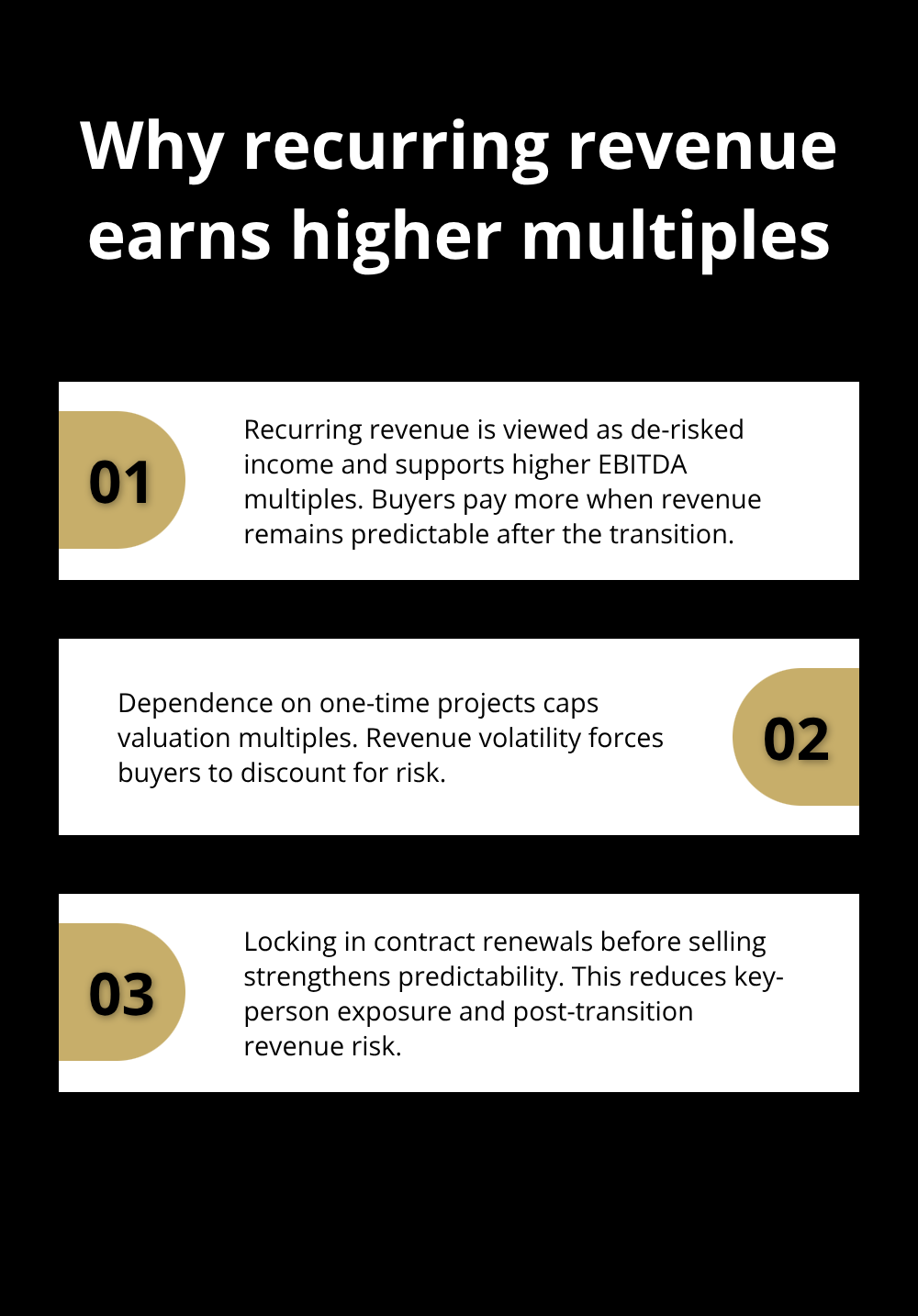
The first action any owner should take before selling is to lock in contract renewals. Don’t wait until three months before your sale announcement to secure those agreements. Sign them now, while clients feel comfortable with your leadership.
The Overhead Advantage That Multiplies Value
Low overhead structures command premium prices because they signal operational efficiency. A service business that runs lean-minimal physical infrastructure, remote or small teams, outsourced support functions-attracts buyers who see immediate margin expansion potential. If you operate from a home office or shared workspace rather than maintain expensive real estate, make this explicit during sale discussions. It demonstrates your business model works without heavy capital requirements.
If your overhead is high, document exactly why it exists and what value it creates. A large team signals scalability but also creates payroll risk; buyers want clarity on whether headcount is essential or inflated. You can reverse this by normalizing your financials now-removing owner discretionary expenses, separating one-time costs from recurring operations, and clearly presenting what a buyer would actually inherit. This preparation work directly impacts whether a buyer sees your 40% profit margin as real or inflated.
Customer Relationships as Your Strongest Asset
Strong customer relationships aren’t soft assets in a buyer’s eyes-they’re the foundation of post-acquisition success. Buyers specifically analyze customer concentration, contract length, and churn rates. If any single customer represents more than 25 percent of your revenue, you’ve created a valuation ceiling that no amount of other optimization can overcome. Conversely, a diversified customer base with average contract lengths of 2+ years and churn rates below 10% annually attracts serious buyers willing to pay full price.
Document your top 20 customers, their contract values, renewal dates, and the strength of those relationships. Include testimonials from actual clients that describe measurable outcomes you delivered-not generic praise but specific results like cost savings, time improvements, or revenue increases. Case studies with real company names and quantified results outweigh ten pages of marketing copy. This documentation becomes your competitive advantage when multiple buyers evaluate the same business.
How Marketing Clarity Influences Buyer Confidence
The one with clear proof of customer satisfaction and predictable retention wins the negotiation. But buyers also want to understand how you acquired those customers in the first place. A documented marketing strategy that shows repeatable lead sources and conversion rates signals that the business can sustain growth after the sale. If your marketing relies entirely on word-of-mouth or your personal network, that creates key-person risk in a buyer’s mind. Instead, show that your marketing channels (Google Ads, local SEO, referral partnerships, or social media) function independently of your involvement. This is where your next strategic move matters most.
How to Document Your Sales Process So Buyers See Repeatability
Your sales process remains invisible to buyers unless you make it visible. Most service business owners operate on instinct-they close deals through relationships, phone calls, and word-of-mouth-but this approach terrifies acquirers. A buyer stepping into your business needs proof that new clients will keep arriving without your personal involvement. The fastest way to demonstrate this is to map exactly how customers find you, what happens after they inquire, and why they choose your services over competitors.
Track every customer source and conversion rate
Start by tracking your last 20 customer acquisitions. Where did each one originate? Google search, referral from an existing client, social media, local partnership, or direct outreach? Assign a source to every deal you closed in the past 12 months. If 40 percent came from Google Local Services Ads and 30 percent from referrals, you’ve already proven your business has multiple revenue streams. Document conversion rates alongside these numbers.
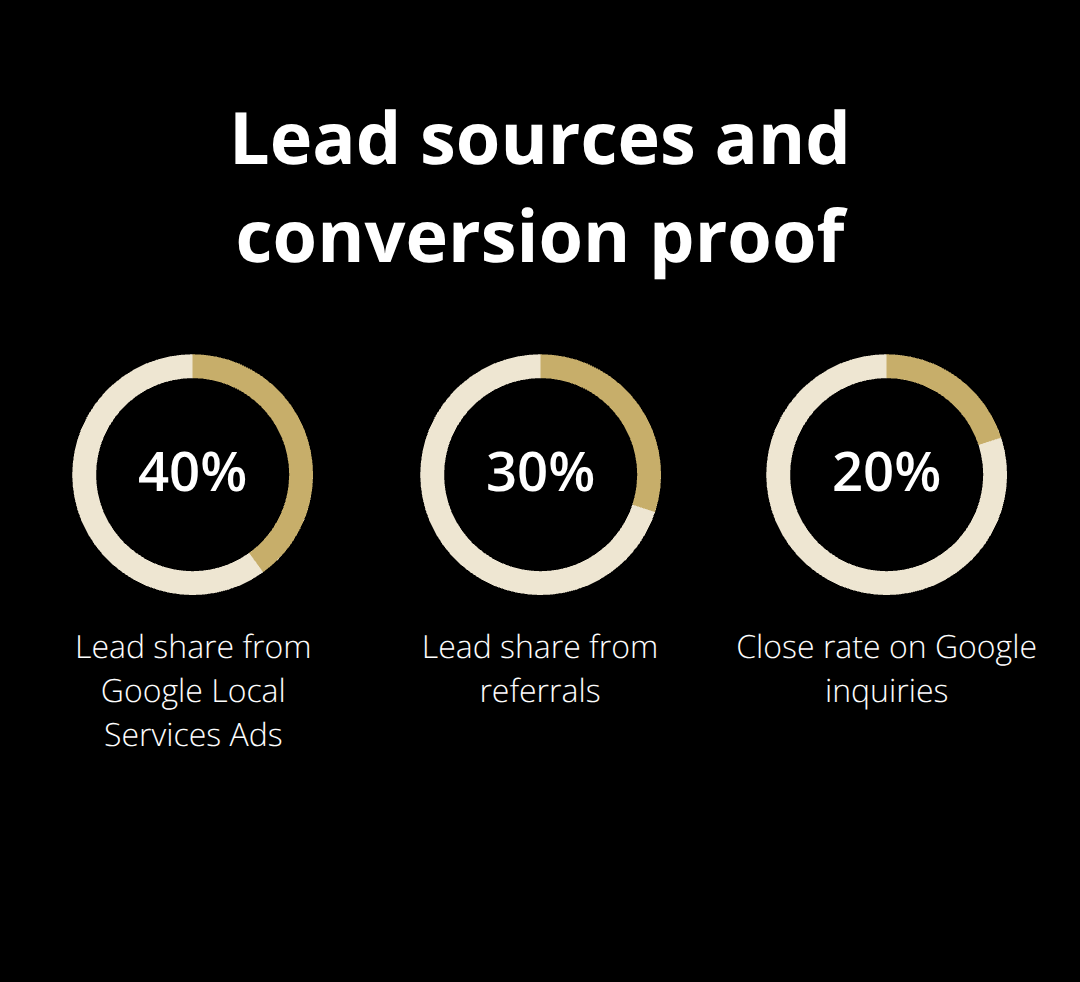
If you close 1 out of every 5 Google inquiries into paying customers, that’s a 20 percent conversion rate-concrete proof of sales efficiency. Buyers use this data to project future revenue and calculate return on investment. Without it, they default to worst-case assumptions and lower their offers.
Collect named testimonials with specific results
Real testimonials from named clients with specific results command attention from buyers in ways generic five-star reviews never will. A statement like “Sarah Chen, Operations Manager at TechFlow Solutions, reduced her invoice processing time by 12 hours per week after implementing our accounting services” carries infinitely more weight than “Client testimonials show satisfaction.” Include the client’s actual business name, their role, the measurable outcome, and if possible, the financial impact. A 12-hour weekly time savings translates to roughly 624 hours annually-something a buyer can quantify and understand. Reach out to your five most satisfied customers and ask them to describe the specific problem you solved and the result they experienced. Video testimonials carry even more weight because they signal confidence and authenticity, but written statements work equally well if they’re detailed and attributed.
Build case studies around measurable outcomes
One detailed case study showing before-and-after metrics outweighs a hundred generic marketing claims. Structure your case study around the challenge your client faced, the solution you provided, and the quantified outcome. A commercial cleaning company might present a case study showing how they reduced a client’s monthly cleaning costs by 18 percent while improving inspection scores from 82 to 94 percent. Include timeline, pricing, and the client’s name and business type. Buyers analyze these case studies to understand your service’s real-world impact and scalability. If you demonstrate that you’ve solved similar problems for multiple clients with similar results, you’ve proven your business model works reliably, not just occasionally. This documentation becomes your strongest negotiation tool when multiple buyers compete for your business.
Present Your Marketing Channels as Repeatable Systems
Buyers want to see that your marketing functions independently of your personal involvement. Document which channels generate the most qualified leads and at what cost. If your Google Ads spend produces leads at $45 per inquiry with a 20 percent close rate, that’s a $225 customer acquisition cost-a metric buyers understand and can project forward. Show that you’ve tested multiple channels (local SEO, referral partnerships, social media, or paid advertising) and identified which ones deliver consistent results. This transforms your marketing from a mysterious art into a predictable system. A buyer inheriting a business with documented, repeatable marketing channels feels confident about revenue continuity and willing to pay accordingly.
Organize Documentation for Due Diligence
Compile all this information into a single, organized document that a buyer can review during due diligence. Include your customer acquisition breakdown by source, conversion rates by channel, top 20 customer contracts with renewal dates, testimonials with attribution, and 2-3 detailed case studies. Add your marketing spend by channel and the results each one produced.
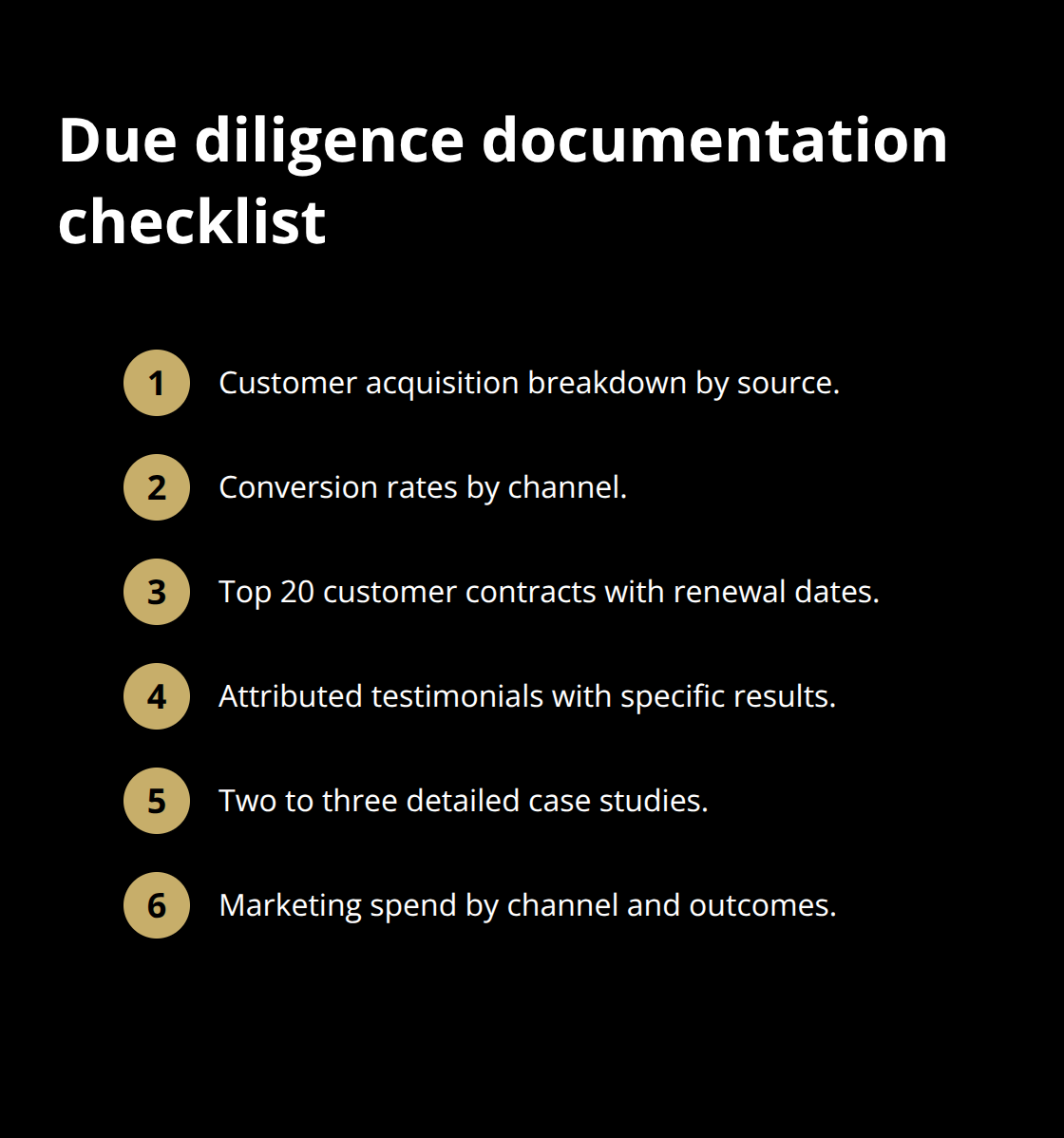
This package demonstrates that your business operates on systems and data, not luck or personal relationships. Buyers move faster and offer higher prices when they can see exactly how your business functions and why it will continue functioning after the transition.
The next step involves pricing your business correctly so that this documented value translates into maximum return.
Pricing Your Service Business for Maximum Return
Pricing a service business for sale demands precision, not guesswork. The industry standard uses EBITDA multiples for service businesses, which depend on the size of your company, its profitability, its growth prospects, and the industry in which it works. If your business generates $200,000 in EBITDA annually with recurring revenue contracts and low customer concentration, you’re looking at a valuation range of $600,000 to $1.2 million. But this range only matters if you’ve normalized your financials first.
Clean Your Financial Foundation
Most service business owners inflate their actual profitability by mixing personal expenses into operational costs. You need to remove owner salary adjustments, one-time discretionary spending, and non-recurring revenue to show a buyer what the business actually produces. A CPA or financial advisor can help here, but the work falls on you to gather clean income statements and balance sheets for the past three years. Without this foundation, any valuation is meaningless.
Profit margins and operational efficiency directly influence your valuation multiple. A service business running at 35 percent net profit attracts higher multiples than one operating at 15 percent, even if both generate the same total revenue. Buyers see margin as proof of operational efficiency and pricing power. If your margins have grown year-over-year, document that trajectory because it signals improving business health, not stagnation.
Demonstrate Growth Potential and Market Demand
Growth potential and market demand directly influence what multiple a buyer applies to your EBITDA. A service business in a shrinking market or serving a concentrated geographic area commands lower multiples than one positioned in expanding markets with room for geographic expansion. If your accounting firm serves small businesses in a metro area with growing entrepreneurship, that’s valuable context.
Show market research proving your service category is in demand and that your business captures only a small percentage of available customers. This frames your business as having untapped upside, which buyers reward with higher valuations.
Build Confidence Through Transparent Pricing
Transparent pricing models matter equally because they reduce buyer anxiety about hidden costs or unclear revenue recognition. If your service pricing is straightforward, documented, and justified by market rates, buyers gain confidence in revenue projections. Hidden discounting, inconsistent pricing across similar clients, or unclear billing terms create red flags.
Document your pricing structure, show how it compares to local competitors, and explain the reasoning behind your rates. A buyer stepping into a business with clear, defensible pricing feels secure about maintaining that revenue stream after acquisition.
Align Valuation with Wealth Impact
The Exit Planning Institute reports that 80 to 90 percent of a business owner’s wealth is tied to the business itself, making the sale a major wealth event. Price incorrectly and you leave hundreds of thousands on the table. Price too aggressively and you scare away qualified buyers. The sweet spot emerges when you combine documented EBITDA, realistic profit margins, clear growth potential, and transparent pricing into a cohesive valuation narrative that buyers can understand and defend to their investors.
Final Thoughts
A service business sale commands premium pricing when you combine three elements: repeatable marketing systems that function without your involvement, documented customer relationships with measurable outcomes, and clean financials that reflect actual profitability. Buyers pay for certainty, and you create that certainty through documented customer acquisition costs, conversion rates, and retention metrics that transform speculation into concrete data. The owner who locks in contract renewals, organizes customer testimonials with specific results, and normalizes financial statements eliminates the biggest risks in a buyer’s mind.
Your marketing strategy directly shapes what a buyer will pay for your service business. When you prove that customers arrive through repeatable channels-Google Ads, local SEO, referral partnerships-rather than through your personal relationships, you’ve solved the key-person risk that terrifies acquirers. EBITDA multiples between 3 and 6 times depend on your recurring revenue, profit margins, customer concentration, and growth potential, but these multiples only apply if your financials are clean and your pricing transparent.
Start your preparation now rather than waiting until you’re ready to sell. Lock in contract renewals, organize your customer data, and clean your financials because these actions compound over months and directly influence your final sale price. Unbroker offers transparent, low-cost guidance to help you navigate this process without the high brokerage fees that eat into your proceeds.