Selling a business shouldn’t feel like you’re negotiating in the dark. Most brokers hide their fees behind vague commission structures, leaving sellers guessing about what they’ll actually pay.
At Unbroker, we believe a transparent pricing policy isn’t just nice to have-it’s essential. This guide shows you exactly how pricing works, what hidden costs look like at traditional brokers, and how clarity protects your bottom line.
Why Traditional Brokers Charge So Much
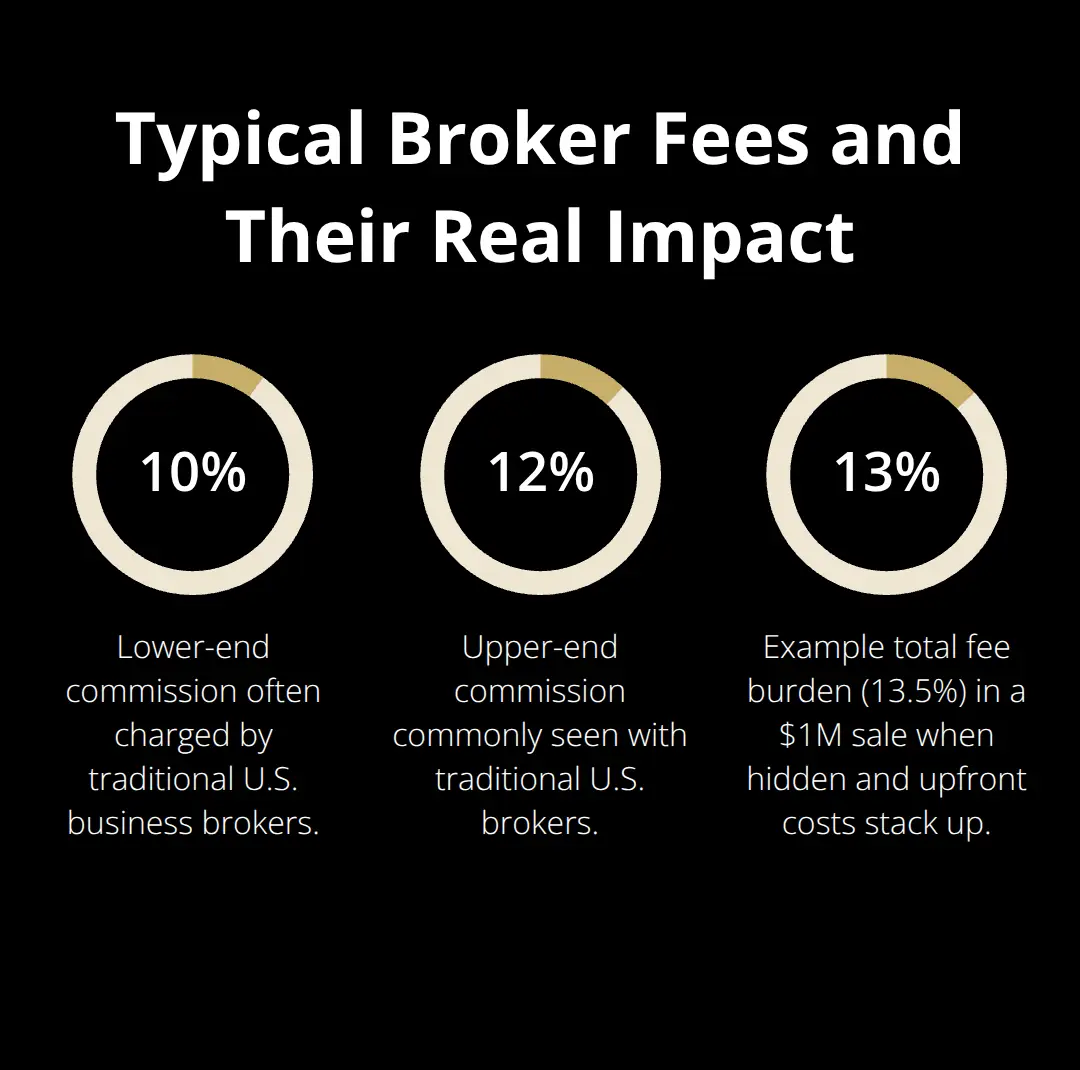
The business brokerage industry operates on a commission model that typically ranges from 10% to 12% of the sale price. For a business selling at $1 million, that translates to $100,000 to $120,000 going to the broker-money that comes directly from your pocket. Traditional brokers justify these fees by claiming they provide comprehensive services, but the reality is far more complicated. Many brokers layer additional charges on top of commissions: transaction fees, document preparation costs, marketing expenses, and administrative charges that they don’t disclose upfront.
A seller might discover during closing that they’re paying undisclosed costs beyond the stated commission percentage. This lack of clarity about total fees is intentional. When brokers keep pricing vague, sellers can’t easily compare options or negotiate better terms. The industry has normalized this opacity, making it nearly impossible for business owners to know their actual cost of sale until the final stages of the transaction.
Commission Structures Create Misaligned Incentives
Commission models create perverse incentives that don’t align with seller interests. A broker earning 10% makes more money when your business sells for $1 million versus $900,000, but they invest the same effort either way. This means brokers have little motivation to push for your highest possible price. They want a deal done quickly to move to the next client. A seller might accept a lower offer thinking their broker has exhausted the market, when in reality the broker simply stopped looking because the deal was good enough for their commission. Additionally, traditional brokers often require sellers to pay for marketing, legal reviews, and appraisals upfront-sometimes $5,000 to $15,000 before any results materialize. If the sale falls through, these costs vanish without compensation to the seller. This structure means you fund the broker’s operations while you assume all the financial risk.
Hidden Fees Erode Your Sale Proceeds
A $1 million sale with a 10% commission costs $100,000. Add $20,000 in hidden fees, $10,000 in upfront marketing costs, and $5,000 in miscellaneous charges that appeared late in the process, and your total cost reaches $135,000. That’s a 13.5% reduction in proceeds-money that could fund your next venture or secure your retirement. Many sellers don’t realize they’ve been overcharged until after closing, when it’s too late to renegotiate. The traditional broker model also obscures how much time and resources actually go into selling your business. A broker might spend 20 hours on your deal but charge fees as if they spent 200 hours. Without transparent pricing, you have no way to validate whether you’re getting fair value for what you’re paying.
What Transparent Pricing Looks Like
Transparent pricing eliminates these surprises entirely. Instead of hidden layers, you see every cost upfront (marketing, legal support, transaction fees) and know exactly what you’ll pay at closing. This approach lets you compare brokers on actual total cost, not just commission percentages. You can make an informed decision about which service model fits your situation and budget. The next section shows how transparent pricing works in practice and what your actual costs look like across different sale scenarios.
How Transparent Pricing Actually Works
We at Unbroker structure pricing around a principle that traditional brokers avoid: you know your total cost before you sign anything. Instead of vague commission structures, transparent pricing ties your cost directly to your outcome. For a Full Service Business Sale, Unbroker charges a 6% success fee, paid only when your business sells. This contrasts sharply with traditional brokers charging 8% to 12% (or more) on the sale price. Because the fee is disclosed upfront as a simple percentage, you know exactly what you’ll pay before you ever list your business.
How Aligned Incentives Protect Your Interests
This structure aligns incentives correctly: we profit when you sell, not when you accept a lower offer. You also avoid the trap of paying upfront marketing costs that vanish if the deal fails. With transparent pricing, there are no surprises at closing, no hidden document preparation charges, and no administrative fees buried in fine print. You see exactly what you’ll pay months before closing happens.
What You Actually Keep From Your Sale
The clarity extends to what you actually retain from your sale. If you sell for $1 million with traditional brokers, you lose $100,000 to $135,000 in fees and hidden costs, leaving you with $865,000 to $900,000. With Unbroker’s 6% success fee, you pay $60,000, keeping $940,000. That $40,000 to $75,000 difference funds your next business, secures your retirement, or covers transition expenses.
Why Transparent Pricing Makes Comparison Easy
Sellers often underestimate how much traditional brokers actually cost them because the fees appear across multiple line items throughout the process. Unbroker’s pricing consolidates everything into a single success fee you see upfront. You can also compare the actual dollar amount across brokers without doing complex math on commission percentages. A broker charging 8% on a $2 million sale costs $160,000 compared to Unbroker’s 6% fee of $120,000-a $40,000 difference that’s easy to see once you do the math.
Planning Your Post-Sale Finances With Certainty
You also gain the ability to budget accurately for your sale. No surprises mean you can plan your post-sale finances with confidence, knowing exactly how much capital you’ll have available. This certainty transforms how you approach the sale itself-you can negotiate from a position of strength when you understand your actual costs. The next section shows how different pricing models stack up against each other and what your costs look like across various sale scenarios.
Which Pricing Model Fits Your Sale
The choice between full service and DIY selling with support fundamentally changes what you pay and how much control you maintain. Unbroker offers both paths because sellers have different needs, budgets, and comfort levels with managing their own sale. Full Service Business Sale charges a 6% success fee, paid only when your business sells, providing hands-off support from initial listing through final documentation. Assisted Business Sale gives sellers who want to lead the process themselves expert guidance on valuations, legal templates, and buyer negotiations. The math reveals why this structure works: a seller moving a $2 million business through traditional brokers pays roughly $200,000 to $240,000 in commissions and hidden fees, while Full Service at Unbroker’s 6% fee costs $120,000-a savings of $80,000 to $120,000 compared to traditional brokers. Those savings scale with your sale price, which is the core advantage of transparent, percentage-based pricing.
Full Service Means You Step Back and Let Experts Handle It
Full Service works best for owners who want minimal involvement or lack time to manage the sale themselves. Unbroker handles buyer outreach through its network, manages confidentiality agreements, coordinates legal document preparation, and guides negotiations toward closing. You attend key meetings but don’t spend weeks fielding buyer inquiries or managing administrative details. A business owner selling a $1.5 million service company can focus on running operations during the sale rather than becoming a part-time broker. The 6% success fee, paid only at closing, covers all closing logistics, ensuring nothing gets missed. This model appeals to busy owners and those unfamiliar with sales processes who don’t want to learn deal mechanics while managing their exit.
DIY Selling with Monthly Support Gives You Control and Lower Costs
Assisted Business Sale suits owners who want to stay involved and learn the process. You control the timeline, set your own asking price, and decide which buyer inquiries to pursue. Unbroker provides valuation tools, customizable legal templates, and direct access to negotiation advisors when you hit friction points. A tech founder selling a software company for $3 million might prefer this approach, handling initial buyer conversations but requesting expert guidance before signing term sheets. The trade-off is your time investment. Managing buyer communications, scheduling calls, and coordinating document exchanges requires five to ten hours monthly depending on interest level. For owners who have time and want to stay connected to their exit, the control and savings compared to traditional brokers justify the effort.
Real Cost Comparisons Across Different Sale Scenarios
A $500,000 business sale with traditional brokers costs $40,000 to $60,000 (8% to 12%). Full Service at Unbroker costs $30,000 (6%). A $2 million business costs $200,000 to $240,000 through traditional brokers versus $120,000 for Full Service. A $5 million business costs $500,000 to $600,000 through traditional brokers while costing $300,000 for Full Service. The savings accelerate as your business value increases because traditional brokers scale their fees with your sale price, and while Unbroker’s 6% success fee scales too, it stays well below typical broker rates. An owner selling a mid-market business for $10 million saves roughly $400,000 (compared to a 10% traditional brokerage fee) by choosing Full Service. That capital funds acquisitions, pays down debt, or secures retirement without erosion from excessive broker fees.
Final Thoughts
Selling your business ranks among the biggest financial decisions you’ll make, and the difference between understanding your costs upfront and discovering hidden fees at closing can mean tens of thousands of dollars in your pocket or lost to unnecessary charges. A transparent pricing policy removes the guesswork that traditional brokers rely on to justify inflated fees. When you know exactly what you’ll pay before signing anything, you gain control over your exit strategy and can compare brokers on actual dollar amounts rather than percentages that scale with your sale price.
The math speaks clearly. A $2 million business sale costs $200,000 to $240,000 through traditional brokers, while the same sale through Unbroker’s 6% success fee costs $120,000-a savings of $80,000 to $120,000 that funds your next venture, pays down debt, or secures your retirement. We at Unbroker built our platform around this principle because sellers deserve clarity, offering either Full Service for hands-off selling or Assisted Business Sale for DIY sellers who want expert guidance. Either way, your cost is a transparent success fee tied to your outcome, with no hidden fees or surprise charges appearing at closing.
The choice becomes obvious once you see the numbers. Explore Unbroker to see how a transparent pricing policy protects your bottom line and makes your business sale straightforward.