Selling a business requires knowing what it’s actually worth. At Unbroker, we’ve seen too many owners walk into negotiations unprepared, armed with nothing but a gut feeling about their company’s value.
Small business valuation methods aren’t one-size-fits-all. The approach you choose-whether asset-based, earnings-based, or market-based-can shift your sale price by hundreds of thousands of dollars.
Asset-Based Valuation: What Your Business Actually Owns
Understanding Net Asset Value
Net asset value strips away the earnings story and focuses on what your business owns versus what it owes. This approach works by taking your total assets, adjusting them to what they’d actually sell for today rather than what you paid for them years ago, then subtracting all liabilities. Most small business owners make a critical mistake here: they rely on balance sheet values that are outdated or incomplete. A building you bought ten years ago at $500,000 might be worth $800,000 today, but your books still show the original cost minus depreciation. Adjusted net asset value corrects this problem.
You revalue real estate, equipment, inventory, and accounts receivable to current fair market values. This matters because the difference between book value and adjusted value can easily be six figures for a business with significant physical assets. The adjusted approach also captures intangible assets that never appear on your balance sheet.
Tangible and Intangible Assets
A customer list with decades of relationships, proprietary software your team built, brand reputation in your local market, or exclusive supplier agreements all have real monetary value. Many valuation professionals include these in their analysis because they directly impact what a buyer will pay. The asset-based method works best when your business owns substantial physical assets, real estate, or valuable intellectual property that a buyer could leverage immediately.
It’s particularly relevant if you operate in manufacturing, retail with owned locations, or professional services with client lists worth protecting. It also serves as a floor value in any negotiation-knowing the liquidation value of your assets gives you a baseline you won’t go below.
When Asset-Based Valuation Falls Short
This approach can undervalue a thriving business with strong cash flows but few tangible assets. A software company with minimal equipment but millions in recurring revenue would look artificially cheap using only asset values. That’s why you should use the asset approach alongside earnings and market methods to triangulate a realistic price.
When you prepare to sell, start by documenting every asset your business owns, including those not formally recorded. Get current market appraisals for real estate and significant equipment. List customer relationships, patents, trademarks, and any proprietary systems. This groundwork makes the asset-based valuation accurate and gives you ammunition during price negotiations. With your assets properly valued, you’re ready to examine how your business’s earnings power shapes its true market value.
Earnings-Based Valuation: What Your Business Actually Generates
The Income Approach Explained
Earnings-based valuation cuts through the noise and focuses on what buyers care most about: how much cash your business generates. This approach values your company based on its ability to produce profits, which is why it dominates most business valuations. The logic is straightforward-a buyer isn’t purchasing your assets or your history; they’re purchasing your future cash flows.
The income approach uses a simple formula: Value equals the benefit (your earnings or cash flows) divided by the required rate of return. That denominator captures risk; a stable, predictable business commands a lower discount rate and therefore a higher valuation than a volatile one.
EBITDA and Industry Multiples
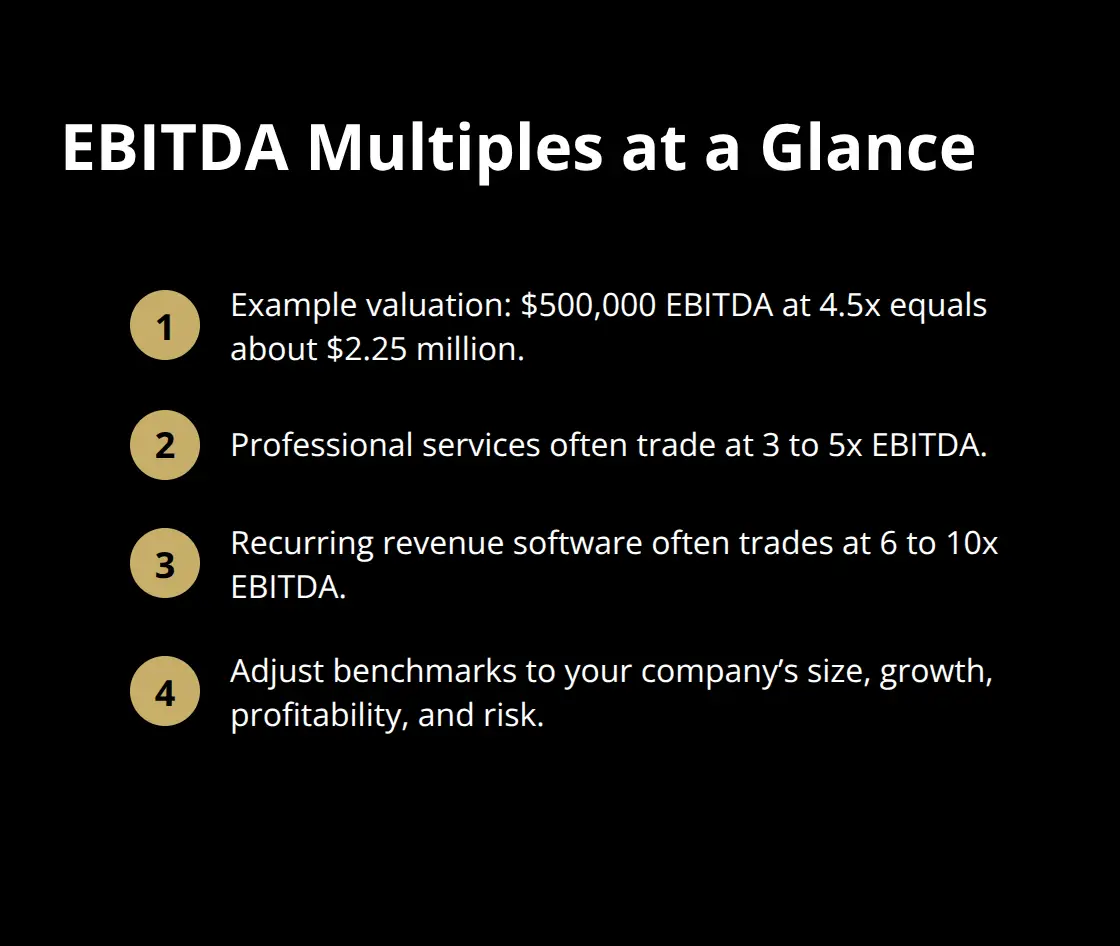
EBITDA (earnings before interest, taxes, depreciation, and amortization) is the metric most buyers and valuers use because it strips away financing decisions and accounting choices to show what the business actually generates operationally. If your business earned $500,000 in EBITDA last year and similar businesses in your industry trade at 4.5x EBITDA, your valuation would land around $2.25 million. Industry multiples vary significantly based on company size, profitability, growth prospects, and industry-professional services firms might command 3 to 5x EBITDA, while recurring revenue software businesses often fetch 6 to 10x. The Business Reference Guide publishes hundreds of industry-specific multiples that give you benchmarks, though you need to adjust these for your company’s specific circumstances.
Profit Margins and Valuation Impact
Profit margins matter equally; two companies with identical revenue but different margins tell completely different valuation stories. A business with 15% net profit margins is fundamentally more valuable than one with 5% margins because the owner actually keeps more money. Most small business owners make a costly mistake here: they present their financial statements without adjustments. Buyers and valuers normalize earnings to reflect what a market-rate owner would actually take home.
Normalizing Earnings for True Value
If you pay yourself $150,000 annually but a comparable business owner in your industry makes $200,000, valuers adjust your earnings upward by $50,000. Similarly, if you run discretionary expenses through the business-a vehicle you use partly personally, meals and entertainment that aren’t strictly business, or insurance policies you don’t really need-these get added back to show recurring, sustainable earnings. This adjustment, called Seller’s Discretionary Earnings, can increase your valuation significantly depending on how many personal expenses flow through your P&L.
Preparing Your Financials for Valuation
Before you list your business, audit your last three years of tax returns and financial statements. Document every expense that a new owner wouldn’t need to incur. Get professional appraisals if you’re uncertain about fair market compensation for your role. This groundwork transforms your earnings from a number on a spreadsheet into a defensible valuation that buyers will respect and price accordingly. With your earnings properly documented and adjusted, the final piece of the valuation puzzle emerges from what similar businesses actually sold for in your market.
Market-Based Valuation: What Comparable Sales Reveal About Your Business Value
Market-based valuation grounds your business in reality by examining what similar companies actually sold for. This approach matters because it answers the question buyers ask first: what did comparable businesses fetch in my industry? The challenge is finding true comparables. Statistics Canada notes there are just over one million Canadian small businesses across 923 industry types, yet publicly available transaction data remains sparse because most small business owners never disclose sale prices. This scarcity means online calculators cannot deliver accuracy. Instead, you must actively search for transactions in your specific industry and geography. The Business Reference Guide and similar databases publish sale multiples across hundreds of industry categories, but these national averages often miss local market conditions that directly affect price. A restaurant in a thriving downtown district commands different multiples than an identical operation in a declining neighborhood.
How Location and Business Profile Shape Comparable Value
Two professional services firms with the same revenue can sell at vastly different multiples depending on client concentration, retention rates, and whether the owner’s personal relationships drive the business. Size matters significantly because a $2 million revenue business typically commands different multiples than a $20 million operation. Growth trajectory affects value since a business expanding 15% annually is worth more than a stagnant competitor at the same revenue level. Customer concentration determines risk, as a business dependent on three major clients carries more valuation risk than one with diversified revenue. Owner involvement indicates whether the business runs independently or relies on the owner’s personal effort. A comparable business that sells at 4x EBITDA but has one customer representing 60% of revenue isn’t truly comparable to your business with twenty balanced customers.
Finding Real Transaction Data in Your Market
The most reliable comparable sales come from your industry peers and local business brokers who track actual deals in your region. If you’re selling a manufacturing business, contact equipment dealers and industry associations who see transactions regularly. For professional practices, trade associations often publish valuation guidelines specific to accountants, financial advisors, or medical practices. Real estate agents and commercial brokers in your area have access to sold properties and business sales data that doesn’t appear in national databases. When you evaluate a comparable sale, adjust for critical differences that separate your business from the transaction you’re studying.
Using Multiples to Anchor Your Price
Industry multiples serve as a starting framework rather than a final answer. Industry multiples for professional services typically range from 3 to 5x EBITDA according to historical transaction data, while recurring revenue software businesses often command premium valuations because predictable income justifies higher pricing. However, the spread within each industry is enormous. A dental practice with strong patient retention and documented systems might command 5.5x EBITDA, while one with aging equipment and reliance on the owner’s reputation sells at 3.5x. The difference between these multiples represents hundreds of thousands of dollars.
Building Your Case for Premium Multiples
Document your business’s competitive advantages relative to typical comparables in your industry. If your customer retention rate exceeds industry averages, if your margins sit above median, or if your business has expanded faster than peers, you have justification for a multiple at the higher end of the range. Conversely, if your business faces headwinds that comparables don’t share, expect a discount. When you combine comparable sales data with your asset values and normalized earnings, you triangulate a defensible price that reflects genuine market conditions rather than wishful thinking.
Final Thoughts
You now understand how asset-based, earnings-based, and market-based approaches work independently. The real power emerges when you use all three together, since no single method captures the complete picture. Your physical assets provide a floor value, your normalized earnings show what a buyer actually acquires, and comparable sales ground everything in market reality.
Most small business owners underestimate how much professional valuation impacts their sale price. When you walk into negotiations with documented asset values, adjusted earnings figures, and comparable transaction data, you eliminate the guesswork that typically costs sellers hundreds of thousands of dollars. Buyers respect numbers backed by evidence far more than intuition or online calculators, which is why understanding small business valuation methods transforms your negotiating position.
Start preparing now, even if you’re not selling immediately. Pull three years of tax returns and financial statements, document every asset (including those not on your balance sheet), calculate what a market-rate owner would earn in your role, then add back discretionary expenses to show true earnings power. When you’re ready to move forward, professional guidance matters because credentialed valuers bring expertise that protects your interests and strengthens your negotiating position.