Selling a business is one of the biggest financial decisions you’ll make. Most small business owners underestimate how much preparation is needed to maximize their exit value.
At Unbroker, we’ve seen firsthand that small business sale readiness separates owners who walk away satisfied from those who leave money on the table. This roadmap walks you through the essential steps to get your business ready for sale.
Is Your Business Actually Ready to Sell?
Financial Records: The First Test
Most small business owners wait until they need to sell before they assess whether their business is sellable. That’s backwards. According to the Exit Planning Institute, only about 50,000 of the 250,000 U.S. companies planning to exit by 2030 will be market ready. The gap between wanting to sell and being able to sell profitably is massive, and it starts with an honest evaluation of where your business stands today.
Your financial records are the first place buyers look, and messy books are a deal killer. Buyers need to see three years of clean financial statements, tax returns, and bank reconciliation. If your accounting is scattered across spreadsheets, your accountant’s memory, or worse, a shoebox, start organizing now.
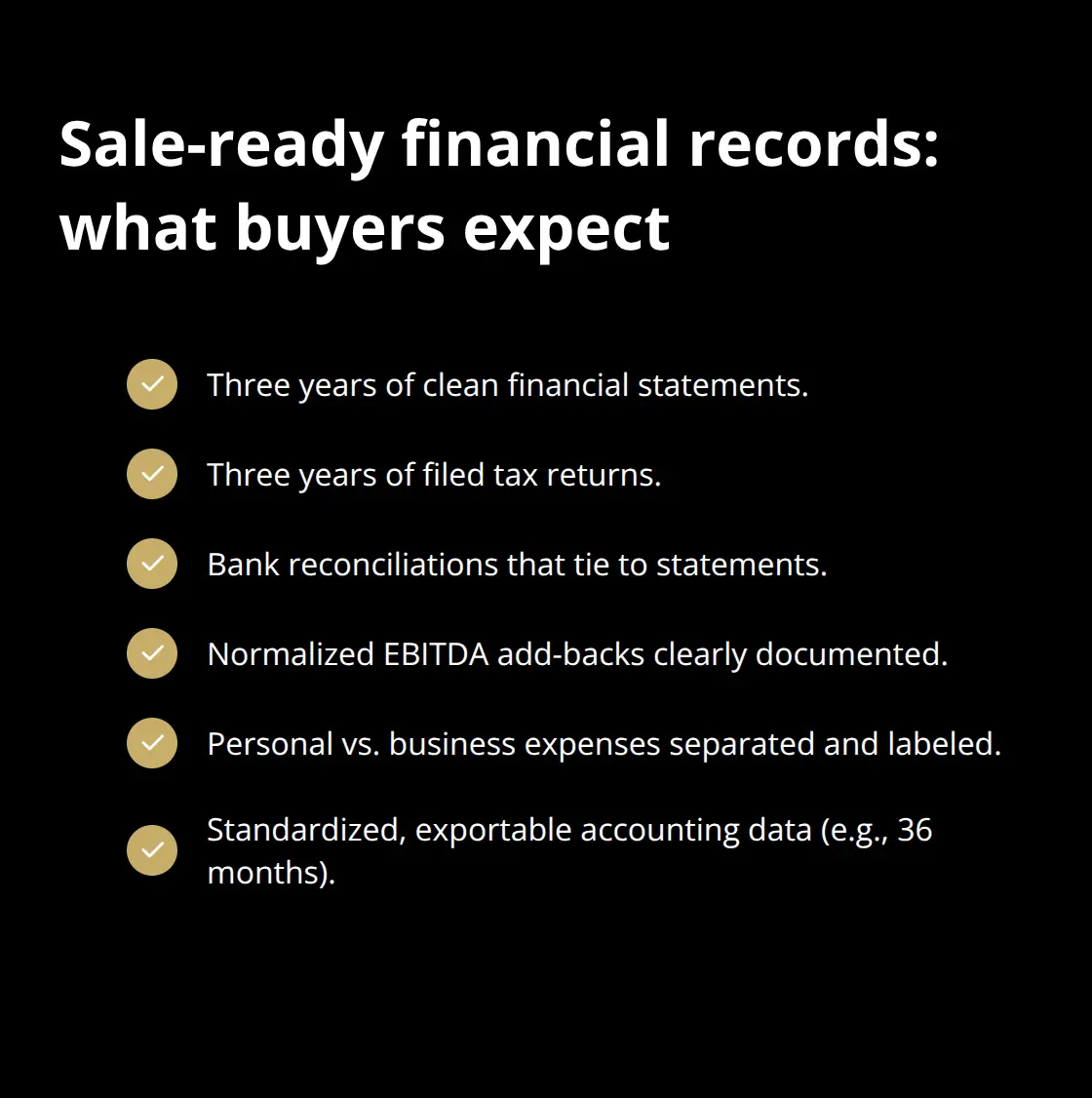
Normalized EBITDA is what matters most to buyers, not your top-line revenue. This means adjusting your earnings to remove one-time expenses, owner compensation that exceeds market rates, rent paid to related parties, or other non-recurring items. If you paid yourself $200,000 annually but a replacement manager would cost $80,000, buyers will adjust your EBITDA down by that difference. Get ahead of this by documenting exactly which expenses are personal versus business operational.
Operational Independence and Customer Concentration
Your operational independence directly affects your valuation. If your business depends on you to close deals, manage key accounts, or run critical processes, buyers see risk. They’ll either pay less or walk away. Start documenting your standard operating procedures, assign responsibilities to team members who can execute without you, and measure how much of your revenue comes from your personal relationships.
The Switzerland structure-where no single customer represents more than 10 to 15 percent of revenue and no single vendor is irreplaceable-makes your business more valuable. Track your customer concentration now and actively work to diversify before you market the business. This shift reduces buyer hesitation and protects your valuation from concentration risk.
Intellectual Property and Defensible Assets
Your intellectual property and assets need to be clearly inventoried and protected. This includes trademarks, patents, proprietary processes, customer lists, software, and domain names. If you’ve built proprietary technology or systems that competitors don’t have, that’s a value multiplier. Document what makes your business different and defensible. Buyers will conduct trademark and patent searches anyway, so ensure everything is properly registered and your ownership is clear.
Recurring Revenue as a Value Multiplier
Recurring revenue is the single biggest value driver in any sale. Businesses with subscription models, service contracts, or long-term customer agreements command higher multiples than those relying on one-off transactions. If your business model is transactional, consider converting customers to annual service agreements or subscription offerings before you sell. This doesn’t require a complete business pivot, just formalizing what customers already expect.
Management Depth and Team Stability
Assess your management depth and team stability now. Buyers want to know the business will function without you and that your team will stay through the transition. High turnover among key staff signals problems. If your best people have left in the past year, address retention now. Document who runs what, create succession plans for critical roles, and demonstrate that your team can operate independently. Your goal is to show buyers a business that runs itself, not one that depends on your daily involvement.
Once you’ve completed this honest assessment, you’ll know exactly where your business stands and what gaps remain. The next step is to take action on those gaps-and that’s where the real value creation happens.
Building Value Before You Sell
The gap between a business that’s ready to sell and one that commands top dollar comes down to execution in the months before you list. Most owners focus on finding a buyer first, then scramble to fix operational problems during due diligence. That approach costs you money. The real work happens now, while you still control the narrative and have time to show buyers a business that runs smoothly and generates predictable cash flow.
Eliminate Operational Dependencies
Operational dependencies destroy valuation. Document every critical process your business relies on, then assign each one to a team member who can execute it without you present. If you’re the only person who closes deals, services your largest accounts, or manages vendor relationships, buyers will demand a discount because the business’s performance depends on your personal involvement.
Create written procedures for your top five revenue-generating processes this month. Test them by stepping back for a week and measuring whether the business runs smoothly. If it doesn’t, you’ve identified exactly what needs fixing before you market the business. This isn’t busywork; it’s the difference between selling at a higher multiple and leaving money on the table.
Convert Transactional Revenue to Recurring Contracts
Transactional businesses command lower multiples than those with recurring revenue. If 60 percent of your revenue comes from annual contracts or subscriptions and 40 percent from one-off sales, buyers see stability. If it’s the reverse, they see risk.
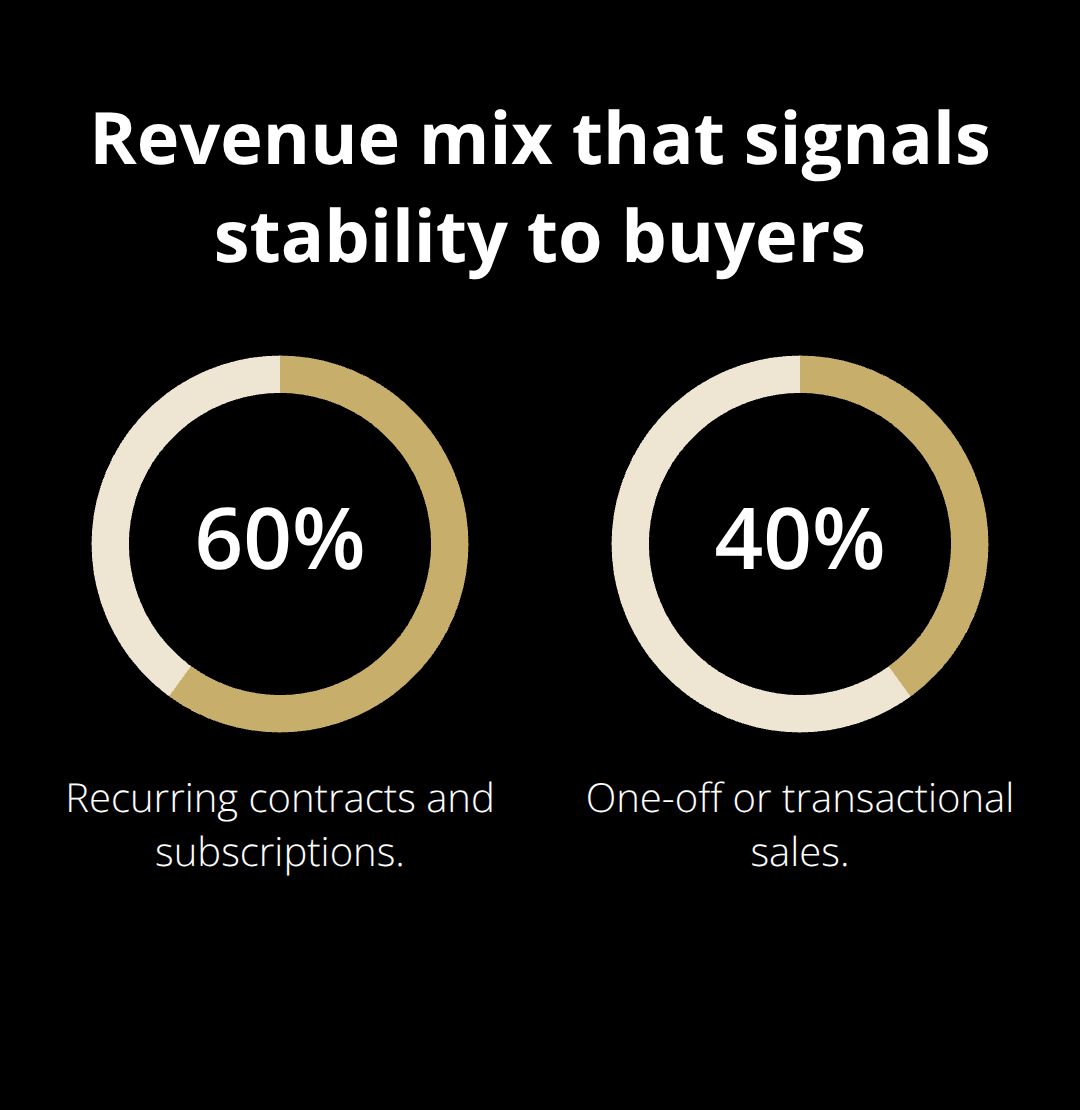
Spend the next 90 days converting your top 20 customers to annual service agreements or subscription models. Offer them a small discount for committing to 12 months of service. This accomplishes two things: it locks in revenue that buyers will value at a higher multiple, and it demonstrates customer loyalty during due diligence. Recurring revenue dramatically boosts business valuation because it creates predictable cash flow and lowers risk for buyers.
Prepare Sale-Ready Financial Records
Get your financial records into sale-ready condition now. Buyers don’t just want three years of tax returns; they want detailed schedules showing customer revenue by account, monthly cash flow trends, and a breakdown of all operating expenses.
If your accountant maintains your books in QuickBooks, export your last 36 months of data and create a clean, standardized set of financial statements. Normalize your EBITDA by documenting every add-back: your salary, related-party rent, one-time legal fees, or bonuses that won’t recur under new ownership. Create a simple spreadsheet showing what you paid yourself, what a replacement manager would cost, and the adjusted EBITDA number. Buyers will perform this calculation anyway, so control the narrative by showing them your analysis first.
Clean financials aren’t optional; they’re the foundation of a credible sale price. With these three areas addressed, your business transforms from a risky acquisition into a predictable, scalable asset that attracts serious buyers willing to pay what your business is actually worth.
Pricing Your Business and Finding the Right Buyer
Set a Defensible Valuation
Getting your valuation right is where most owners stumble. You need a number that’s defensible to buyers, not a wishful guess based on what you think your business should be worth. The Exit Planning Institute found that of 250,000 U.S. companies planning to exit by 2030, only about 14,000 will actually sell at their desired value. The gap between what owners want and what buyers will pay comes down to how well you’ve prepared and how realistic your asking price is.
Start with a professional business valuation from a credible source: a local accounting firm, regional business broker, or investment bank. These firms use current national data on transactions in your industry to establish fair market value based on your financials, growth trajectory, and comparable sales. Don’t rely on online valuation calculators or industry rules of thumb.
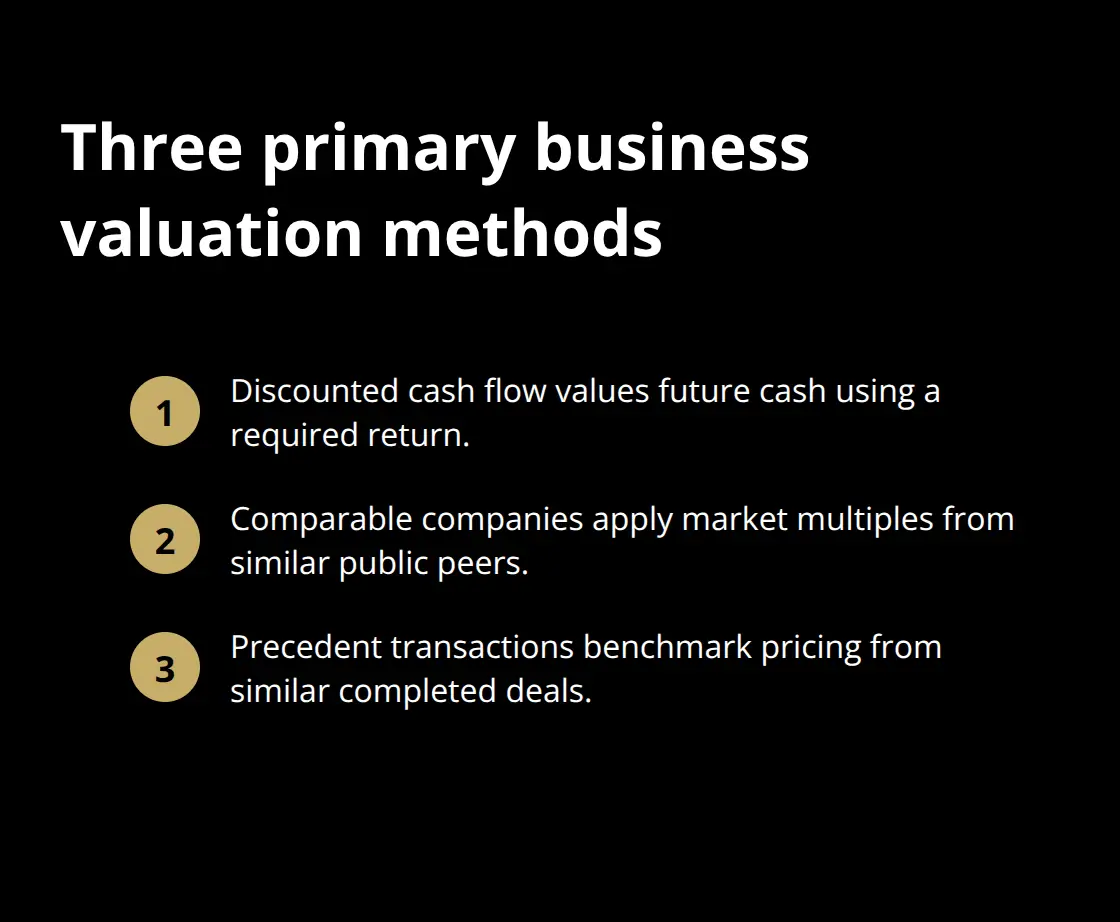
Your valuation should weigh your normalized EBITDA, net assets, management quality, and cash flow, then apply a multiple that reflects your growth potential and market conditions. You’ll encounter three primary business valuation methods: discounted cash flow, comparable companies, and precedent transactions.
Once you have that number, subtract 10 to 15 percent as your initial asking price. This move gives you negotiating room without pricing yourself out of the market. Buyers expect to negotiate down; starting with a defensible price is standard practice and keeps you in the conversation.
Expand Your Buyer Pool with Professional Help
Finding qualified buyers requires a different approach than hoping someone walks through your door. If you market the business yourself, you’ll waste time on tire-kickers and unqualified prospects who can’t actually close a deal. A professional business broker expands your buyer pool significantly, educates prospects on your business’s value, negotiates on your behalf, and improves your odds of finding the right buyer.
According to Sidharth Ramsinghaney at Twilio, buyers today are increasingly sophisticated and diligence processes are more rigorous, making professional preparation and structured transition planning essential. The typical timeline to complete a business sale is 10 to 12 months from buyer selection to closing, though some advisors recommend 18 to 24 months of prep before going to market.
Organize Your Records for Due Diligence
When you do find interested buyers, due diligence is where your preparation pays off. Buyers will request organized financial records for due diligence, customer contracts, vendor agreements, employee information, intellectual property documentation, and tax returns. Have everything in a dedicated data room, organized by category and easily accessible. Messy, incomplete documentation kills deals or tanks your price.
Answer questions directly and don’t volunteer information beyond what’s asked. Your role during due diligence is to demonstrate that your business is exactly what you’ve represented, nothing more.
Navigate Negotiations with Confidence
The negotiation phase tests your nerve. Buyers will ask for price reductions based on findings during due diligence. Expect this and don’t panic. Most negotiations involve some concession on price or terms; the Exit Planning Institute found that roughly 16,000 of the planned exits involve exactly this scenario.
If you’ve built your business on solid fundamentals and documented everything properly, you’ll have leverage to hold your price or negotiate non-financial terms like earnout structures or extended transition periods that benefit you.
Final Thoughts
The owners who succeed in selling their businesses aren’t the ones who stumble into a buyer and hope for the best-they’re the ones who spend months preparing their business, documenting their financials, building recurring revenue, and eliminating operational dependencies before they ever list for sale. According to the Exit Planning Institute, only 14,000 of the 250,000 companies planning to exit by 2030 will actually sell at their desired value, and that gap comes down to execution in the months before you market your business. Clean financial records, a management team that operates without you, and a customer base that isn’t concentrated in a handful of accounts will determine whether you achieve small business sale readiness or leave money on the table.
Common mistakes derail deals constantly: owners overestimate their valuation and price themselves out of the market, they fail to organize financial records and force buyers to dig through chaos during due diligence, they depend too heavily on personal relationships and signal to buyers that the business won’t survive without them, and they underestimate how long the process takes. Avoid these traps by starting your preparation now, not when you’re ready to sell, and by assessing where your business stands against the readiness framework in this roadmap. Identify your biggest gaps and create a 90-day action plan to address them.
If you need professional guidance navigating the sale process, Unbroker offers transparent, low-cost options with no hidden fees and access to a vast buyer network. Whether you handle the sale yourself or work with support, the preparation you do today directly determines the outcome you’ll achieve tomorrow.