Selling your business without a broker used to mean navigating a maze of legal paperwork and expensive attorney fees. We at Unbroker believe that shouldn’t be the case.
With legal templates included in your toolkit, you can handle the core documents yourself while keeping costs down. This introduction walks you through why DIY sales are gaining traction, how templates simplify the process, and the pitfalls to sidestep.
Why More Sellers Are Skipping the Broker
Broker commissions typically run 6–10% of the sale price, which on a $5 million business sale means $300,000 to $500,000 out of your pocket. That’s not a small number, and sellers increasingly question whether the traditional broker model justifies that cost. The frustration is real: you built the business, you know its value, and you watch a significant chunk disappear to intermediaries. Digital platforms now let you reach buyers directly without paying those inflated fees. Sellers who take control of their own sale process keep more of what they’ve earned. The shift toward DIY sales isn’t just about cost savings-it’s about reclaiming ownership of one of the most important financial decisions of your life.
The Misconception About Broker Value
Professional representation does increase sale prices compared to DIY efforts. However, that doesn’t automatically mean you should pay a broker. The real question is whether that premium justifies the commission. On a $5 million sale, a broker might secure $5.5 million instead of $4.5 million, but after you pay $330,000 in commission, you net $5.17 million versus $4.5 million from DIY-only $170,000 more. The value gap narrows when you factor in the actual dollars you keep. Modern platforms eliminate this friction (you gain access to professional tools, buyer networks, and legal templates that brokers once controlled exclusively). You no longer face a choice between saving commission and losing market reach.
Control Over Timing, Terms, and Buyer Relationships
When you sell through a broker, they control the timeline, set the asking price, and filter which buyers you interact with. You become a passenger in your own transaction. DIY selling lets you move at your own pace and negotiate terms that matter to your situation. You decide whether a buyer’s offer works for you without a broker pushing you toward their preferred outcome. You can structure post-closing arrangements like consulting roles or transition employment the way you want them (no intermediary reshaping your deal). You also protect your confidentiality more carefully by controlling who sees what information and when. These details shape the entire outcome of your sale, which is why the next section covers how legal templates remove the biggest obstacle most DIY sellers face: handling the paperwork without expensive attorney fees.
How Legal Templates Protect Your Deal and Cut Costs
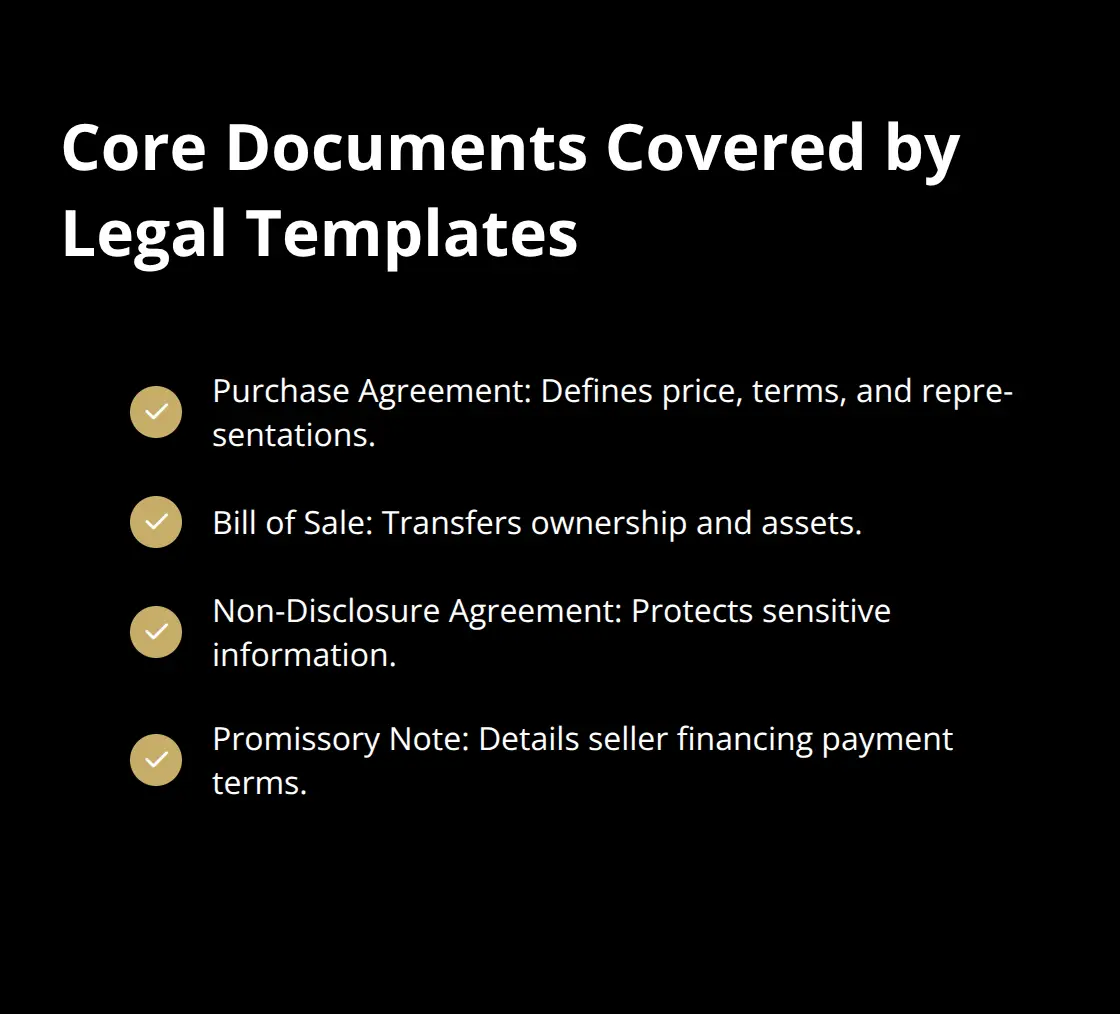
The paperwork in a business sale stops most DIY sellers cold. Without templates, you face two bad choices: hire an attorney at $300–$500 per hour to draft documents from scratch, or use generic forms that miss critical details specific to your business. Legal templates solve this exact problem. A solid template library covers the Purchase Agreement, Bill of Sale, Non-Disclosure Agreement, and Promissory Note-the core documents that protect both you and the buyer. These aren’t generic forms; they’re attorney-crafted and designed to address the real issues that come up in deals: earnout structures, seller financing, and non-compete clauses, transition employment terms, tax allocation, and payout timing.
Using pre-drafted templates cuts your legal prep time from weeks to days. Instead of starting from a blank page, you answer guided questions about your business, sale terms, and state requirements, then download a customized document ready to sign. This approach costs a fraction of traditional attorney fees while keeping the legal foundation solid.
Why Proper Templates Beat Free Online Forms
Many sellers think they can save money by downloading free forms online, but that approach backfires fast. Free templates often miss industry-specific language, fail to address your state’s legal requirements, and leave gaps that create disputes after closing. Sellers who used incomplete documentation faced renegotiations and delays that cost them more in time and lost deal momentum than they saved upfront. Templates from reputable providers with attorney-created forms and ISO 27001 certification give you legal credibility without the $5,000–$10,000 bill for custom attorney work. The key is choosing templates updated regularly to reflect current laws, not relying on outdated forms. When you use proper templates, you also build an auditable trail-board minutes, signed agreements, and clear records-that makes due diligence faster for the buyer and reduces friction during closing. This efficiency matters because every week a deal lingers costs you opportunity cost and buyer confidence.
Structure Deal Terms Beyond the Purchase Price
Templates force you to think through deal structure beyond just price, which is where inexperienced sellers leave significant money on the table. Earnouts, seller financing, consulting arrangements, and non-compete terms are all negotiable and often easier to lock in when you have a professional template spelling out the mechanics. A seller financing structure might let you bridge a valuation gap while earning interest; a consulting role might extend your income and smooth the buyer’s transition. These aren’t afterthoughts-they’re deal components that templates help you implement cleanly. The eSign functionality built into modern template platforms speeds up multi-party execution; you set the signing order and both you and the buyer move through approval in hours rather than days of back-and-forth emails. Document storage features also keep everything organized and accessible, which matters when your CPA or attorney needs to review terms or when the buyer’s legal team requests a complete package.
Move Forward With Confidence
Templates remove the legal friction that stops most DIY sellers before they even start. You gain access to documents that protect your interests without paying attorney rates that eat into your proceeds. The next section covers the mistakes that even well-prepared sellers make-and how to spot them before they derail your deal.
Where DIY Sellers Lose Money Without Realizing It
The gap between what your business is actually worth and what you accept often comes down to three decisions made in the first few weeks of selling. Most DIY sellers price their business 15–25% below market value simply because they lack access to comparable sales data that brokers guard closely. You know your revenue and profit margins, but you don’t know what similar businesses in your industry sold for last quarter or what multiple buyers will pay for recurring revenue versus one-time contracts. This information asymmetry costs you directly. A $3 million business underpriced by 20% leaves $600,000 on the table before you even meet a buyer.
Price Your Business Using Three Concrete Methods
The solution isn’t guessing or using generic valuation calculators. You need to build your valuation on three concrete methods that triangulate a defensible asking price. Start with Comparable Company Analysis by finding publicly traded companies in your space and benchmarking your metrics against their valuations, then adjust downward for size since small businesses typically trade at lower multiples than large ones. Follow that with Discounted Cash Flow analysis, which projects your business’s future earnings and discounts them to present value using a risk-adjusted rate that accounts for your industry and growth trajectory. Finally, research Precedent Transaction Analysis by identifying what similar businesses actually sold for in your region and industry over the past 18 months. The more recent the comparable transactions, the more reliable your pricing becomes.
Vet Buyers Before You Share Sensitive Information
The second money-killer is failing to properly evaluate who you’re actually selling to. You’ll receive interest from tire-kickers, serial acquirers with poor track records, and buyers who can’t actually finance the deal but won’t admit it until weeks into negotiations. Each false lead costs you momentum and creates the illusion of competition when you actually have no serious buyers. Vet ruthlessly before you share sensitive information. Require a signed Non-Disclosure Agreement before you disclose revenue, customer lists, or margins; this weeds out browsers immediately. Request proof of funds or pre-qualification from a lender showing the buyer can actually finance the purchase price you’re asking. Ask direct questions about their timeline, financing sources, and whether they’ve bought businesses before. Buyers serious about closing will answer these questions; those who dodge them aren’t worth your time. Document every conversation and keep detailed notes on each prospect’s credibility signals because you’ll reference these later when you decide who to negotiate with seriously.
Organize Your Documentation Before You List
The final mistake compounds the first two: inadequate documentation that creates friction during due diligence and closing. Buyers request organized financial records, customer contracts, vendor agreements, and tax returns going back three years. Many DIY sellers scramble to gather these or provide incomplete packages that raise red flags and give buyers ammunition to renegotiate downward. Start organizing your documentation now, before you list. Pull three years of tax returns, profit and loss statements, balance sheets, and cash flow statements prepared on an accrual basis, not cash basis. Verify that your accounting separates personal expenses from business expenses so your numbers reflect true business performance. Compile a list of your top 20 customers with contract values and renewal dates; this demonstrates revenue stability. Gather all material contracts, leases, and licensing agreements in one folder. This level of preparation removes friction from due diligence, speeds closing timelines, and signals professionalism that builds buyer confidence. When you present organized, auditable documentation that addresses earnouts and seller financing clearly, buyers see a deal that’s ready to close rather than one requiring months of back-and-forth.
Final Thoughts
Legal templates included in your toolkit eliminate the biggest barrier most DIY sellers face: the cost and complexity of legal documentation. You no longer need to choose between paying a broker $300,000 in commission or hiring an attorney at $500 per hour to draft agreements from scratch. Templates provide attorney-crafted documents customizable to your situation that handle Purchase Agreements, NDAs, earnout structures, and seller financing terms without the traditional legal bill.
Success requires the preparation work covered throughout this post: you must price your business using three concrete valuation methods, vet buyers before sharing sensitive information, and organize your documentation so due diligence moves fast. These steps separate sellers who net significantly more from those who leave money on the table. Digital platforms now provide the tools brokers once controlled exclusively, which means you can reach buyers directly, structure deal terms your way, and keep the proceeds you’ve earned.
Start by organizing your financial records and gathering comparable transaction data in your industry. Use legal templates to build a professional foundation, vet buyers carefully, and document everything. Unbroker offers transparent options designed specifically for DIY sellers, including legal document templates and negotiation assistance at a fraction of standard commission rates.