Selling your business is one of the biggest financial decisions you’ll make. Getting it right requires a structured approach, which is why we at Unbroker have created this guide to exit planning steps.
This article walks you through three critical phases: assessing your business and setting goals, preparing it for sale, and navigating the actual sales process. By following these steps, you’ll move from thinking about an exit to closing the deal with confidence.
Assess Your Business Before You Sell
The first step to a successful exit is understanding exactly what you’re selling and what it’s worth. According to the Exit Planning Institute, 75% of business owners want to exit within the next ten years, yet most never take a hard look at their financial position beforehand. This gap between intention and action costs owners real money.

Start with your last three years of financial statements-your profit and loss statement, balance sheet, and cash flow projections. Focus on your EBITDA, which is what most buyers care about. If your financials are messy or incomplete, clean them up now. Reconcile any personal loans you’ve extended to the business and collect receivables that are past due 90 days or more. Write off what you can’t recover. The cleaner your books, the faster due diligence moves and the less skeptical buyers become. According to the 2023 Q4 Market Pulse Report, 74% of businesses under $500K did no exit planning at all, and that number only improved slightly for larger businesses. This lack of preparation directly impacts valuation and deal terms.
Define Your Exit Timeline and Financial Needs
Set a specific target departure date. Without one, your exit plan has no traction. Five years is the minimum for owners who want to maximize sale value, and ten years is better for owners with complex ownership structures, estate planning needs, or significant operational improvements required. Once you have a date, calculate how much money you need from the sale to meet your financial security goals and retirement plans. This isn’t a full financial plan-work with a financial advisor to get this right-but it forces you to connect your business sale to your personal financial future. Many owners discover their business won’t generate enough proceeds at current valuation, which means you need to identify value-building strategies now. Consider whether you need to diversify your customer base, improve operational efficiency, or develop your leadership team. These moves take time and directly influence what a buyer will pay.
Identify Your Ideal Buyer Profile
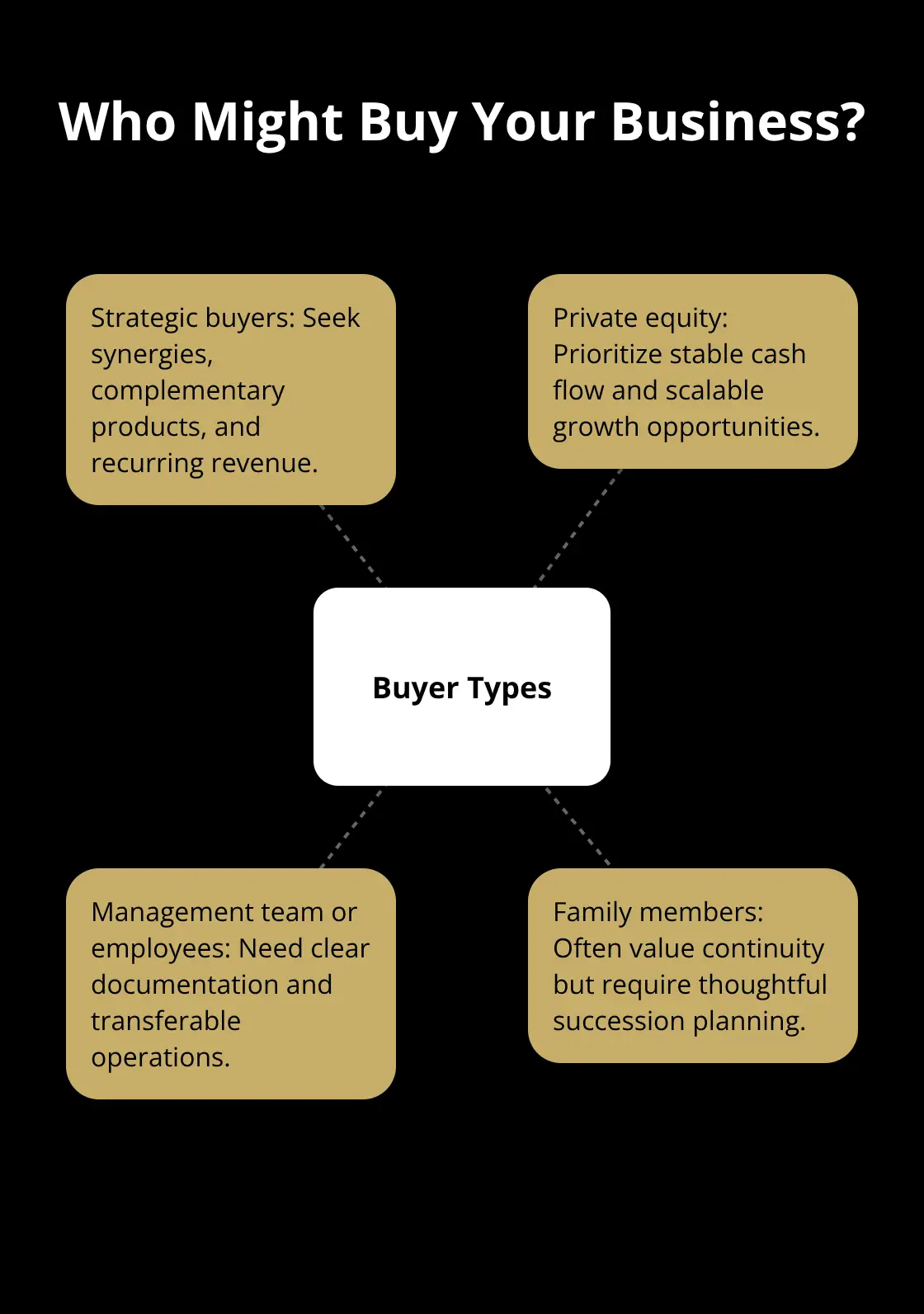
Potential buyers fall into distinct categories: strategic buyers from your industry, private equity firms, internal candidates like your management team, or family members. Each type values different things. Strategic buyers look for ways your business can complement or strengthen their own operations, valuing synergies and recurring revenue. Private equity investors focus on cash flow stability and growth potential. Your management team or employees want clear documentation of how the business runs. Identify your ideal buyer profile early because it shapes everything else-your valuation approach, the information you prepare, and how you market the business. If you’re considering a sale to employees, explore whether an employee stock ownership plan makes sense for your situation.
Establish a Preliminary Valuation
Start with a preliminary valuation to understand where your business stands financially. You don’t need a certified appraisal at this stage, but you do need a realistic sense of value so you can set meaningful financial goals and identify what work remains before you go to market. Three common approaches exist: the asset approach (fair market value of assets minus liabilities), the income approach (present value of projected future cash flows), and the market approach (what similar businesses sold for in the past 3–5 years). A debt capacity analysis can also help you determine a sustainable price for your shares. Once you understand your preliminary valuation, you’ll know whether your financial goals align with what the market will bear-and what preparation steps matter most before you move forward.
Prepare Your Business for Sale
Now that you understand your business’s financial position and preliminary valuation, the real work begins: preparing the business itself for inspection and negotiation. Most owners underestimate how much time this phase takes. The Business Enterprise Institute found that owners typically spend 5–10 years preparing and executing a business transition, and much of that effort happens before a buyer even arrives.
Document Your Operations
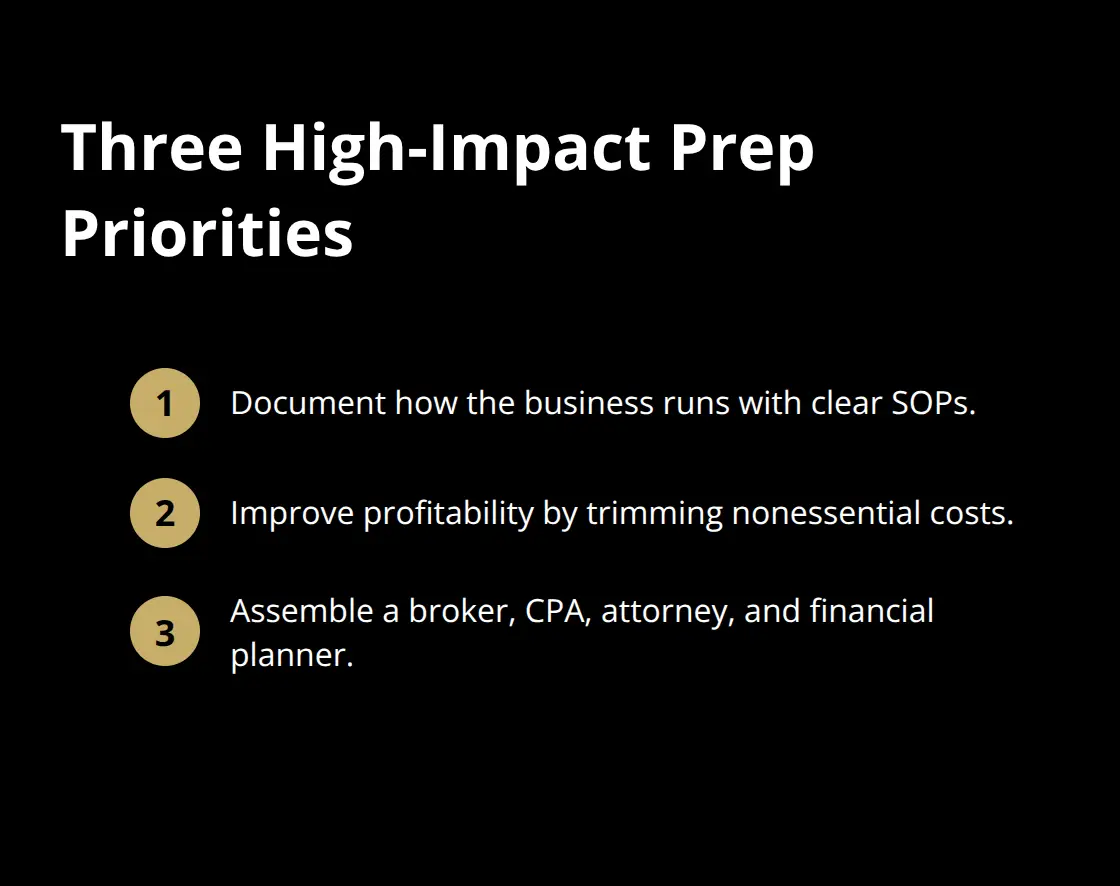
Start with your operational documentation. Write down how your business actually runs-not how you wish it ran. Document standard operating procedures for every critical function: customer onboarding, inventory management, financial reporting, vendor relationships, and decision-making authority. Make these documents clear enough that someone unfamiliar with your business could follow them. This matters because buyers conduct extensive due diligence, and gaps in documentation raise red flags about whether the business can operate without you.
If your customer base depends heavily on personal relationships, this becomes especially important. You need to show that customer relationships can transfer smoothly to new ownership. Identify your top 20 customers and their contract terms. If any customer represents more than 10% of revenue, develop a transition plan that introduces them to the new leadership team before closing. Buyers specifically ask about customer concentration and revenue stability, so addressing this now prevents deal surprises later.
Improve Profitability and Efficiency
Address operational inefficiencies that drag down profitability. Review your expenses from the past two years and identify costs that don’t directly support revenue generation. Can you consolidate vendors, reduce overhead, or eliminate redundant processes? Even small improvements compound: a 5% reduction in operating expenses directly increases EBITDA, which directly increases valuation.
Develop your leadership team aggressively during this phase. If your current management team lacks depth, recruit experienced people or plan to transition key roles before the sale. Buyers want confidence that the business won’t collapse when you leave. Strong internal leadership signals stability and reduces perceived risk in the eyes of potential acquirers.
Assemble Your Advisory Team
Assemble your professional advisory team now-a business broker or investment banker, a CPA familiar with business sales, a business attorney, and a financial planner. These professionals guide valuation, tax strategy, deal structure, and post-sale wealth management. A business broker specifically helps market your business to qualified buyers, negotiate terms that protect your interests, and manage the sales process from listing through closing. This coordination prevents costly mistakes and ensures your exit aligns with both your financial goals and personal priorities.
With your operations documented, profitability optimized, and advisory team in place, you’re ready to move into the final phase: actually marketing your business and navigating the sales process itself.
Navigate the Sales Process and Close the Deal
Once your business is prepared, marketing it to qualified buyers becomes your focus. Your broker or investment banker should have access to a network of strategic buyers, private equity firms, and other potential acquirers. Most brokers use buyer databases and industry connections to identify serious prospects, but the quality of your marketing materials matters enormously.
Prepare a confidential information memorandum that tells your business story: revenue trends, customer retention rates, growth drivers, and competitive advantages. Buyers need this narrative to understand why your EBITDA deserves premium valuation. Many owners cast too wide a net, creating deal noise that wastes everyone’s time. Instead, target 20 to 30 qualified buyers who genuinely fit your business profile. Strategic buyers from your industry typically move fastest and pay the highest multiples because they see operational synergies you might not. Private equity investors move slower but offer certainty of funding. Your broker filters prospects and fields initial inquiries, which keeps your business confidential while testing the market. This phase typically lasts 60 to 90 days. If you’re not fielding multiple offers at week twelve, your price is too high or your marketing isn’t reaching the right audience. Adjust quickly rather than waiting.
Structure Offers and Manage Negotiations
When offers arrive, structure matters as much as price. A buyer offering 6x EBITDA in all cash differs dramatically from one offering 5.5x EBITDA with 40% contingent on future performance. Evaluate total proceeds, not just headline price. An earnout spreads your proceeds over years, which offers tax advantages and steady cash flow, but it also ties you to the business post-sale and introduces collection risk if the buyer underperforms. Consider an equity rollover if you want to participate in the acquiring company’s future growth, though this adds complexity. Negotiate aggressively on working capital adjustments, non-compete terms, and representations and warranties insurance. These details shift thousands of dollars between buyer and seller. Your attorney must review every provision. Due diligence happens simultaneously with negotiation. Buyers request access to financial records, customer contracts, employee agreements, intellectual property documentation, and operational systems. Organize these materials in a virtual data room before buyers ask. Slow responses to information requests signal weakness and kill deals. Respond within 48 hours. If a customer contract requires consent to transfer ownership, address this early. Buyers conduct customer calls to verify revenue and satisfaction. Prepare your top customers for these conversations and brief them on why you’re selling. Transparency prevents surprises that crater deals at the last moment. Most businesses close within 90 to 120 days from signed letter of intent to final closing, so momentum matters. Your advisory team coordinates legal work, tax planning, and financial mechanics to keep the timeline tight.
Finalize Legal Agreements
The purchase agreement is where all deal terms become binding. This document specifies purchase price, payment structure, representations and warranties, indemnification provisions, and post-closing obligations. Your attorney negotiates every clause. Standard representations cover financial accuracy, legal compliance, customer contracts, and absence of undisclosed liabilities. Indemnification protects the buyer if representations turn out to be false after closing. Many sellers resist indemnification caps and baskets, but reasonable limits are market standard. A basket of 0.5% to 1% of purchase price is typical, meaning small claims don’t trigger indemnification. Consider representations and warranties insurance, which typically ranges from 3% to 4% of the insured amount but protects you from post-closing claims that could otherwise come from your pocket. Closing mechanics include wire transfers of proceeds, signing of legal documents, delivery of assets, and transfer of licenses or permits. Your CPA coordinates tax reporting and ensures the deal structure minimizes your tax burden. Some sellers structure installment sales to spread income recognition across years, reducing your tax bracket impact. If you retained an equity stake, your financial advisor helps you understand your new role as partial owner and ongoing shareholder. After closing, you may have a transition period of weeks or months where you answer questions or train the new leadership team. Document this commitment clearly in the purchase agreement so expectations align. Post-sale cash flow planning is essential to cover ongoing costs and service any remaining debt obligations.
Final Thoughts
You’ve now walked through the complete exit planning steps from initial assessment through closing the deal. The path from deciding to sell your business to signing final documents requires discipline, professional guidance, and realistic timelines. Most owners underestimate how much preparation matters-the businesses that sell fastest and command premium valuations aren’t the ones with the highest revenue, but rather the ones with clean financials, documented operations, strong leadership teams, and clear customer relationships.
Your advisory team (broker, attorney, CPA, and financial planner) isn’t optional. These professionals coordinate valuation, tax strategy, deal structure, and post-sale wealth management in ways that protect your interests and maximize proceeds. They handle the operational details that trip up unprepared sellers: data room organization, customer communication, due diligence responses, and legal negotiations. Without this coordination, deals stall or collapse.
We at Unbroker understand that selling a business shouldn’t require paying traditional brokerage fees that eat into your proceeds. Our Full Service and Assisted Business Sale programs offer transparent, low-cost options that give you access to a vast buyer network and professional tools without hidden costs. Start your exit planning now-the time you invest today directly translates to confidence, speed, and proceeds when you’re ready to close.