Selling a service business is fundamentally different from selling a product company. Buyers care about client relationships, recurring revenue, and whether your business can run without you-not just your balance sheet.
At Unbroker, we’ve seen too many service business owners lose deals because they didn’t understand what buyers actually value. This guide walks you through valuation, preparation, and transparent pricing so you can sell on your terms.
What Buyers Actually Pay For in a Service Business
The Cash Flow Metric That Matters Most
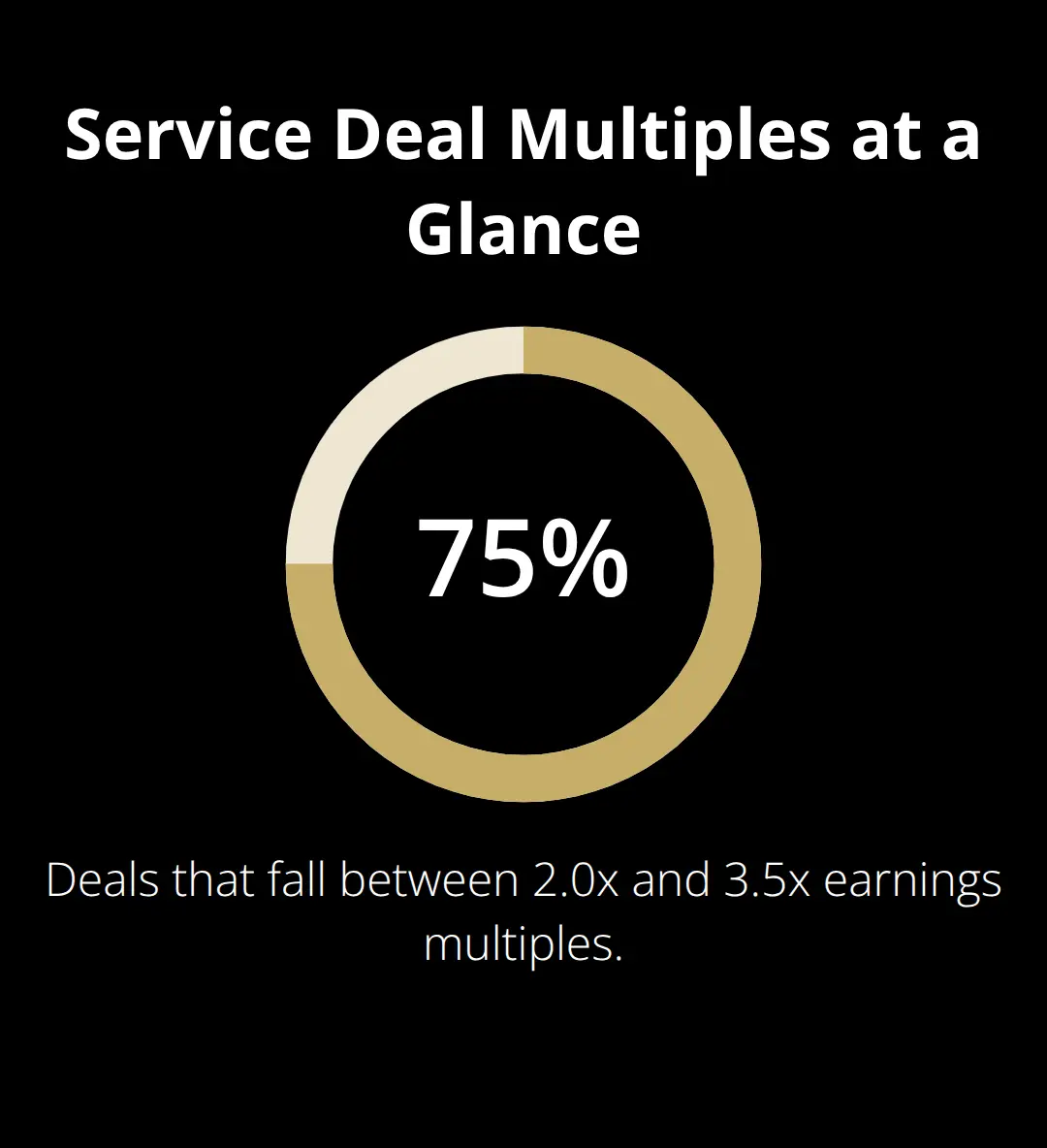
Service business valuation works nothing like selling a product company, and most owners misunderstand it completely. Buyers ignore your fancy office or equipment inventory. They focus on one thing: predictable cash flow they can count on after you leave. According to BizBuySell data, the average service business sells for 2.40x earnings, with roughly 75% of deals falling between 2.0x and 3.5x earnings multiples. This means a service business generating $100,000 in annual earnings typically sells for $200,000 to $350,000.
The metric that matters most is normalized earnings, which strips out owner perks and one-time expenses to show what a new owner can actually pocket. Gather three years of financial documents and work with an accountant to calculate this properly, because buyers will verify every number you claim. Revenue multiples matter less-they typically range from 0.4x to 1.5x with a median of 0.78x-but they become relevant when your business lacks consistent earnings data.
Recurring Revenue Commands Premium Prices
The real differentiator is whether your revenue comes from recurring clients or one-off projects. Recurring revenue commands higher multiples because buyers see it as lower risk. If you’ve built a book of business that renews automatically, that’s worth significantly more than the same revenue from sporadic contracts.
What separates a $200,000 valuation from a $350,000 one comes down to operational independence and documentation. Buyers will depress your multiple if they see you’re the business-meaning clients only work with you personally and operations fall apart without your involvement. Create documented systems, write operating manuals, and ideally transition some client relationships to your team before listing.
Location, Retention, and Lead Generation Drive Value
Location matters for some service businesses; a plumbing company in a dense urban area with high barriers to entry commands more than one in a declining town. Customer retention is another critical factor. If 80% of your clients renew annually, that’s worth far more than 40% renewal. Document this explicitly.
A business with ad hoc marketing and no repeatable pipeline depresses multiples significantly, while one with a proven lead generation system attracts multiple buyers willing to pay premium prices. Unfavorable lease terms or vendor lock-in also hurt value. Clean contracts and flexibility increase buyer confidence.
Operational Independence Determines Your Final Price
The goal is making your business look like a turnkey operation, not a one-person show dependent on your personal relationships and hustle. Buyers assess whether the business can function without you, and they pay accordingly. The stronger your systems and team, the higher your multiple and the faster your sale closes. This operational strength directly impacts how transparent and straightforward your pricing can be during negotiations-a well-run business with clear financials attracts buyers who respect honest deal structures and avoid surprises.
Getting Your Records Sale-Ready
Most service business owners think preparing for sale means sprucing up the office and writing a polished pitch. That’s backwards. Buyers spend weeks forensically examining your financial records, client contracts, and operational systems. If your documentation is a mess, you’ll either lose the deal or watch your valuation crater.
Pull Three Years of Complete Financial Records
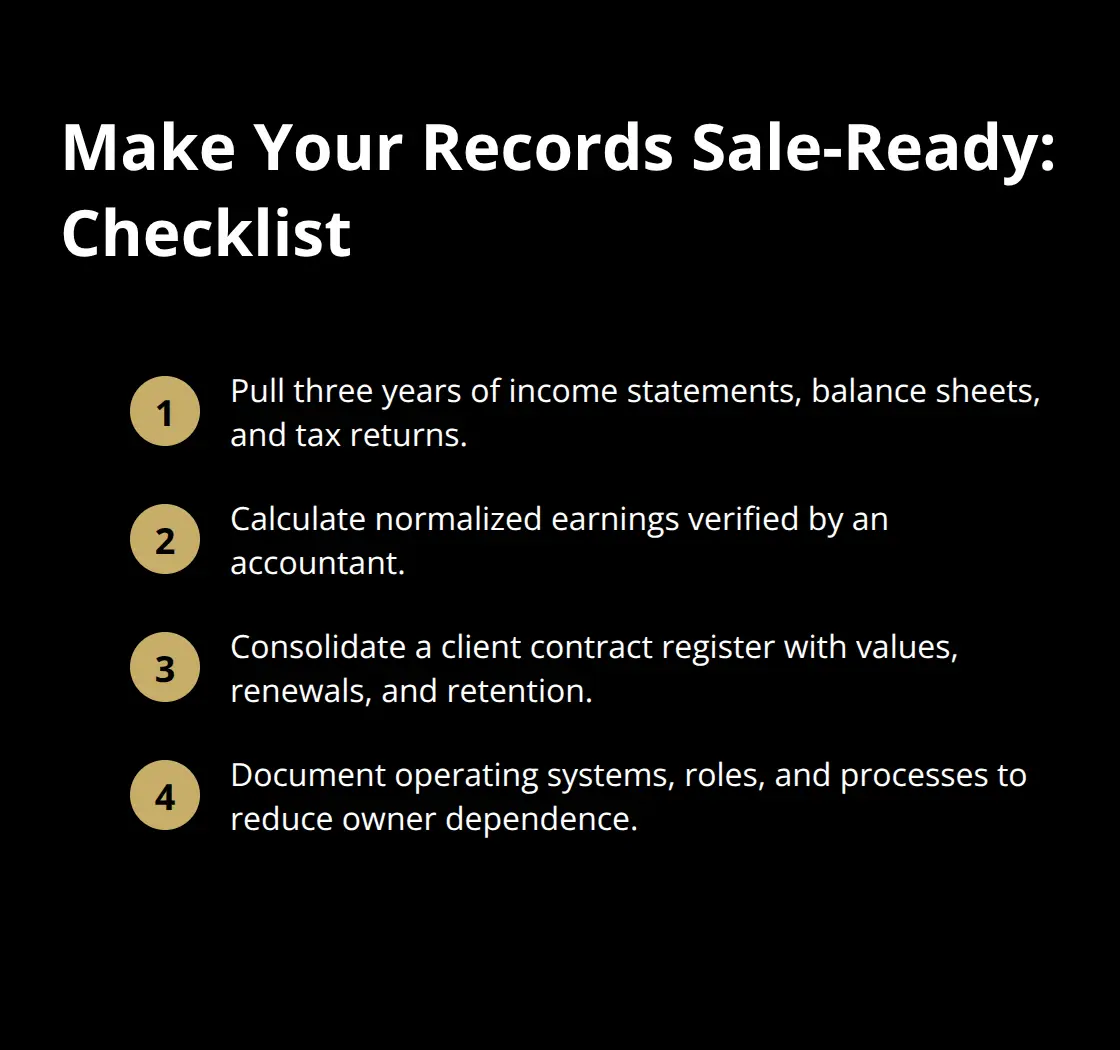
Start by gathering three years of complete financial records: income statements, balance sheets, and tax returns. An accountant needs to verify every number and calculate your normalized earnings, which removes one-time expenses and owner perks to show what a buyer actually inherits. Buyers will verify every claim you make, so accuracy matters more than optimism here.
Document Your Client Relationships and Revenue Streams
Create a detailed client contract register listing every active client, contract value, renewal date, and whether the relationship is recurring or project-based. Buyers want to see exactly which revenue is locked in and which could vanish. If you track client retention rates, document that too. Many service business owners keep this information scattered across email, spreadsheets, and memory. Consolidate everything into a single document with clear dates, amounts, and terms.
Build Systems That Operate Without You
Building systems that operate without you is not optional if you want a serious buyer. Document every major process: how you onboard clients, deliver services, handle billing, manage staff, and generate leads. Write simple operating manuals for each role, not because you love bureaucracy, but because buyers view owner-dependent businesses as riskier and discount them accordingly. If a client only works with you personally, work on transitioning at least some relationships to a team member before listing.
Clean Up Contracts and Operational Agreements
Unfavorable lease terms or vendor contracts that lock you in also depress value, so review those agreements and flag any red flags for your attorney. When buyers see clean, organized documentation and operations that function without you at the helm, they move faster and negotiate less aggressively on price. They also respect transparent deal structures and avoid introducing hidden fees or surprise demands during closing.
The businesses that sell fastest and for the highest multiples are the ones where financial records tell a consistent story and systems prove the business can survive and thrive under new ownership. With your records organized and your operations documented, you’re ready to navigate the actual sales process-where pricing transparency becomes your competitive advantage.
Selling Without Surprises
Hidden fees during a service business sale kill deals faster than almost anything else. When a buyer discovers unexpected charges buried in closing costs, legal fees, or broker commissions halfway through negotiations, trust evaporates. They start questioning everything you’ve disclosed, second-guessing your financial records, and often walk away entirely. The damage extends beyond losing a single offer: word spreads, your reputation suffers, and subsequent buyers approach negotiations with skepticism. Sellers who list their true costs upfront and break down every fee into clear, itemized components close faster and command better prices. Buyers respect transparent fee disclosure because it signals confidence in your business and removes the anxiety that accompanies discovering surprises at closing.
What Buyers Actually Expect to Pay
Service business sales typically involve multiple cost categories that must be disclosed clearly. Broker commissions in service business sales run 8 to 10 percent of the final sale price, making this your largest expense. Legal fees for contract review and closing documents typically range from $2,000 to $5,000 depending on complexity. Accounting fees for preparing normalized earnings statements and tax documentation usually cost $1,500 to $3,000. Due diligence expenses, including client verification and operational audits, can add another $1,000 to $2,500. Transfer taxes, recording fees, and escrow services vary by location but should never surprise you if documented upfront. Most sellers treat these costs as negotiable at closing rather than transparent from day one. Itemize every anticipated expense before you list, include it in your asking price discussion, and show buyers exactly where their money goes. When you present a $500,000 business with a clear breakdown showing $75,000 in brokerage fees, $3,000 in legal costs, and $2,000 in accounting fees, buyers understand the math and rarely object. The same buyer facing a vague quote that later reveals hidden charges becomes hostile.
How to Structure Transparent Deal Terms
Request itemized quotes from every service provider involved in your sale: your broker, your accountant, your attorney, and any consultants handling due diligence. Compare these quotes side by side, flagging inconsistencies and price gaps that suggest hidden costs. Insist on written agreements that specify exactly what’s included and what would trigger additional charges. For broker services, clarify whether the commission covers marketing, buyer outreach, negotiation support, and closing coordination or whether certain activities cost extra.
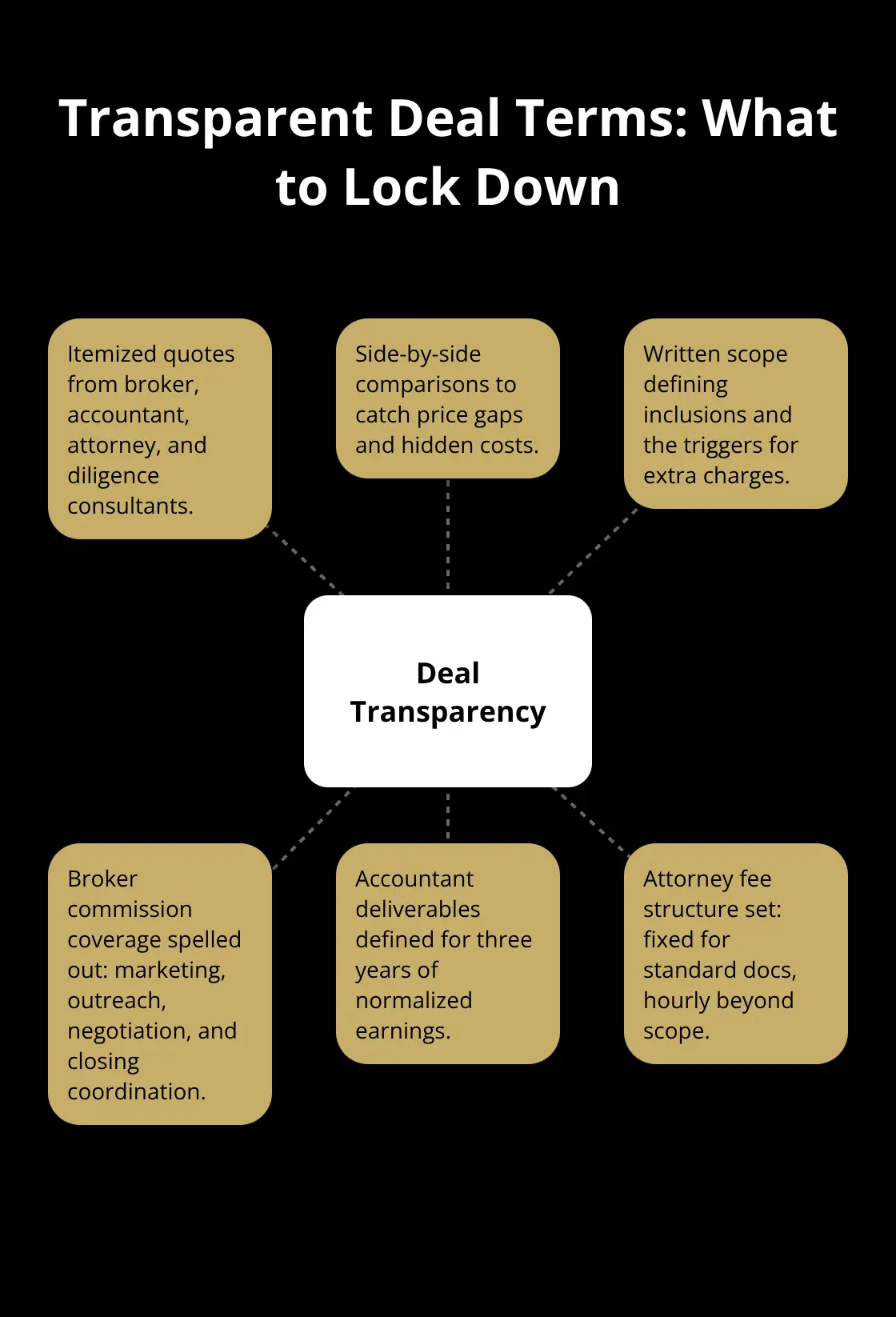
With your accountant, confirm whether normalized earnings preparation covers three years of statements or whether additional analysis costs more. Your attorney should provide a fixed fee for standard closing documents with a clear hourly rate for any additional work beyond scope. Create a formal closing statement template that documents every selling cost as a deduction from your sale price, reducing your taxable gain. This document becomes your proof that charges were legitimate business expenses, keeping buyers honest and protecting your tax position. Adopting transparent pricing principles for your business sale builds credibility and confidence with potential buyers.
Negotiating Without Letting Buyers Introduce Hidden Costs
During negotiations, buyers will try to shift costs onto you or introduce unexpected demands disguised as closing conditions. A common tactic involves requesting that you cover the buyer’s legal fees, accounting costs, or financing charges as a condition of sale. Document every such request and evaluate it against your original asking price. If a buyer wants you to pay $3,000 in their legal fees, that’s equivalent to reducing your sale price by $3,000. Make that explicit in your counteroffer rather than accepting it as a separate line item that feels less painful. Establish a clear point of contact with your broker or attorney who handles all buyer communications, preventing miscommunication and surprise demands that arrive through informal channels. Specify in your purchase agreement exactly which costs the seller covers and which the buyer covers, leaving no ambiguity. Many service business sales involve earnest money deposits held in escrow; confirm upfront who pays escrow fees and whether those costs come from the deposit or are charged separately. Request references from clients in your industry who’ve sold similar businesses, asking them specifically about unexpected costs that arose during closing. A professional partnership with your broker and advisors should protect you from surprises, not create them. If your broker, accountant, or attorney cannot clearly explain every cost and how it benefits you, find someone who can.
Final Thoughts
Selling a service business without hidden fees requires three core actions: understand what buyers actually value, prepare your business to prove that value, and maintain transparency throughout the sale. Buyers pay for predictable cash flow and operational independence, not your personal relationships or effort invested. When you document normalized earnings, client retention rates, and systems that function without you, serious buyers pay fair multiples-the average service business sells for 2.40x earnings, but that multiple rises significantly when records tell a consistent story.
Preparation separates owners who sell quickly at premium prices from those who struggle through lengthy negotiations. Three years of organized financial records, a detailed client contract register, and documented operating systems eliminate buyer skepticism and reduce the forensic examination period. Clean contracts and transparent cost structures signal confidence in your business and remove the anxiety that accompanies discovering surprises at closing.
Hidden fees destroy deals faster than almost anything else. When you itemize every anticipated cost upfront (broker commissions, legal fees, accounting expenses, due diligence charges), buyers understand the math and rarely object. We at Unbroker help you sell a service business with transparent, low-cost options that eliminate high brokerage fees and surprise demands at closing.