Brokers rarely show you how they arrive at their valuations. At Unbroker, we’ve seen countless sellers accept lowball offers because they didn’t understand the valuation secrets hidden in broker calculations.
Most brokers use methods that favor their commissions over your actual business value. This guide reveals what they don’t want you to know.
How Brokers Actually Price Your Business
Brokers rely on five primary valuation methods, but they rarely explain which one they’re using or why it matters to your bottom line. The most common approach is the earnings multiplier method, where a broker takes your annual net profit and multiplies it by an industry standard-typically between 3 and 6 for small businesses. A service business with $200,000 in annual profit might be valued at $800,000 to $1.2 million using this method alone. The problem is that brokers often cherry-pick comparables to justify higher multiples, then pocket the difference through inflated listing prices. When no buyer emerges at that inflated price, they pressure you to lower it, making the original valuation look credible while their commission stays intact.
The discounted cash flow method, which projects future earnings and discounts them to present value, should theoretically be more rigorous. Yet brokers frequently apply discount rates of 8–10% that understate risk, artificially inflating valuations. If a broker assumes your business will generate $100,000 annually for five years at a 10% discount rate, they’ll claim a value around $379,000-but change that discount rate to 15% to reflect actual small-business risk, and the value drops to $336,000. Most brokers won’t explain this sensitivity to you because higher discount rates mean lower valuations and lower commissions.
The Commission Trap Built Into Valuations
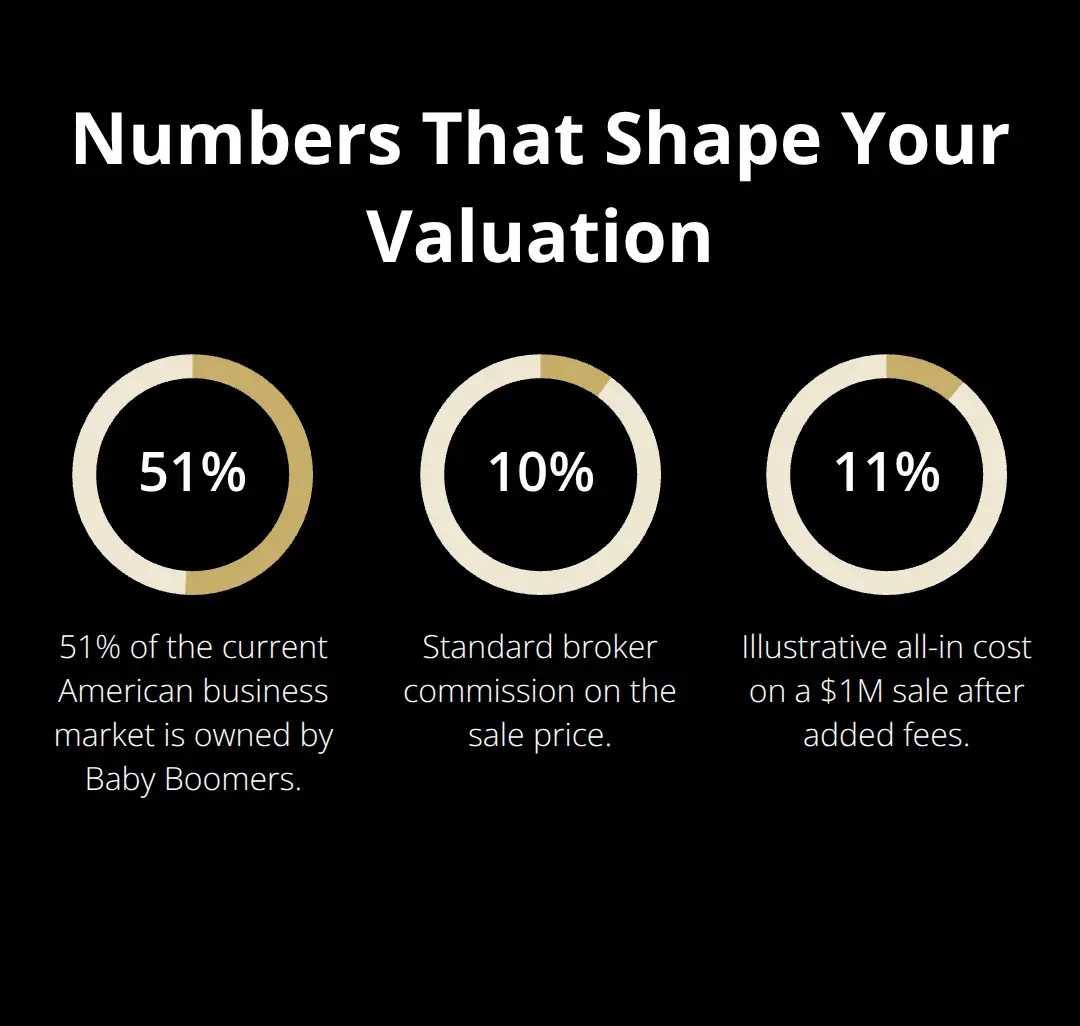
Here’s what brokers won’t tell you: their commission structure incentivizes overvaluation. A typical broker charges 10% of the sale price, meaning a $1 million sale nets them $100,000 while a $900,000 sale nets $90,000. That $10,000 difference motivates them to list your business high, even if the market won’t support it. A veteran business broker has stated that only about 1 in 15 small businesses are actually sellable in their current form, yet brokers will list almost anything if you’re willing to pay their upfront marketing fees. When your business sits on the market for 120 days without offers, the broker suggests lowering the price-conveniently back toward what the valuation should have been originally. You’ve now wasted four months while the broker collected marketing fees and established themselves as your advisor.
Why Revenue Multiples Mislead
Brokers frequently value businesses using revenue multiples-applying an industry factor to your gross revenue rather than your profit. A software company generating $2 million in revenue might be valued at 3 to 5 times that amount, suggesting a $6 million to $10 million valuation. Two problems emerge immediately. First, a business with $2 million in revenue and 5% profit margin is worth far less than one with 25% profit margin, yet the multiple approach treats them identically. Second, brokers apply multiples selectively. They’ll cite high multiples from successful public companies or recent acquisitions while ignoring the thousands of small businesses that sold at 1 to 2 times revenue because they lacked growth, stability, or owner independence.
What Buyers Actually Value
Your business needs consistent profitability, documented systems, and the ability to operate without you-qualities most small businesses lack. If your business depends entirely on your personal relationships and daily involvement, buyers will discount the valuation significantly because the business value disappears when you leave. This owner-dependency problem affects how brokers should calculate your true market value, yet many brokers ignore it when setting initial listing prices. The gap between what a broker lists your business for and what a buyer will actually pay often reflects this fundamental misalignment.
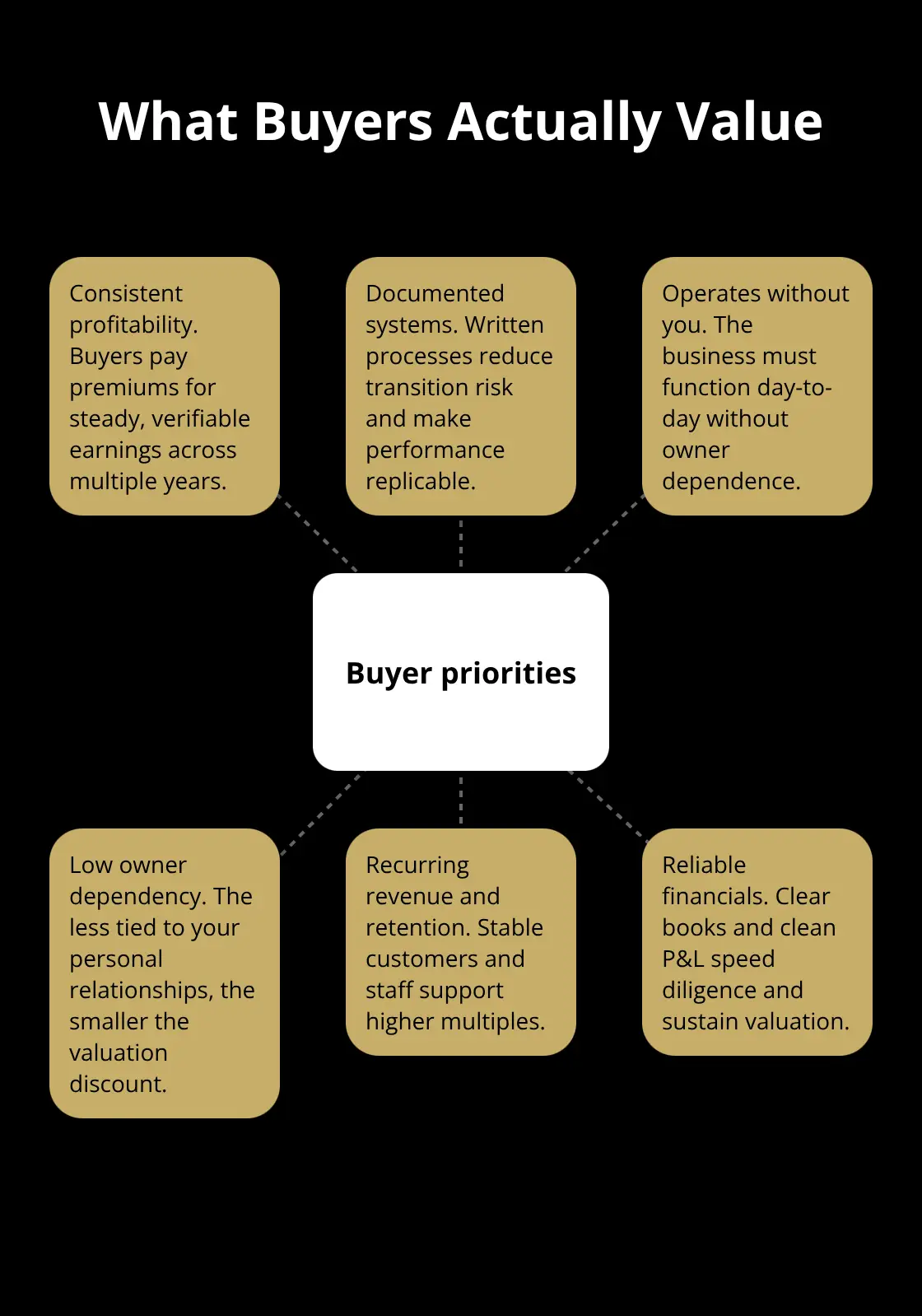
Understanding this gap is essential before you accept any broker’s valuation or agree to their marketing approach.
How Brokers Justify Wildly Different Valuations
When you contact three different brokers about selling your business, you’ll often receive three drastically different valuations. One broker values your $500,000-revenue service firm at $1.2 million using a 2.4x revenue multiple. Another applies a 3.5x multiple and claims $1.75 million. A third uses discounted cash flow, assumes 12% annual growth, and lands on $950,000. None of them will explain why their method beats the others or acknowledge that their chosen approach directly inflates or deflates the number in their favor. This inconsistency isn’t accidental-it’s how brokers position themselves as the expert while keeping you confused enough to accept their listing price without pushback. The real problem surfaces when you realize that brokers select methodology after seeing your financials, not before. They reverse-engineer the valuation to justify a higher listing price, knowing that even if the business sits unsold for months, they’ve already collected marketing fees and established credibility with you.
The Methodology Shell Game
Brokers switch valuation approaches depending on what serves their interests. If your business has strong revenue but modest profit margins, they’ll emphasize revenue multiples and ignore profitability. If your profit is solid but revenue is flat, they’ll suddenly pivot to earnings multiples or discounted cash flow to highlight bottom-line strength. The Exit Planning Institute found that 51% of the current American business market is owned by Baby Boomers, who are set to transition over the next zero to ten years, meaning most sellers have never compared valuation methodologies and can’t spot when a broker cherry-picks the approach that produces the highest number. Ask two brokers why they chose their specific method, and you’ll hear two entirely different justifications-one citing industry standards, another claiming their proprietary model accounts for market conditions. Neither will admit that the earnings multiplier method produces a higher valuation than discounted cash flow when applied to the same business, or that switching to an asset-based approach might reveal your valuation is actually 30% lower. Demand written documentation of the valuation methodology before you sign anything. A broker who resists providing this transparency signals that the number isn’t defensible.
Fee Structures That Hide True Costs
Brokers obscure their total cost through layered fees that don’t appear until late in the process. The standard 10% commission on the sale price is only the beginning. Many brokers also charge upfront marketing fees ranging from $2,000 to $10,000 to list your business, create marketing materials, and conduct initial outreach. Some add success fees if they locate a buyer, transaction fees for closing coordination, or consulting fees if you need guidance during negotiations. A seller expecting a $1 million sale and paying 10% commission thinks they’re spending $100,000. In reality, they’ve also paid $5,000 upfront for marketing, $2,000 for transaction coordination, and $3,000 for seller consulting, raising the true cost to $110,000 or 11% of the sale price. Brokers present these fees separately so the 10% commission appears reasonable in isolation. Request an itemized fee schedule showing every possible cost before you engage. If a broker can’t produce a written fee schedule without equivocation, that hesitation reveals they’re counting on you not asking hard questions.
The Comparable Company Trap
Brokers cite comparable sales to justify their valuation multiples, but they select comparables to support their predetermined number rather than to establish an objective market range. A broker valuing your plumbing company at 4x EBITDA will reference three recent plumbing acquisitions that sold at 4x while ignoring the seven that sold at 2.5x because they lacked recurring revenue or had higher owner-dependency. They present the high-multiple comparables as representative of the market, when they actually represent the best-case scenarios. IRS Revenue Ruling 59-60 requires considering all three valuation approaches and using a rigorous, reconciled process rather than a simple average, yet brokers regularly ignore this standard and cherry-pick data. Request that your broker provide the complete universe of comparable sales in your industry over the past 24 months, not just the three that support their valuation. Ask them to explain why certain comparables were excluded and what percentage of those comparables actually sold at the multiple they’re claiming. A broker who can’t defend every comparable in their analysis is building the valuation on sand.
What Transparency Actually Looks Like
The contrast between traditional brokers and modern platforms becomes clear when you examine how each handles valuation disclosure. Traditional brokers bundle methodology, fees, and comparables into a single package that resists scrutiny. Modern platforms separate these components and present them clearly. You see the valuation method upfront, understand the fee structure without surprises, and access the data that supports the number. This transparency allows you to compare valuations across multiple sources and spot when a broker is cherry-picking methodology. Understanding how broker networks operate reveals why many resist this level of openness. When you move forward with a sale, you’ll know exactly what you’re paying and why the valuation makes sense. The next section reveals the specific questions you should ask any broker or platform to uncover whether they’re operating with genuine transparency or hiding behind industry jargon.
How to Verify Your Business Value Before Talking to Brokers
You need independent verification before a broker’s valuation becomes your anchor. Start by calculating your discretionary cash flow, which differs from accounting profit. Take your net profit and add back owner-specific expenses-your salary, vehicle lease, health insurance, or any personal expenses the next owner won’t carry. If your business produced $150,000 in net profit but you paid yourself $80,000 in salary plus $12,000 in personal expenses, your actual discretionary cash flow is $242,000. This number matters because buyers value what the business produces after they take over, not what it produced when you ran it. Most brokers won’t walk you through this calculation; they’ll use your reported net profit instead, which artificially deflates your valuation. Calculate this figure yourself using your last three years of tax returns and P&L statements.
Next, research actual sales of comparable businesses in your industry using public databases. The SBA tracks business sales data, and industry associations often publish transaction multiples for their sectors. If you own a dental practice, dental-specific brokers publish that practices in your region sold between 0.75x and 1.2x annual revenue depending on patient retention rates and staff stability. Cross-reference these ranges against what brokers tell you. A broker claiming your dental practice is worth 1.8x revenue when the market standard is 0.9x is either misrepresenting the market or your business has exceptional qualities they haven’t documented.
Ask Brokers These Specific Questions
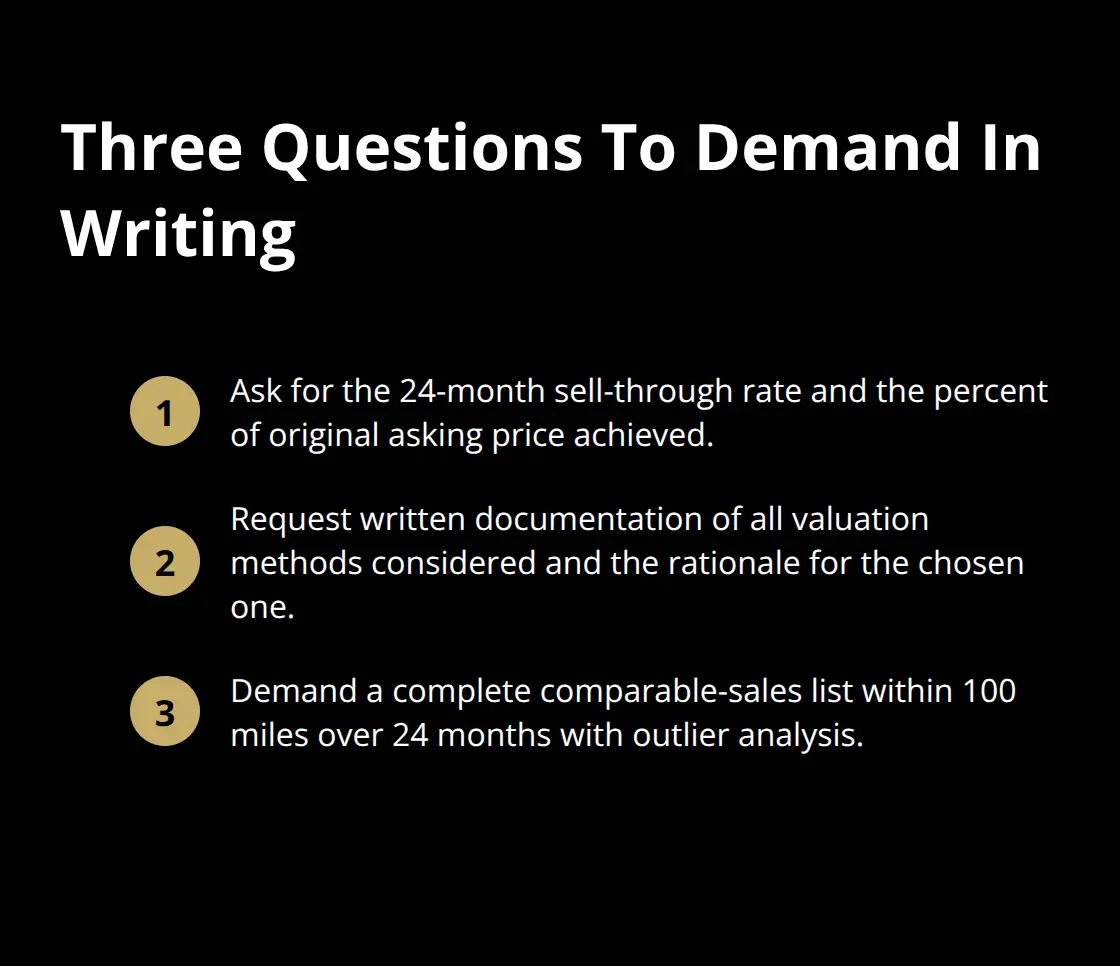
Demand written answers to three non-negotiable questions before you sign anything. First, ask: What percentage of businesses you listed in the past 24 months actually sold, and at what percentage of the original asking price? A broker claiming 85% sell-through rates is either extremely selective about what they list or inflating their success metrics.
Industry data suggests most brokers sell 40-60% of their listings, with the remainder delisted unsold. If a broker won’t provide this number in writing, their track record won’t withstand scrutiny.
Second, ask them to document every valuation method they considered for your business, explain why they rejected the others, and provide the written rationale for their chosen approach. This forces them to defend their methodology rather than present it as gospel. Third, request a complete list of comparable business sales data they’re using-not just the three that support their valuation, but every transaction in your industry over the past 24 months within a 100-mile radius. Ask them to identify which comparables sold above their stated multiple and which sold below, then explain why the outliers don’t represent your business.
A broker who resists providing this documentation in writing operates without transparency by design. Insist on email responses so you have proof of what they claimed. During conversations, brokers sound authoritative and confident, but written documentation exposes gaps in their reasoning. One final question: Do you charge any fees beyond the commission, and can you provide an itemized breakdown of every possible cost I could incur? This prevents the surprise fees that materialize weeks into the process.
Calculate Your Own Valuation Range
Use the earnings multiplier method yourself to establish a baseline. Take your discretionary cash flow and multiply it by 3, 4, and 5 to create a range. If your discretionary cash flow is $200,000, your valuation range spans $600,000 to $1 million. This range represents what typical buyers in your industry might pay, assuming your business shows consistent profitability and operates somewhat independently of you.
Now apply the discounted cash flow method. Project your next five years of cash flow conservatively-assume zero growth if you’re uncertain-and use a 15% discount rate, which reflects actual small-business risk rather than the 8-10% brokers typically apply. A business producing $200,000 annually for five years at 15% discount yields roughly $670,000. Notice how this DCF calculation lands in the middle of your earnings multiplier range. When your independent calculations cluster around a similar number, that’s your market reality.
A broker valuation significantly above this range requires detailed explanation with comparable sales and growth documentation. A valuation significantly below suggests the broker undervalues your business or sees problems you haven’t addressed. Either way, your independent analysis prevents you from accepting the first number you hear. Run these calculations yourself using your actual financials, not estimates or projections. The precision matters because a 20% difference between $800,000 and $960,000 represents $160,000 in real money that affects your retirement.
Final Thoughts
The valuation secrets brokers protect boil down to three tactics: they select methodology after reviewing your numbers, cherry-pick comparables to justify inflated prices, and layer fees that obscure true costs. You now possess the knowledge to identify these tactics and verify your business value independently before any broker anchors you to an unfavorable price. Transparency in valuation protects your financial outcome because it eliminates the information advantage brokers exploit.
Traditional brokers charge 10% commissions plus hidden fees that can push total costs to 11–12% of your sale price, creating incentives to overvalue your business. When your listing sits unsold for months, the broker suggests lowering the price back toward what it should have been originally-you’ve lost time while they’ve already collected marketing fees. We at Unbroker built our platform to eliminate this misalignment through transparent pricing: a 6% success fee, paid only when your business sells, with no hidden fees or commission-driven overvaluation.
Calculate your discretionary cash flow, research comparable sales in your industry, and demand written documentation of any valuation methodology before you commit to a broker. Compare what you learn against what any advisor claims, because the difference between accepting the first valuation you hear and verifying it independently could represent hundreds of thousands of dollars in your pocket at closing.