At Unbroker, we know that understanding how to valuate a small business is crucial for entrepreneurs and investors alike.
Accurate valuation helps in making informed decisions about buying, selling, or growing a business. This step-by-step guide will walk you through the essential methods and factors to consider when determining a small business’s worth.
By the end, you’ll have a solid foundation for conducting your own business valuation or working effectively with professional appraisers.
What Are the Key Business Valuation Methods?
At Unbroker, we understand the importance of business valuation methods for anyone involved in buying, selling, or growing a small business. Let’s explore the four main approaches used to determine a company’s worth.
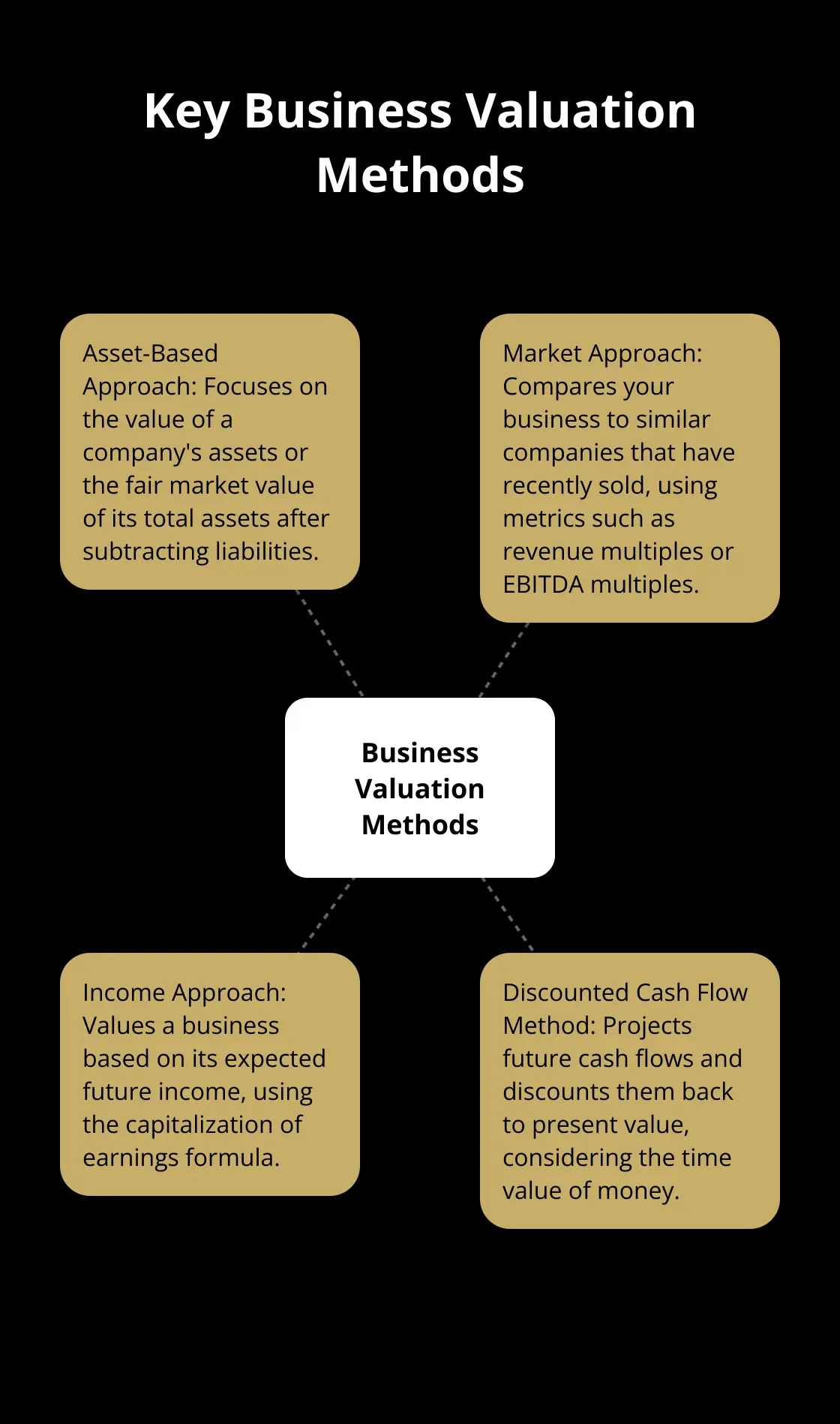
Asset-Based Approach
This method focuses on the value of a company’s assets or the fair market value of its total assets after subtracting liabilities. It’s particularly useful for asset-heavy businesses like real estate companies or manufacturers. However, it often undervalues companies with significant intangible assets or strong growth potential.
Market Approach
This approach compares your business to similar companies that have recently sold. It’s like comparing house prices in a neighborhood. We look at metrics such as revenue multiples or EBITDA multiples to determine value.
Income Approach
This method values a business based on its expected future income. We use the capitalization of earnings formula: Value = Annual Earnings / Capitalization Rate.
Discounted Cash Flow Method
This sophisticated approach considers the time value of money. We project future cash flows and discount them back to present value. It’s particularly useful for high-growth companies or those with fluctuating cash flows.
Using multiple valuation methods provides a comprehensive view of your business’s worth. Each method has its strengths and weaknesses, and the most appropriate approach often depends on your specific business and industry.
Valuation combines both art and science. While these methods provide a framework, factors like market conditions, competitive landscape, and unique business attributes also play significant roles in determining the final value.
Now that we’ve covered the key valuation methods, let’s move on to the next critical step: gathering essential financial information. This data forms the foundation of any accurate business valuation.
What Financial Data Do You Need for Valuation?
At Unbroker, we understand that accurate financial information forms the foundation of a reliable business valuation. Let’s explore the essential financial documents you need to gather for a comprehensive assessment of your small business’s worth.

Income Statements and Balance Sheets
Income statements show all of a company’s revenues and expenses and are key indicators of how they’ll perform in the future. Balance sheets provide a snapshot of your assets, liabilities, and equity at a given point in time.
For a thorough valuation, collect these statements for the past 3-5 years. This historical data helps identify trends and provides insights into your business’s financial health over time.
Cash Flow Statements
Cash flow statements track the movement of cash in and out of your business. Assessing cash flows is essential for evaluating a company’s liquidity, flexibility, and overall financial performance. Positive cash flow indicates a healthy business.
Focus on your operating cash flow. A positive and growing operating cash flow indicates a healthy business.
Tax Returns
Tax returns offer a wealth of information for valuation purposes. When it comes to taxation, the valuation of a business serves as a basis for assessing capital gains and estate taxes. Tax authorities rely on these valuations for various purposes.
Try to gather at least three years of tax returns for a comprehensive valuation. This aligns with the IRS’s record-keeping recommendations and provides a solid foundation for assessing your business’s financial trajectory.
Business Assets and Liabilities
A detailed inventory of your business assets and liabilities is essential, especially for asset-based valuations. This includes tangible assets (equipment, inventory, real estate) and intangible assets (patents, trademarks, goodwill).
Account for all liabilities, including loans, accounts payable, and any contingent liabilities.
The process of gathering this financial information might seem overwhelming, but it’s a critical step in the valuation process. The more accurate and comprehensive your financial data, the more reliable your valuation will be. This data not only informs the valuation but also provides valuable insights into your business’s strengths and areas for improvement. Now that we’ve covered the essential financial data, let’s move on to explore the various factors that can significantly impact your business’s value.
What Factors Impact Your Business’s Value?
At Unbroker, we understand that business valuation extends beyond mere number crunching. Several key factors significantly influence a company’s worth. Understanding these elements helps in making strategic decisions to enhance business value.

Industry and Market Dynamics
The state of your industry and overall market conditions play a vital role in determining your business’s value. The tech industry, for instance, has experienced growth in recent years. According to CompTIA, 45% of respondents expect their revenue and profitability numbers in 2023 to exceed those of 2022 if the tech sector flourishes. This growth positively impacts the valuation of tech companies.
Conversely, industries facing challenges or disruption might see lower valuations. The retail sector, for example, grapples with the shift to e-commerce, affecting traditional brick-and-mortar store valuations.
Growth Potential and Scalability
Investors and buyers often pay a premium for businesses with strong growth potential. This applies particularly to companies in emerging markets or those with innovative products or services.
McKinsey reports that while multiples can be a useful tool for valuation, in some situations they can miss or even distort the real picture. To showcase your growth potential, highlight metrics like customer acquisition costs, lifetime value of customers, and market penetration rates.
Customer Relationships and Retention
Strong customer relationships and high retention rates can significantly boost your business’s value. Bain & Company reported in 2006 that, for the first time ever, marketing to existing customers was exceeding that to new ones.
To improve this aspect, implement customer feedback systems, loyalty programs, and personalized marketing strategies. These efforts not only enhance customer relationships but also provide valuable data for potential buyers or investors.
Competitive Edge and Unique Selling Proposition
A strong competitive advantage sets your business apart and increases its value. This could involve proprietary technology, exclusive partnerships, or a unique business model.
For example, a software company with patented AI algorithms (a significant competitive advantage) might command a higher valuation than competitors without such intellectual property. Document your competitive advantages clearly, and quantify their impact on your business performance where possible.
These factors should be at the forefront of your business strategy, whether you plan to sell or aim to grow. Understanding and optimizing these elements will work towards increasing your business’s value.
Final Thoughts
Valuing a small business combines financial analysis, market understanding, and strategic thinking. We use various methods, from asset-based approaches to discounted cash flow analyses, to provide comprehensive insights. Accurate financial data, including income statements, balance sheets, and tax returns, forms the foundation of reliable valuations.
Numbers tell only part of the story when you valuate a small business. Industry trends, growth potential, customer relationships, and competitive advantages significantly impact a company’s worth. These elements often set high-value companies apart from their peers and warrant careful consideration in the valuation process.
For complex valuations or when significant assets are at stake, professional assistance proves invaluable. We at Unbroker offer a modern platform for transparent, cost-effective business sales. Our tailored services suit different needs, from full-service options to assisted DIY sales, all designed to maximize your business’s value.