Selling a business is one of the biggest financial decisions you’ll make as an owner. Most business owners leave money on the table because they don’t prepare properly or understand what buyers actually want.
We at Unbroker have helped countless entrepreneurs navigate this process. This guide walks you through the exact strategies that maximize your exit value.
Building a Business Buyers Actually Want to Buy
Financial records that buyers trust
The gap between what owners think their business is worth and what buyers will pay often comes down to one thing: preparation. Deloitte found that 35.2% of M&A professionals expect increased due diligence scrutiny, which means buyers examine the fundamentals more closely than ever. Your financial records, operational efficiency, and customer base will make or break your valuation.
Start with your books. Disorganized financials immediately signal risk to buyers and kill deal momentum. You need three years of clean tax returns, profit-and-loss statements, and balance sheets that tell a consistent story. If your records are a mess, hire a fractional CFO or accountant to reconcile everything before you hit the market. This costs between $2,000 and $5,000 typically, but it can add 10-15% to your final offer because buyers trust what they can verify. Document every revenue stream, expense category, and one-time costs so buyers understand what’s recurring and sustainable.
Operations that run without you
Buyers want to see that your business runs without you constantly steering the ship. Streamlined, low-waste operations command higher valuations because they reduce perceived risk. Standardize your core processes, document your standard operating procedures, and train your management team to execute independently.
If a key customer represents more than 15% of revenue, that’s a red flag that tanks valuations. Diversify aggressively now. Same goes for supplier concentration-reduce dependency on any single vendor to strengthen your position with buyers.
Customer relationships as your valuation engine
Customer relationships matter because they’re the revenue engine. Spend the next 6-12 months deepening relationships with your top accounts, locking in multi-year contracts where possible, and introduce your management team directly to key clients. Buyers want to see that customers are loyal to the business, not just to you personally. This loyalty becomes your single biggest leverage point when you enter valuation conversations and begin screening potential buyers.
What Your Business Is Actually Worth
Most owners guess their valuation instead of calculating it. That’s a costly mistake. Your business value depends on which method you use, and buyers won’t accept inflated numbers without hard evidence to back them up. The three primary methods are Seller’s Discretionary Earnings (SDE) multiples for smaller businesses, EBITDA multiples for established companies with strong cash flow, and asset-based valuation for businesses heavy in tangible assets.
Choose the right valuation method for your business
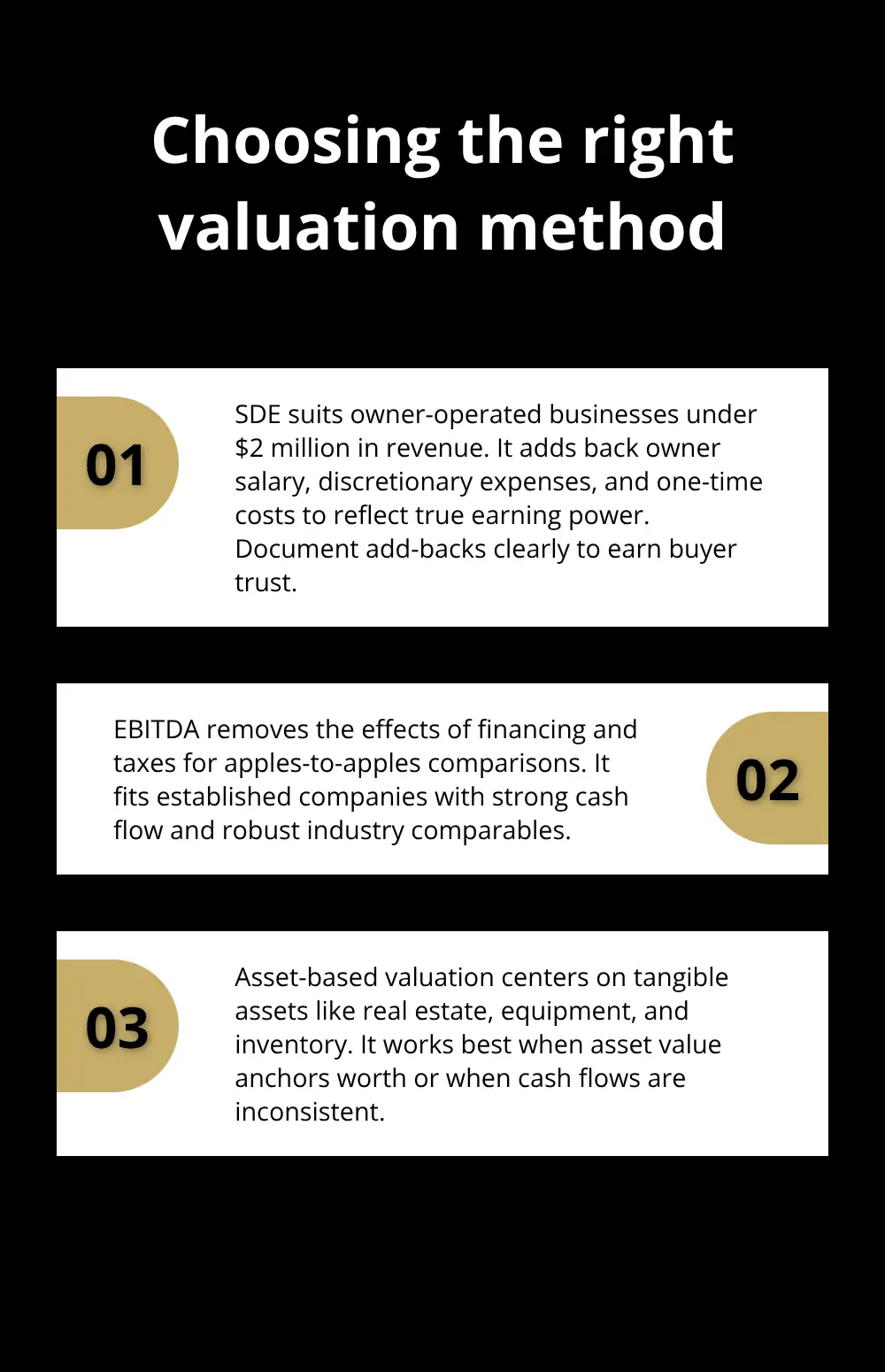
SDE works best for owner-operated businesses under $2 million in revenue because it adds back owner salary, discretionary expenses, and one-time costs to show true earning potential. EBITDA strips out debt, taxes, and capital structure to show operational profitability across comparable companies. Asset-based valuation matters if you own real estate, equipment, or inventory that holds standalone value. Pick the method that matches your business type, or hire a professional M&A advisor to run all three and triangulate a defensible range.
A professional valuation costs $1,500 to $3,500 but gives you credibility when buyers question your asking price.
Market comparables anchor your price to reality
Don’t price in a vacuum. Research what similar businesses in your industry and region actually sold for in the past 12–24 months. Industry databases like INC Research, BizBuySell, and Flippa track transaction multiples by sector. Software companies trade at 4–8x EBITDA, while service businesses land at 3–5x, and manufacturing sits at 2–4x depending on margins and growth. Regional differences matter too. A business in a high-growth tech hub commands a premium over the same business in a declining industrial region. Look at recent deals in your space, not old benchmarks. Interest rates, economic sentiment, and sector trends shift valuations fast. When debt is cheap and buyers are aggressive, multiples spike; when rates climb, they contract. Check what strategic buyers in your space paid in the last year, what private equity platforms acquired similar businesses for, and whether your industry is consolidating or fragmenting. Consolidation drives higher multiples because roll-up platforms pay premiums for add-on acquisitions that fit their strategy.
Growth and earnings sustainability drive the final number
Buyers project future cash flow and discount it back to today. If you show consistent revenue growth over the past three years and a clear path to margin expansion, you’ll command a higher multiple. A business that grows 20% annually is worth far more than a flat business at the same current profit level. Document your growth drivers explicitly: new customer wins, market expansion, product launches, or efficiency gains. If your market expands and your share grows faster than the market, emphasize that. Conversely, if you operate in a shrinking market but gain share, that’s valuable too.
Present credible growth narratives, not speculation
Future earnings assumptions are where buyers and sellers clash most. Conservative buyers assume growth flattens or margins compress post-sale. Aggressive buyers believe they can accelerate growth through their network or operational improvements. Your job is to present a credible growth narrative backed by customer contracts, market research, or pipeline data, not hope. A buyer paying 5x EBITDA expects to earn 5 years of profits; if you claim 30% annual growth forever, they’ll discount that aggressively. Realistic projections showing 10–15% growth for three years and then normalizing to market growth earn far more trust. The gap between your valuation and what a buyer offers often shrinks when you replace speculation with documented customer commitments and market traction. Once you’ve anchored your price to real data, you’re ready to take your business to market and attract the right buyers.
How to Attract the Right Buyers and Close the Deal
Define your ideal buyer profile
Your business appeals to different buyer types, and each one values different things. Strategic buyers in your industry will pay a premium because your business fills a gap in their portfolio or brings new customers and geography. A private equity platform hunting for add-on acquisitions pays based on roll-up potential and how your business fits into their broader strategy. A financial buyer focuses purely on cash flow and return multiples. Each buyer type responds to different messaging. If you sell a software company, strategic tech firms and PE platforms focused on SaaS consolidation are your targets. If you own a service business, look for larger service platforms consolidating regionally. Tailor your marketing materials to speak directly to what each buyer type values-for strategic buyers, emphasize market position, customer relationships, and operational synergies; for PE platforms, highlight growth runway, margin expansion opportunities, and how you fit into a larger roll-up thesis.
Reach qualified buyers with focused marketing
Quality beats volume every time. A focused outreach campaign to 50 qualified strategic buyers outperforms mass listings to 500 unqualified prospects. Work with an M&A advisor or use platforms designed for serious transactions to reach the right people confidentially. Confidentiality matters because premature disclosure tanks employee morale, spooks customers, and invites lowball offers. Professional marketing channels filter out tire-kickers and connect you with buyers who have real capital and serious intent.
Screen buyers before sharing sensitive data
Not every inquiry deserves a peek at your financials. Ask upfront questions about their acquisition strategy, capital source, typical deal timeline, and whether they’ve completed similar transactions before. Buyers with actual capital move faster and commit more seriously than those still hunting for funding. Request proof of funds or a letter from their financing source before you hand over detailed financials. This filters out the vast majority of time-wasters immediately and protects your confidentiality.
Assemble your deal team and negotiate strategically
Preparation beats persuasion every time. Have your deal team in place before the first offer arrives: an M&A attorney, a CPA or tax professional, and ideally an M&A advisor who understands your industry. Your deal team negotiates payment structure, earnout terms, working capital adjustments, non-compete agreements, and post-closing involvement. These details matter as much as the headline price. A $5 million all-cash offer at closing beats a $5.5 million offer with $1 million in earnouts over three years because you face real risk if the buyer misses targets post-close.
Prepare meticulous documentation for due diligence
Buyers will scrutinize your contracts, customer agreements, employee arrangements, tax compliance, and operational details. Organize your data room with clean financials, customer contracts, employee handbooks, vendor agreements, lease documents, and any pending litigation or regulatory issues. Transparency during due diligence actually speeds deals because it removes surprises that kill momentum. Buyers who discover hidden problems late often renegotiate terms downward or walk entirely. The businesses that close fastest are the ones where sellers anticipated buyer questions and provided answers before being asked.
Final Thoughts
Selling a business requires discipline, preparation, and realistic expectations. The owners who maximize value spend 12–24 months cleaning their financials, strengthening operations, and building a credible narrative about what their business can deliver. Underestimating how much due diligence matters costs most sellers real money-buyers will find problems, and you either fix them first or they use those problems as leverage to cut your price during negotiations.
Pricing without evidence ranks as the costliest error we see. Guessing your business is worth 6x EBITDA when comparable sales in your industry landed at 3.5x sets you up for rejection or a painful repricing conversation. Use real market data, get a professional valuation if your business is complex, and anchor your asking price to what similar businesses actually sold for in the past year. Timing matters more than most owners realize-interest rates, sector consolidation, and buyer appetite shift fast, and a business worth $3 million when debt is cheap might fetch $2.4 million when rates spike.
Negotiate hard on payment structure, earnouts, non-competes, and post-closing involvement because a lower headline price with all cash at closing often beats a higher price with risk baked in. We at Unbroker offer transparent, low-cost options for selling a business without the high brokerage fees that traditional brokers charge. Whether you want hands-off support or expert guidance as you navigate the process yourself, you have options designed to protect your interests and maximize what you receive.