Selling a business is one of the biggest financial decisions you’ll make. Getting the valuation right determines whether you walk away with fair value or leave money on the table.
Market approach valuation grounds your asking price in real data-actual sales of comparable businesses in your industry. At Unbroker, we’ve seen how this method cuts through guesswork and gives sellers the confidence to negotiate from a position of strength.
What Market Approach Valuation Actually Is
The Foundation of Real Market Data
Market approach valuation ties your business price directly to what similar businesses actually sold for recently. This method examines real transactions in your industry, identifies businesses comparable to yours, and uses those sales prices as the foundation for your valuation. The core principle is straightforward: if a business similar to yours sold for $500,000 last quarter, your business should land somewhere in that ballpark, adjusted for specific differences. This approach works because it reflects what actual buyers will pay right now, not what a formula or theoretical model suggests your business should be worth.
How Market Approach Stands Apart
The market approach differs fundamentally from other valuation methods. Income-based approaches project future earnings and discount them back to present value. Asset-based approaches tally up what your business owns. Both methods require assumptions about future performance or detailed financial modeling, which creates room for bias and error. Market approach valuation eliminates most of that guesswork because it rests on observable data. When you list a business, comparable sales data becomes your strongest negotiating tool.
Why Comparable Sales Data Wins Negotiations
Buyers trust numbers they can verify independently. If you state your business is worth $750,000 because similar businesses in your market sold between $700,000 and $800,000 in the past twelve months, that claim holds weight. Without solid comparable data, sellers often price too high or too low, leading to either months without offers or leaving significant money on the table. The businesses that sell fastest and for the best prices are those priced against real market evidence, not owner sentiment or outdated valuations. Comparable sales data transforms your asking price from an opinion into a defensible position backed by market reality.
Now that you understand what market approach valuation is and why it matters, the next step involves identifying which businesses actually qualify as true comparables for yours.
How Market Approach Valuation Works for Business Listings
Identifying Comparable Businesses in Your Industry
Finding true comparables requires more than a quick search. You need to match your business on three core dimensions: industry, size, and geography. A digital marketing agency with $2 million in annual revenue in Austin is not comparable to a $500,000 agency in rural Montana, even though both operate in the same field.

Start with recent sales data from the past 12 to 18 months because market conditions shift quickly. Financial databases, company filings, investor presentations, industry reports, news sources, and industry experts can all help identify comparable companies. You should also check local business brokers, industry associations, and state filing records for completed sales in your specific market.
Building Your Comparable Sales Range
Identify at least three to five genuinely comparable transactions. One sale alone tells you almost nothing; five sales across similar businesses give you a legitimate range to work from. This range becomes your foundation for setting a defensible asking price rather than relying on guesswork or owner sentiment.
Adjusting for Real Differences Between Businesses
Once you have identified comparables, adjustment phase separates accurate valuations from guesses. If your comparable business sold for $600,000 but had 30% higher revenue than yours, that business warrants a downward adjustment. If another comparable operates in a market with higher demand for your service type, that sale price may need adjustment upward to reflect your competitive position.
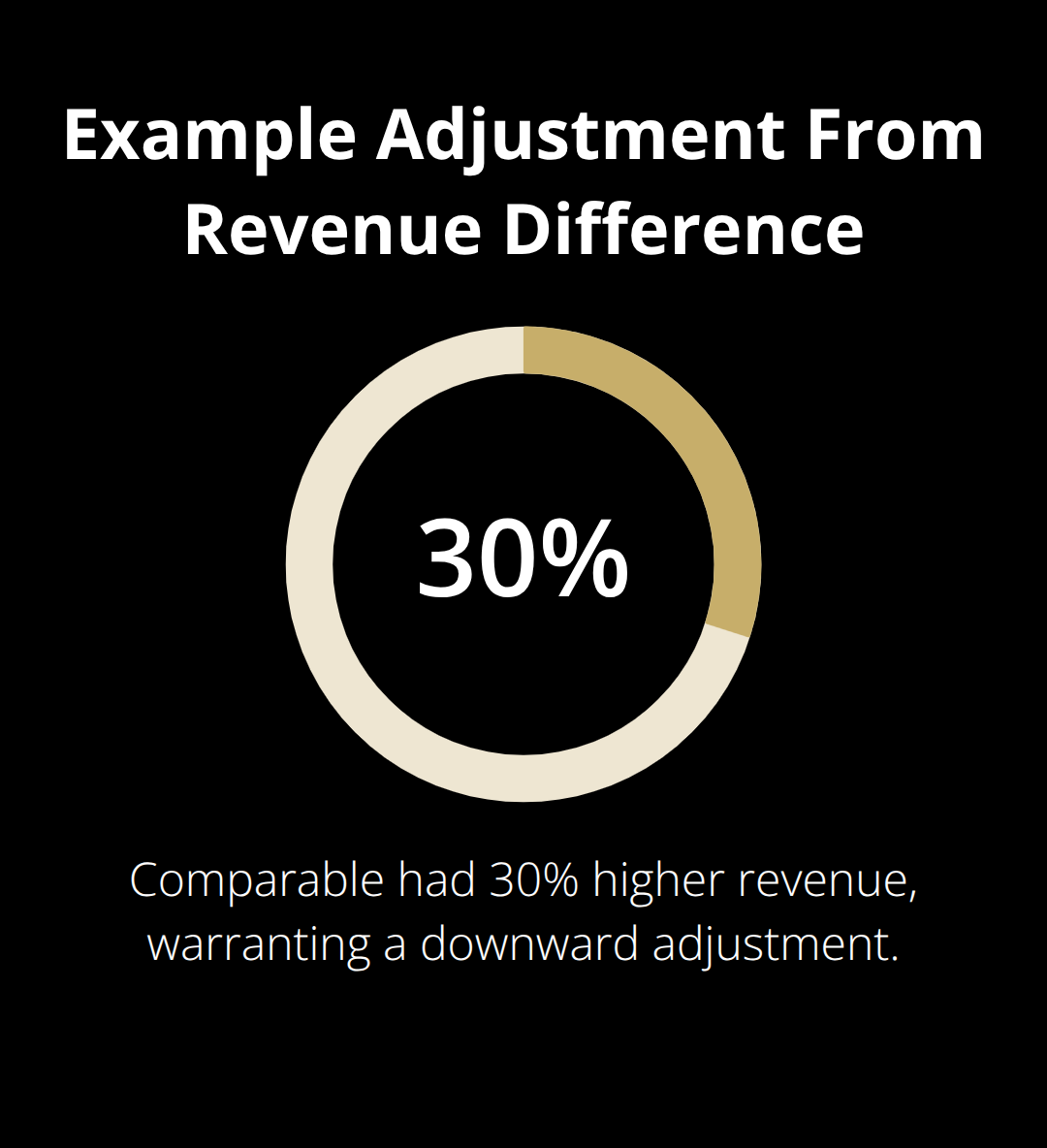
Common adjustment factors include revenue differences, profitability margins, customer concentration, lease terms, equipment condition, and management structure. Adjust one factor at a time rather than stacking multiple adjustments, which compounds error. A business with one owner-dependent revenue stream should trade at a discount to one with diversified revenue sources. If your comparable had a five-year lease at below-market rates and yours expires in two years, that adjustment typically ranges from 5 to 15% depending on your industry.
The National Business Brokers Association reports that guessing at value instead of getting an accurate business valuation is a common pricing error among sellers. Your adjusted valuation should land within a defensible range, not a single precise number. This range reflects market reality and positions you to negotiate from strength when serious buyers appear.
Practical Advantages of Market Approach Valuation for Sellers
Speed Beats Complexity
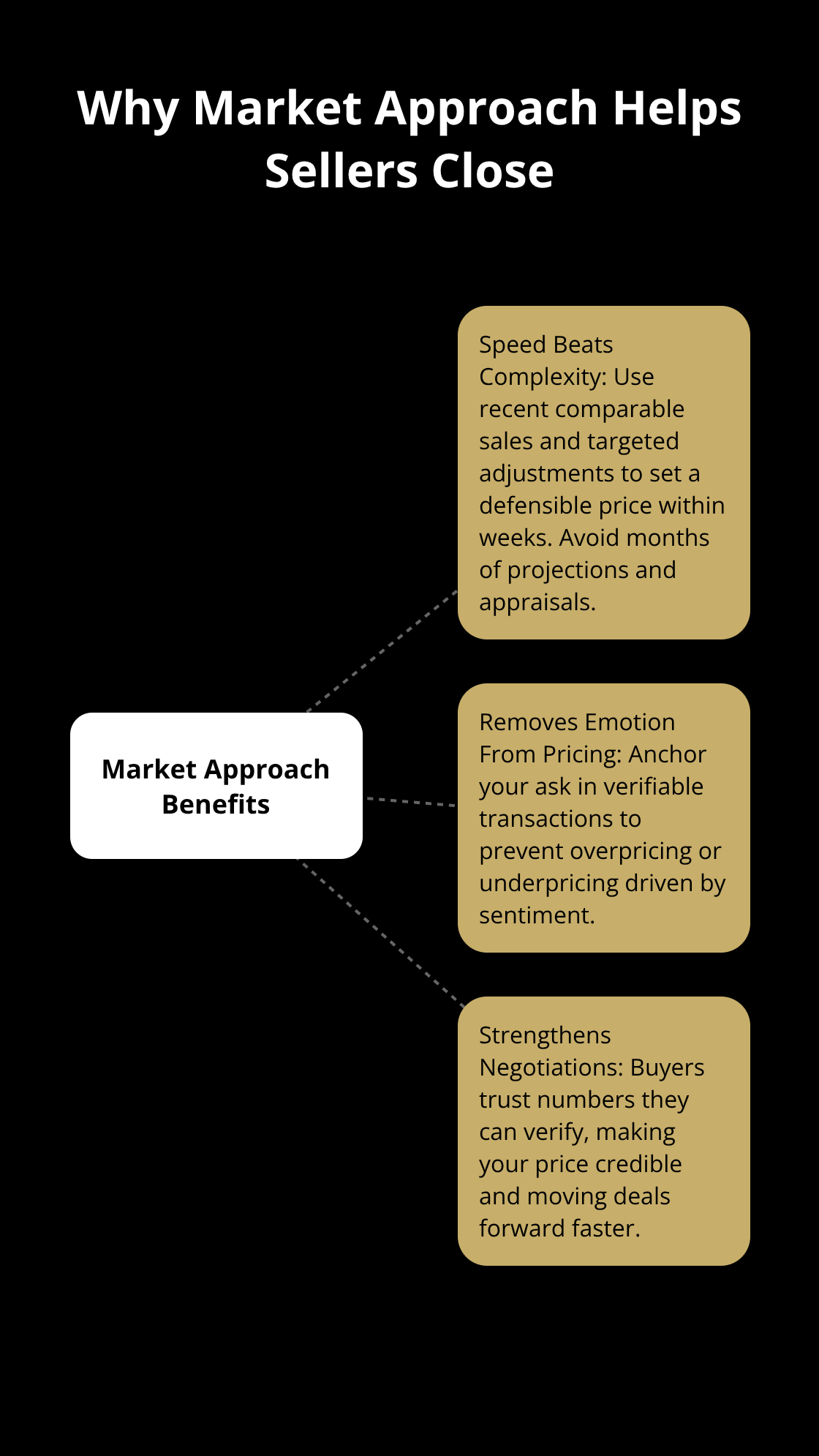
Market approach valuation cuts through the lengthy process that other methods demand. Income-based valuations require detailed financial projections, often stretching months as accountants model future scenarios that may never materialize. Asset-based approaches mean cataloging and appraising every piece of equipment, inventory, and intangible property on your books. Market approach skips this bureaucracy entirely.
You identify comparable sales from the past 12 to 18 months, make targeted adjustments for obvious differences, and land on a defensible price within weeks rather than months. This speed matters when market conditions shift or when you want to capitalize on strong buyer interest. Sellers move faster to closing when their asking price rests on recent comparable data rather than complex financial models that buyers will question anyway.
Real Data Removes Emotion From Pricing
Comparable sales data anchors your asking price in observable market reality instead of owner sentiment. When a buyer challenges your $800,000 asking price, you respond with three recent sales of similar businesses in your market that sold between $750,000 and $850,000 over the past year. That response carries weight because the buyer can verify those transactions independently.
Without this grounding, sellers either overprice and watch months pass without serious offers, or underprice out of uncertainty and leave significant money on the table. Your adjusted comparable range becomes your negotiating floor and ceiling simultaneously, preventing lowball offers while keeping your asking price realistic enough to attract qualified buyers ready to act.
Market Data Strengthens Your Negotiating Position
Buyers trust numbers they can verify independently. When you anchor your price to actual market transactions (rather than formulas or projections), serious buyers recognize the legitimacy of your position and move forward with confidence. Pricing against comparable sales keeps your business competitive and positions you to close faster than sellers relying on owner assumptions alone.
Final Thoughts
Market approach valuation grounds your asking price in what actual buyers paid for similar businesses recently. This method eliminates the guesswork that plagues owner-driven pricing and keeps your expectations aligned with market reality. When you price against comparable sales data, you’re not hoping your business is worth a certain amount-you’re stating what the market has already proven through recent transactions.
Understanding how comparables work transforms your entire selling experience. You move from uncertainty to confidence because your asking price rests on observable evidence rather than formulas or projections. Buyers recognize this legitimacy immediately and respond with serious offers instead of lowball attempts, and the businesses that sell fastest are those priced against real market data (not owner sentiment or outdated valuations).
At Unbroker, we combine market approach valuation with AI-driven buyer matching and national marketing to position your business in front of qualified purchasers ready to move. Start your business sale with Unbroker and let market data work in your favor.