Selling a business is one of the biggest financial decisions you’ll make. Without proper exit planning guidance, most owners leave money on the table or face unexpected complications during the sale.
We at Unbroker have helped hundreds of business owners navigate this process successfully. This guide walks you through valuation, preparation, and finding the right buyer-so you can sell with confidence.
Understanding Your Business Valuation
What Determines Your Business Value
Your business value isn’t what you think it’s worth-it’s what a buyer will pay for it. Most owners overestimate their valuation by 20 to 40 percent because they factor in sweat equity and emotional attachment rather than hard financial metrics. Buyers care about one thing: cash flow. Specifically, they look at EBITDA (earnings before interest, taxes, depreciation, and amortization) or Seller’s Discretionary Earnings to understand what profit the business actually generates independent of owner involvement. If your business generates $200,000 in annual EBITDA and similar businesses in your industry sell for 4 to 6 times EBITDA, your realistic valuation sits between $800,000 and $1.2 million. This multiple varies significantly by industry-tech and SaaS companies command higher valuations, while traditional retail operates at 3 to 5 times. The gap exists because buyers perceive tech businesses as more scalable and less dependent on the owner.
Revenue alone tells you almost nothing. A business that generates $5 million in annual revenue with 5 percent margins is worth far less than one that generates $2 million with 20 percent margins. Buyers run normalized EBITDA calculations, stripping out one-time expenses, owner discretionary spending, and inflated salaries to see the true operating profit. If you paid yourself $150,000 but the new owner could hire a manager for $80,000, buyers add back that $70,000 difference as addback income. Clean financial statements matter enormously-three years of audited P&L statements, balance sheets, and tax returns form the foundation of any credible valuation conversation.
What Buyers Actually Scrutinize
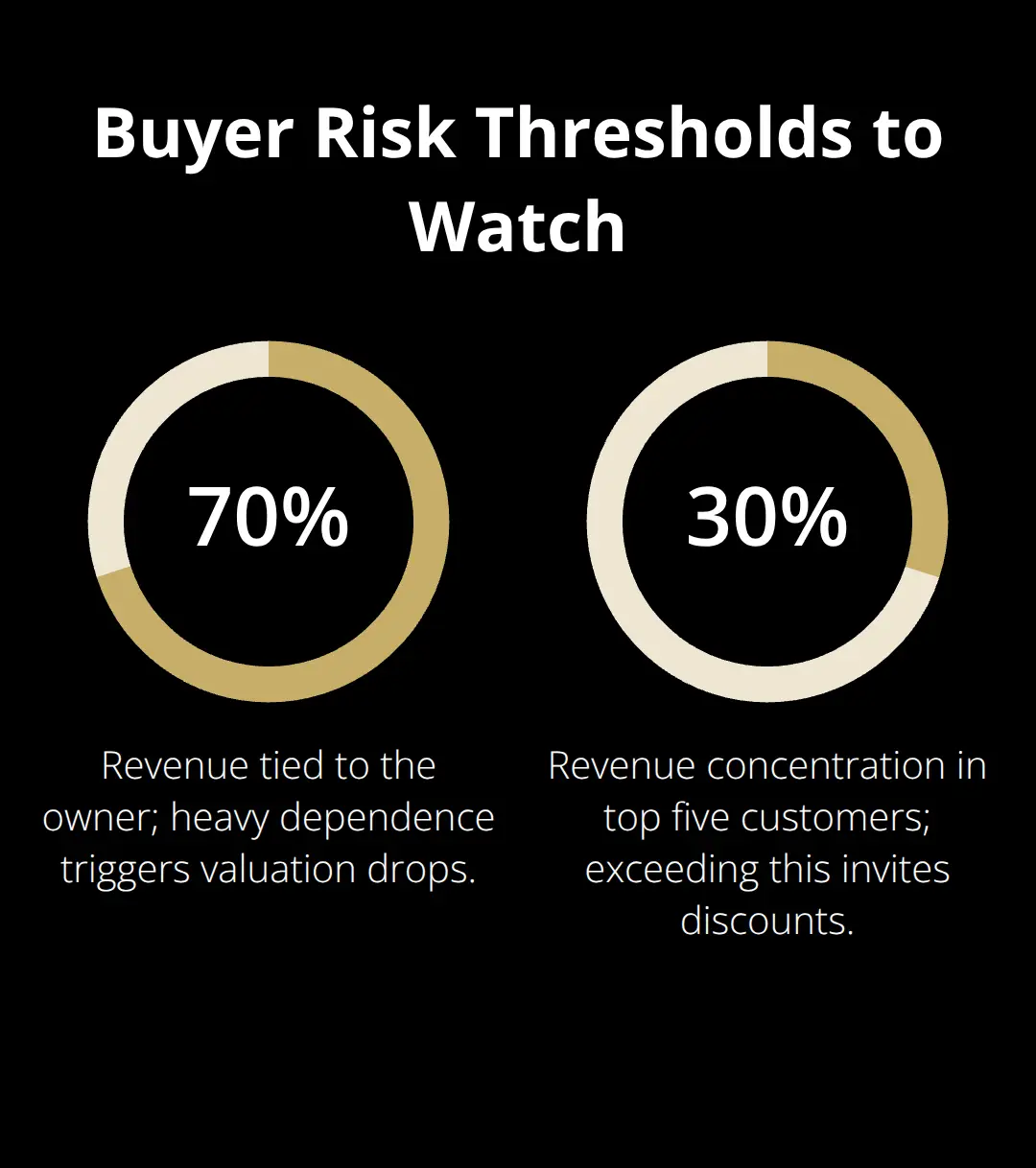
Beyond financial statements, buyers assess management independence aggressively. If 70 percent of your revenue depends on relationships you personally maintain, valuation drops substantially because the business loses value the moment you leave. Buyers want to see documented processes, a capable management team, and customer contracts that survive ownership change. Customer concentration also kills valuations-if your top five customers represent more than 30 percent of revenue, expect a significant discount because losing even one major account cripples the business.
Supplier relationships matter too; if you depend on a single vendor who could raise prices or terminate the relationship post-sale, that creates risk.
Real estate ownership complicates valuation but can add significant value. If you own both the operating business and the property it occupies, separate valuations apply-value the real estate using net operating income and market comparables, then value the operating business on its own cash flow. A grocery business that generates $300,000 in annual EBITDA might sell for $1.2 to $1.5 million, but if you also own the strip mall that produces $200,000 in annual net rental income, that property could be worth another $2.5 to $3 million (depending on local market conditions and lease quality). Decide early whether you’ll sell the business and property together as a packaged deal or separately, since different buyer types pursue each path.
How Valuation Methods Differ in Practice
The market approach compares your business to recent sales of similar companies, but finding truly comparable transactions proves difficult-most sales data stays confidential. The income approach projects future cash flows and discounts them to present value, which requires realistic revenue and margin assumptions. The asset approach values tangible assets like equipment, inventory, and real estate, then adds intangible value for customer relationships and brand. Most buyers use income-based methods because they care about future profit generation, not historical asset accumulation.
For established businesses with stable cash flow, the multiple-of-EBITDA method dominates because it’s straightforward and market-tested. Younger or high-growth businesses often use revenue multiples instead, since profitability hasn’t stabilized. A SaaS company with $2 million in annual recurring revenue might trade at 5 to 8 times revenue even if margins are thin, because investors value predictable, recurring income. Online valuation calculators and rules of thumb like 3 times revenue oversimplify reality and lead to misaligned expectations.
A professional valuation consultant provides defensible numbers grounded in market data and industry benchmarks. That investment protects you during negotiations and prevents wasted time pursuing unrealistic prices that scare off serious buyers. You need accurate valuation before you market the business, not after you’ve already attracted buyer interest. Getting your numbers right upfront shapes every conversation that follows and determines whether you attract qualified buyers or waste months on tire-kickers.
Preparing Your Business for Sale
The gap between what owners think their business is worth and what buyers will actually pay often comes down to preparation. Before you market the business, spend three to six months getting your financial house in order because buyers will scrutinize every number you present. Start by pulling three years of audited financial statements-P&L, balance sheet, and cash flow statements-along with corresponding tax returns. Buyers use these documents to verify your EBITDA claims and spot inconsistencies that raise red flags. If your statements show accounting changes, unusual one-time expenses, or owner discretionary spending that wasn’t disclosed in your valuation conversation, trust erodes immediately.
Organize Your Financial Records
Clean up your bookkeeping now: reconcile accounts, document all owner add-backs clearly, and prepare a normalized EBITDA calculation that strips out expenses a new owner won’t incur. Create a detailed breakdown showing exactly which items you’ve added back and why-the salary adjustment for the departed CFO, the one-time legal settlement, the equipment repair that won’t repeat. Vague add-backs get challenged and discounted. Organize your data room with contracts, leases, employee agreements, vendor relationships, licenses, permits, and any pending litigation or compliance issues. A disorganized data room signals operational sloppiness and slows due diligence, which frustrates buyers and strengthens their negotiating position. Most deals that stall do so because information takes weeks to surface rather than sitting in a prepared folder.
Strengthen Cash Flow Before Selling
Don’t wait until after you’ve attracted buyer interest to improve profitability. The time to cut costs and boost margins is now, when you control the narrative. Conduct a ruthless operating review: identify which customers generate the highest margins, which are break-even or money-losing, and consider pruning the low-margin business. A customer that consumes significant management time but contributes only 2 percent of profit drags down your valuation more than its revenue justifies.
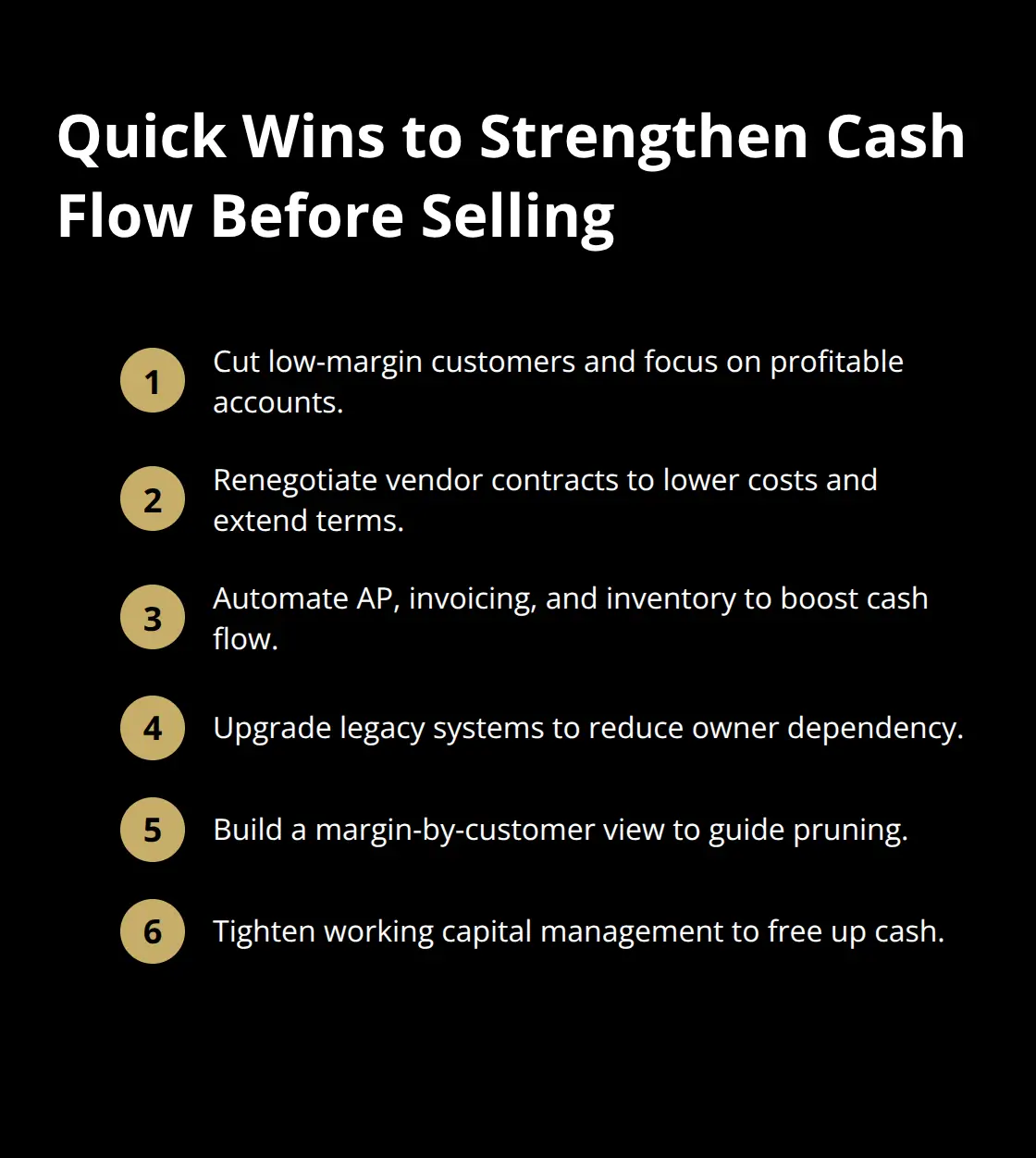
Review your vendor contracts and renegotiate terms where possible-longer payment windows, volume discounts, or service improvements all reduce operating costs and increase cash flow. Automate repetitive processes: accounts payable, invoicing, inventory management. A business that requires constant owner involvement to run smoothly looks riskier to buyers because they fear operational chaos once you leave. Upgrade your systems if they’re outdated; legacy software that only you understand creates dependency risk.
Build a Management Team Independent of You
If you’ve been running lean on staffing, hire or promote a capable operations manager or general manager now. A strong second-in-command demonstrates that the business can function without you and immediately increases buyer confidence. That manager’s salary counts as an operating expense, not an add-back, so it reduces your current EBITDA-but the long-term valuation benefit far exceeds the short-term profit hit. Buyers pay significantly more for businesses that run independently.
Owner dependence is the single largest valuation killer. If major customers work exclusively with you, if suppliers only take calls from you, if critical processes exist only in your head, buyers see a business that evaporates when you leave. Document everything: standard operating procedures for core functions, decision-making frameworks, customer onboarding steps, vendor management protocols. This documentation serves two purposes-it forces you to systematize what’s been ad hoc, and it reassures buyers that operations can continue post-sale.
Transition key customer relationships to your management team gradually. Have them attend client meetings, handle account reviews, and build rapport before the sale closes. When a buyer meets with your top five customers and hears that the account manager (not the owner) drives strategy and execution, valuation improves materially. Similarly, strengthen your management team’s visibility in the business. If your team lacks depth or consists of people who report only to you, recruit or promote talent now. A business with a capable VP of Sales, Operations Manager, and Finance Lead sells for more than one where the owner manages everything. The investment in payroll today pays dividends in valuation and deal speed.
Reduce Customer Concentration Risk
Reduce customer concentration by diversifying your revenue base-if your top three customers represent 40 percent of revenue, that’s a major risk factor that depresses valuation by 15 to 25 percent. Spend the next six months landing new accounts or expanding existing relationships with smaller clients to spread risk. These operational improvements position you to attract serious buyers and command higher offers when you move forward with the sale.
Finding Buyers and Structuring Your Sale
Position Your Business to the Right Buyer Types
Once your business is financially clean and operationally strong, you need buyers who recognize that value. Most owners make a critical mistake here: they assume a business broker or platform will magically attract qualified offers. That’s passive thinking in an active process. You need a deliberate marketing strategy that positions your business to the right buyer types, not just any buyer.
Strategic buyers (competitors or companies in adjacent markets) care about revenue synergies and cost savings they can achieve post-acquisition. Financial buyers (private equity firms or investment groups) prioritize cash flow stability and growth runway. These two groups value completely different things-a strategic buyer might pay a premium for your customer list because they can cross-sell their own products, while a financial buyer wants to see predictable EBITDA with room for margin expansion.
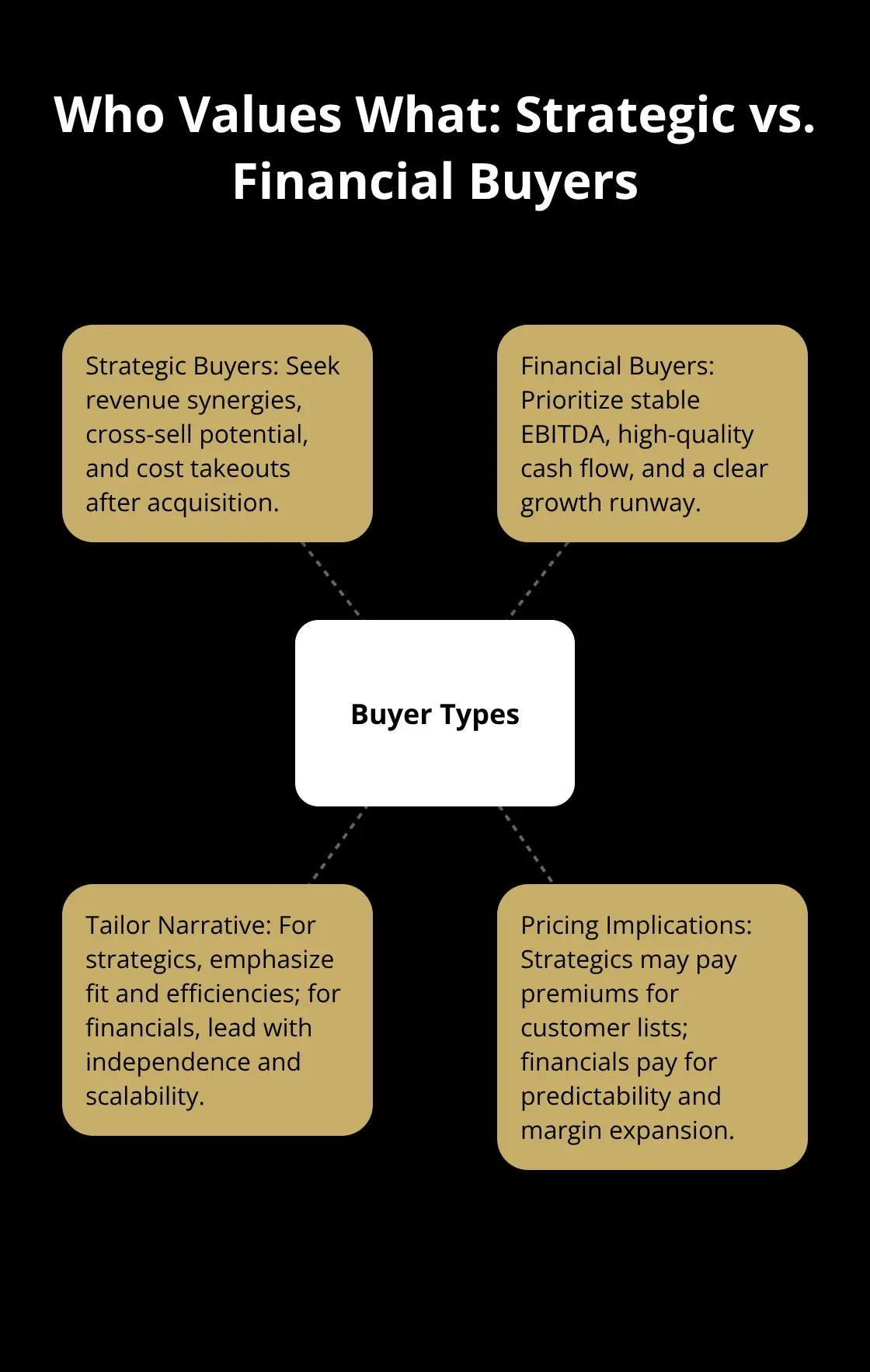
Your marketing narrative should change based on who you’re talking to. If you’re approaching a strategic buyer, emphasize how your business complements their existing operations, market share gains, and operational efficiencies. If you’re talking to financial buyers, lead with cash flow quality, management team strength, and scalability without owner involvement. Most owners craft one generic pitch and wonder why serious offers don’t materialize.
Choose the Right Platform or Advisor
You need the right platform or advisor to execute this strategy effectively. A business broker charges 6 to 10 percent commission on the sale price, which creates misaligned incentives-they profit more from a fast, expensive deal than a slow, well-structured one. We at Unbroker offer a modern alternative: our Full Service business sale charges a 6% success fee, paid only when your business sells, so our incentives stay aligned with getting you the best outcome. You get access to premium marketing tools, legal document templates, a vast buyer network enhanced by AI-driven processes, and negotiation assistance without the bloated commission structure of a traditional broker.
The cost difference matters significantly: a $2 million business sold through a traditional broker costs you $120,000 to $200,000 in fees; the same sale through Unbroker costs you roughly $5,000. That savings stays in your pocket and strengthens your negotiating position when offers arrive.
Evaluate Offers on Multiple Dimensions
When offers arrive, most owners accept the first one because they’re exhausted from preparation and eager to close. That’s where you lose leverage. Serious buyers expect negotiation-they build in lowball opening offers because they assume you’ll push back. If you accept the first number, they wonder what they missed and request additional due diligence to justify a lower price.
Evaluate offers not just on price but on deal structure, timing, and post-close obligations. A $2 million offer with 40 percent paid at close and 60 percent as an earn-out is riskier than a $1.9 million all-cash deal because you lose control over whether you actually receive the back-end payment. Earn-outs create disputes that drag into litigation. If a buyer insists on an earn-out, cap it at 10 to 15 percent of total consideration and set clear, auditable metrics.
Negotiate Terms That Protect Your Interests
Non-compete agreements and employment contracts matter enormously. If a buyer requires you to stay on for 18 months post-close, your personal liquidity doesn’t arrive until that period ends, and you’re bound by restrictive covenants that prevent you from starting a competing business. Negotiate hard on these terms-shorter transition periods, lower non-compete scope, and clear buyout provisions if the relationship deteriorates.
A buyer who demands excessive personal restrictions often signals operational weakness; they fear you’ll leave and take customers with you. Conversely, if a buyer shows confidence in your management team and wants minimal owner involvement post-close, that signals they believe the business can run independently. That’s the buyer profile you should prioritize-they’re buying a sustainable business, not your personal involvement, and that confidence typically translates to better pricing and terms.
Final Thoughts
Selling your business successfully requires three fundamentals: knowing what it’s actually worth, preparing it to run without you, and finding the right buyer who values what you’ve built. Most owners skip one or more of these steps and leave significant money on the table. Your exit planning guidance should start with realistic valuation based on EBITDA multiples and industry benchmarks, not emotional attachment to what you think the business deserves.
Clean financial statements, a capable management team, and diversified customer relationships are what buyers pay for. The preparation phase-getting your finances organized, improving profitability, and reducing owner dependence-typically takes three to six months but directly translates to higher offers and faster closings. When you market your business, position it strategically to the right buyer types, since strategic buyers and financial buyers value completely different things.
Evaluate offers on deal structure and terms, not just price. An all-cash offer at a slightly lower valuation often beats a higher offer loaded with earn-outs and restrictive covenants that keep you tied to the business for years. We at Unbroker help business owners navigate the entire sale process with transparent pricing and no hidden fees, and Unbroker’s platform gives you access to premium marketing tools, legal templates, a vast buyer network, and negotiation support without the bloated commissions traditional brokers charge.