If you want to sell a trucking company, the first thing to understand is that your USDOT number is not an asset you can list, price or hand over. The structure of the deal decides what the buyer actually receives and which filings you both owe the Federal Motor Carrier Safety Administration (FMCSA).
This guide walks through what can and cannot change hands, how your entity type shapes the sale, what to do about trucks, leases and owner-operators, which safety records buyers will ask for, and how to get sale-ready. It is general information, not legal advice, so confirm specifics with a transportation attorney before you sign anything.
Why a trucking company sale is different from a typical small business sale
In most small business sales, the buyer pays for customers, equipment, systems and goodwill, and the business keeps operating the next morning. A trucking company adds a layer: the right to operate is tied to federal registrations that belong to a specific legal person, not to the business in the abstract.
That has three practical effects:
- The registrations are not the product. Buyers are paying for revenue, equipment, drivers, customer relationships and a compliance history. The numbers come along only if the deal structure allows it.
- Your entity type matters more than usual. A sole proprietorship and a corporation lead to very different transactions.
- Paperwork has consequences. A missed filing can threaten the operating authority the buyer thought they were getting.
Owners who skip this and start by asking “what is my MC number worth?” often lose weeks correcting the premise. Start with structure instead.
USDOT numbers and MC authority: what can and cannot change hands
In a bulletin dated March 19, 2026, FMCSA stated that a USDOT number belongs to the same legal person forever and may not be sold, transferred, rented or leased. The agency also said it will inactivate a USDOT number it finds being used by anyone other than the assigned legal person.
Read that as a warning in both directions. If someone offers to buy your number on its own, or a buyer proposes to “lease” it, that is the arrangement FMCSA is calling out. The consequence of getting it wrong falls on the number itself, which can be inactivated, and that damages the business you are trying to sell.
Two distinctions help:
- The USDOT number is an identifier tied to the legal person that registered it.
- Operating authority (the MC number) is the for-hire authority to operate. FMCSA may record a transfer of it in certain transactions, as covered below.
The same bulletin makes one more point that matters for sellers: it applies to the purported sale or lease of registration or operating authority itself. It does not apply to leasing equipment such as trucks or drivers under compliant arrangements governed by 49 CFR Part 376 and 49 CFR Part 390, Subpart G. Ordinary equipment leasing between motor carriers and owner-operators remains permissible.
Sole proprietor vs. corporation: how your entity type shapes the deal
If you operate as a sole proprietor
Per the same March 19, 2026 FMCSA bulletin, a buyer of a sole proprietor’s motor carrier business needs their own USDOT number, because no one else can become the original owner. For operating authority, FMCSA may require the purchaser to obtain separate authority or may record a transfer, depending on the transaction. In every instance, the selling sole proprietor must file an out-of-business notification.
For a sole proprietor, then, you are selling the things around the registration: trucks, trailers, customer relationships, contracts that can be assigned, driver relationships and know-how. The buyer builds their own regulatory identity. Set expectations early, because buyers who assumed they were purchasing “the authority” may need time to register and meet their own requirements before they can haul under their own name.
If you operate as a corporation or other legal business organization
FMCSA says that for a carrier organized as a corporation or other legal business organization, the owner can sell the company and the USDOT number goes with the company. The new owners should update FMCSA records immediately to note the change in ownership.
That is the cleanest path to continuity, and it is why many carriers that expect to sell someday are better off with a company that can be sold as a whole. But “the number goes with the company” is not a free pass. The buyer is also taking the company’s history and liabilities, which is where the next section comes in. If you are weighing whether to incorporate or restructure before selling, talk to a tax adviser and an attorney first. The right answer depends on your state, your tax position and your timeline.
Entity sale or asset sale: what the buyer inherits
Corporate owners usually face a choice between selling the company itself (an entity sale, such as selling stock or membership interests) and selling selected assets out of it (an asset sale). The choice affects the registrations, the liabilities, the tax outcome and the paperwork.
Entity sale
- What moves: the legal entity, including its USDOT number, with the new owners notifying FMCSA of the ownership change.
- What the buyer inherits: the company’s operating history and compliance record, and generally its liabilities too, known or unknown.
- What the seller should expect: detailed questions about past claims, audits and compliance, and often indemnity and representation terms in the purchase agreement.
Asset sale
- What moves: trucks, trailers, shop equipment, assignable contracts and other agreed assets.
- What does not move on its own: the USDOT number, which stays with the legal person that holds it.
- What the buyer needs: a regulatory identity of their own. FMCSA says that if a company is dissolved under state law and operations continue only under another company, the continuing company needs its own USDOT number, and the old number should be deactivated on Form MCS-150 as out-of-business.
Buyers often prefer asset purchases because they can pick assets and leave liabilities behind, and the tax treatment can differ for each side. Sellers often prefer entity sales for simplicity. Which structure suits you depends on facts neither side can settle by rule of thumb, so see our guide to the asset sale approach and review it with a tax adviser and attorney who know trucking.
On operating authority, FMCSA says that in corporate transactions it will record a transfer of the MC number only if motor carrier operations continue with the same safety management oversight and controls after the deal. If a buyer plans to fold your trucks into a very different operation, that is a flag to raise with your attorney early.
Filings to update with FMCSA when ownership changes
The filing burden is lighter than many owners fear, but it cannot be ignored. Here is what FMCSA has said:
- No pre-approval step. FMCSA discontinued its operating authority transfer review and approval process in 2013, so these transactions no longer need FMCSA approval before closing.
- Notification from both sides. FMCSA records and tracks a transfer when it is part of a purchase of an entire operation and the agency receives adequate notification from both the transferor and the transferee documenting the transaction.
- Often just ownership or officer changes. In many corporate cases, per the March 19, 2026 bulletin, only ownership or corporate officer changes must be reported.
- Consequences for missing filings. FMCSA says it will start proceedings to revoke operating authority, despite the parties’ intent, if required filings are not made.
- Out-of-business notices. A selling sole proprietor must file one in every instance, and a dissolved company’s old number should be deactivated on Form MCS-150 as out-of-business.
Put these filings in the closing checklist with a named owner and a date, and make the purchase agreement say who files what. Ask your attorney whether other registrations and insurance filings tied to your carrier need to be updated at the same time, since the right list depends on how you operate.
Equipment, leases and owner-operator arrangements
Trucks and trailers are the most tangible part of the sale, and the part buyers can value most easily. Prepare a clean equipment schedule:
- Every unit with VIN, year, make, model and current condition.
- Titles in hand for owned units, and lienholder details for financed ones.
- Lease agreements for any leased units, with the lessor’s assignment or consent terms.
- Maintenance records for each unit, kept in one place.
If you have financed equipment, the lender typically has a say in whether a loan can be assumed or must be paid off at closing, and the sale proceeds may be applied to payoff. That mechanic is similar in other industries, and our post on selling a business with an SBA loan explains the lien, consent and payoff questions in general terms.
Owner-operator arrangements deserve special care. The FMCSA bulletin clarifies that compliant equipment leasing between motor carriers and owner-operators remains permissible, so these arrangements are not a problem in themselves. What buyers want to know is whether they are properly documented under the applicable rules, whether the owner-operators are likely to stay with a new owner, and whether any of the revenue depends on a handful of relationships. Have a clear list of agreements, their terms and who can assign them. Where an agreement cannot be assigned without consent, find that out before a buyer does.
Safety record and compliance files buyers will ask about
In an entity sale especially, the buyer is acquiring your compliance history along with your trucks. Expect them to look hard at it. Gather these in an organized, confidential data room:
- Safety and inspection history: roadside inspection results, crash history and any safety rating or audit outcomes.
- Driver files: qualification files, licensing documents, medical certification records and drug and alcohol testing program records.
- Hours-of-service and logging records: how you monitor them and how you handle violations.
- Insurance and claims: current coverage, loss runs and any open claims.
- Maintenance and inspection programs: proof that equipment is maintained on a schedule.
- Corrective actions: what you changed after any violation or incident.
Ask your attorney which records the regulations require you to retain, and fix gaps before you go to market. A buyer who finds a hole in a driver file during diligence may lower the offer, ask for an escrow or holdback, or walk. Our seller due diligence tips cover how to organize records so questions get answered quickly.
Cost pressures buyers will price in
Buyers know what it costs to run a truck, and they know the market has been tough. Expect them to model your numbers against industry cost trends.
The American Transportation Research Institute’s Operational Costs of Trucking report, analyzing 2024 costs for for-hire carriers, found an average operating cost of $2.26 per mile including fuel, as reported by FleetOwner in December 2025. The largest costs were fuel, equipment payments and wages, and the data does not include many overhead costs such as office staff compensation.
In the same report’s five-year comparison of for-hire costs, excluding fuel, the fastest-growing costs were equipment payments, tolls and driver wages, each growing about 5-7% annually, generally faster than annual inflation over the same period. FleetOwner’s December 2025 overview also describes an ongoing freight recession in which operational costs keep rising while for-hire rates stagnate.
The same overview, citing ProsperFleet by Valgen, reported that larger fleets (an average of 58 power units among those that cut) were more likely to cut power units than smaller fleets, among fleets with at least 5 power units. That figure covers fleets of that size only, so do not read it as proof about a single-truck operation. It does show that fleet reductions were happening in this market, which may affect how many used trucks are available to buyers and how they value equipment.
What this means for you:
- Know your own cost per mile and your margins by lane or customer, so you can answer a buyer’s questions with your own data rather than industry averages.
- Be ready to explain how you have handled rising equipment, toll and wage costs.
- Show what is durable: contracted freight, repeat customers, drivers who stay and equipment in good condition.
- Expect buyers to be cautious about forecasts. Realistic, documented numbers hold up better than optimistic ones.
Valuation depends on your business, your market and the deal structure. Multiples vary by market and by kind of carrier, so ask a valuation adviser who understands trucking before you set an asking price.
Small fleets are the norm: who your likely buyers are
If you run a small fleet, you are in the majority. According to American Trucking Associations data reported in FleetOwner’s December 2025 Trucking By the Numbers, single-truck fleets made up about 52.9% of registered carriers and 91.5% of motor carriers operated 10 or fewer trucks. The prior year’s edition (2024) reported 66.2% for single-truck fleets and 99.5% for fleets of 10 or fewer trucks, so the mix of carrier sizes shifts between reports and the numbers depend on how each report counts.
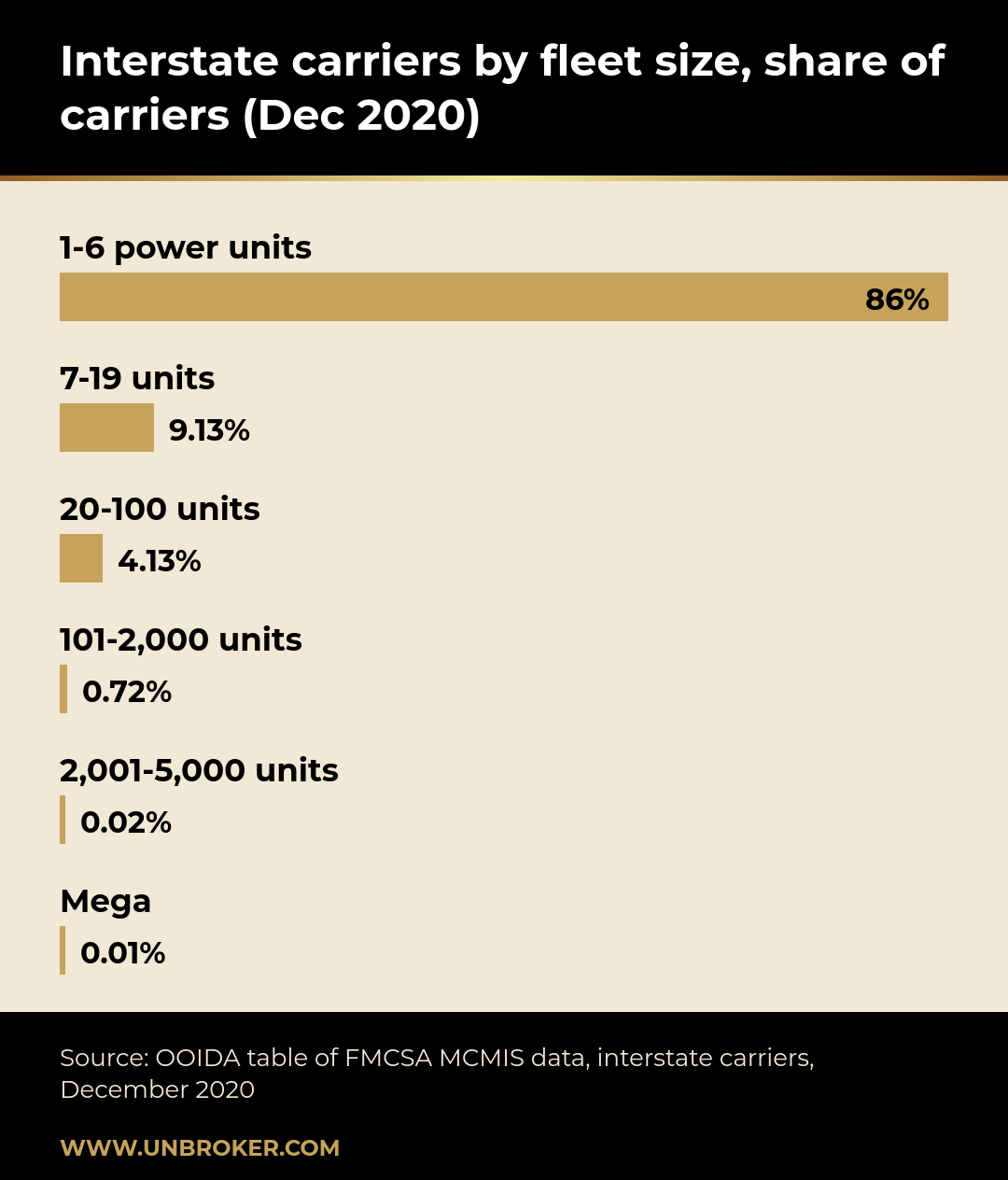
An older snapshot tells a similar story. FMCSA MCMIS data for interstate carriers as of December 2020, as tabulated by the Owner-Operator Independent Drivers Association, showed 584,437 carriers. By fleet size, 86% had 1-6 power units, 9.13% had 7-19 units, 4.13% had 20-100 units, 0.72% had 101-2,000 units, 0.02% had 2,001-5,000 units and 0.01% were in the mega category.
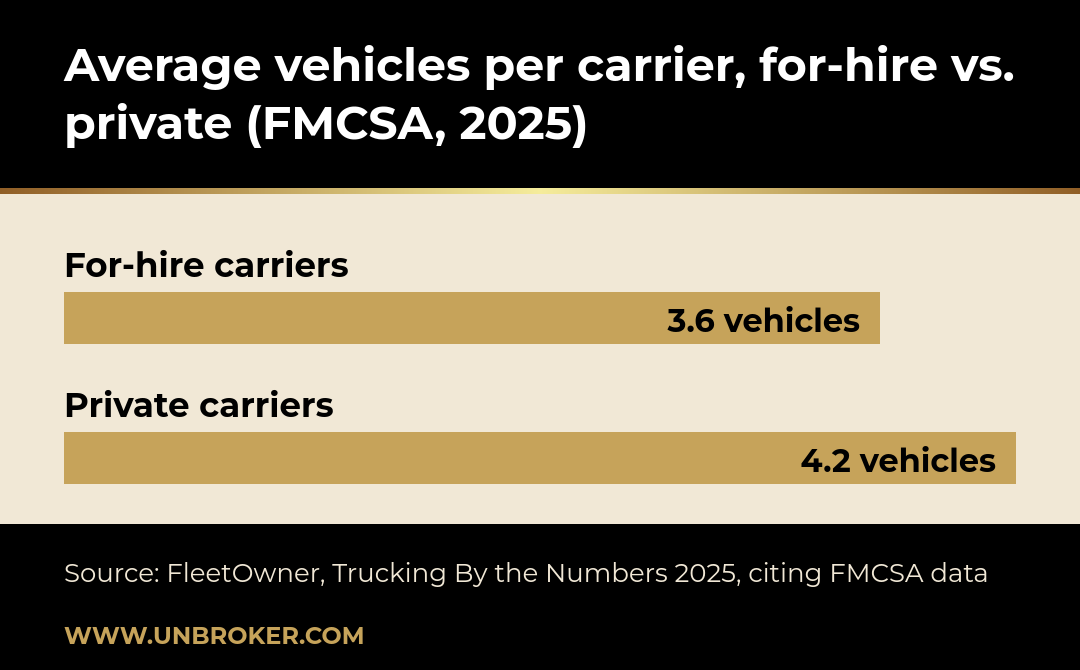
FMCSA data reported by FleetOwner in December 2025 show about 3.9 million vehicles under for-hire carriers, split among 1.1 million carriers, which works out to 3.6 vehicles per for-hire carrier. The same data show 3.4 million vehicles under private carriers, shared among 790,847 carriers, or 4.2 vehicles per private carrier.
What does this mean for a seller? The typical carrier is small, so the typical buyer is probably someone who knows trucking at a similar scale. Likely buyer types include:
- Nearby carriers that want more trucks, lanes or customers and already have their own registrations.
- Experienced drivers or owner-operators ready to run a company, who will often need financing and some transition help from you.
- Larger fleets looking to add capacity or customer relationships.
- Buyers from outside trucking who may need more support and who tend to ask more questions about compliance.
Each type will care about a different part of your business, and each is likely to pick a different structure. A neighboring carrier with its own USDOT number may prefer to buy assets and contracts. A buyer who wants to step into a running company may prefer an entity sale. Our post on preparing a freight brokerage for exit may also help if part of your business sits on the brokerage side.
Getting sale-ready: a checklist for trucking owners
Start well before you talk to buyers. This sequence works for most carriers:
- Confirm your legal structure. Know whether you operate as a sole proprietor or through a corporation or other legal business organization, and which legal person holds each registration.
- Talk to advisers early. A transportation attorney and a tax adviser can tell you how your structure affects the sale, and whether an entity sale or asset sale suits you. Our overview of when you need an attorney for your exit can help you plan that conversation.
- Verify your FMCSA records. Check that your company information, contacts and officers are current, so that later updates are simple.
- Clean up compliance files. Fill gaps in driver files, maintenance records and testing documentation.
- Build the equipment schedule. Titles, liens, leases, condition and maintenance history for each unit.
- Document every owner-operator and lease arrangement. Note assignment and consent terms.
- Organize your financials. Prepare your cost per mile, margins by customer and a clear picture of what the owner actually does in the business, since buyers will want to see what they would need to replace.
- Plan the transition. Buyers will ask how customer, driver and broker relationships will be handed over, and how long you can stay involved.
- Protect confidentiality. Drivers, customers and competitors can react badly to rumors of a sale. Use confidentiality agreements and share sensitive records only with vetted buyers.
- Agree on the filing plan. Decide in the purchase agreement who files each FMCSA notice and by when.
Never agree to sell, lease or “share” a USDOT or MC number as a side arrangement. Everything a buyer needs should come through a legitimate structure: a company sale, an asset sale with the buyer’s own registrations, or a transaction FMCSA can record.
Unbroker pairs expert advisors with AI-driven buyer matching and national marketing, and keeps the sale confidential, with legal document templates and negotiation assistance for sellers who want guidance. Our Full Service Business Sale carries a 6% success fee, paid when the business sells, and sellers who want to stay hands-on can use the same platform tools. Start at unbroker.com when you are ready to talk through a confidential trucking sale.