Most business owners spend years building value but never plan how to exit. At Unbroker, we’ve seen countless founders leave money on the table simply because they started exit planning strategies too late.
The difference between a rushed sale and a profitable one often comes down to preparation. This guide walks you through the concrete steps that matter most.
Define Your Exit Timeline and Goals
The timeline for your exit isn’t arbitrary. We at Unbroker see business owners pick random dates-often retirement age-without considering market conditions or business readiness. This costs money. Start by working backward from your desired exit date, then stress-test it against reality. If you want to exit in three years, that means you have roughly 36 months to fix operational weaknesses, document everything, and build buyer confidence. Most business owners underestimate how long this takes.
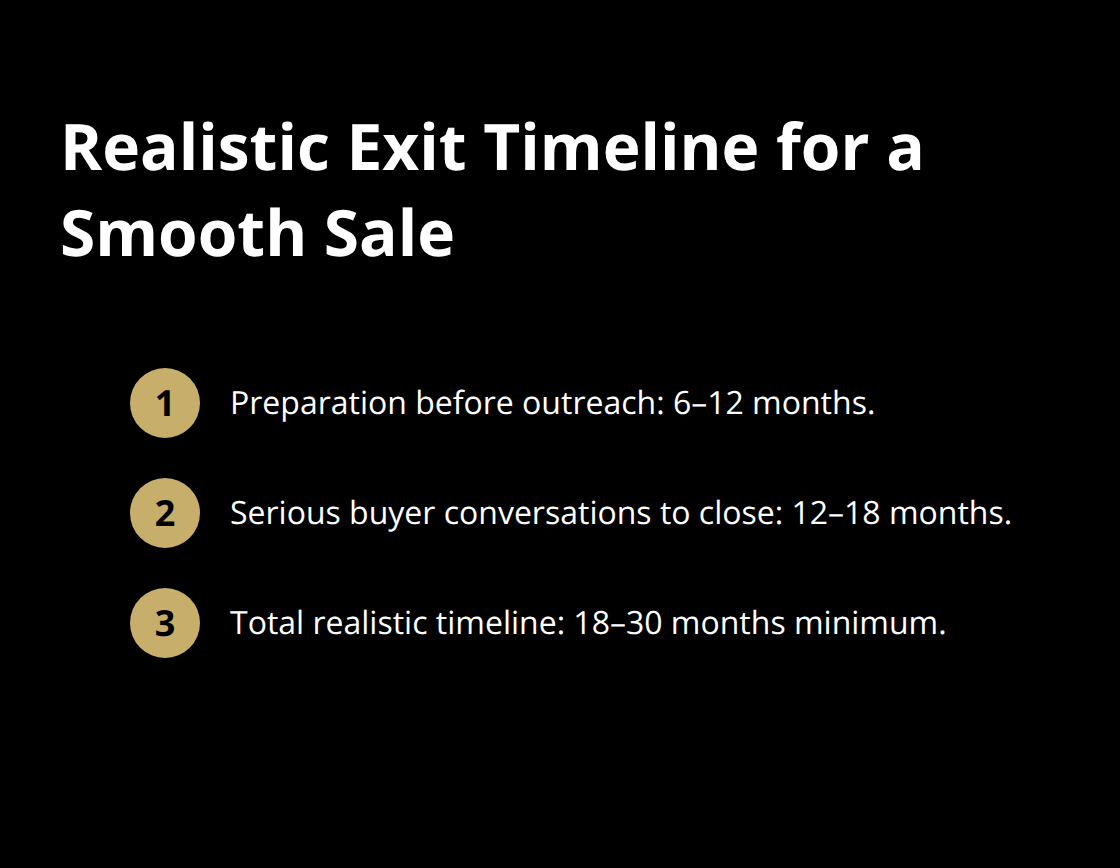
Industry data suggests that well-prepared exits take 12 to 18 months from first serious buyer conversation to close. Add another 6 to 12 months for preparation before you even talk to buyers. That puts a realistic timeline at 18 to 30 months minimum for a smooth sale. If your timeline is shorter, you’ll likely accept a lower valuation or face a rushed process that exposes problems.
Why Your Valuation Probably Isn’t What You Think
Business valuation isn’t what you think your company is worth-it’s what a buyer will actually pay. Founders often anchor on revenue multiples they read online, then discover their actual multiple is much lower. The gap comes from buyer risk assessment. A buyer paying 5x revenue wants proof that revenue is predictable, recurring, and not dependent on you personally.
If your top three clients represent 60% of revenue, that’s a risk. If you’re the only one who understands the operations, that’s a risk. If your financial records are messy, that’s a massive risk. According to business valuation multiples for SaaS companies and service businesses, SaaS companies typically sell for multiples that vary by market conditions, while service businesses trade at lower multiples. These ranges assume clean financials and transferable operations.
Your actual multiple depends on how well you’ve addressed buyer concerns. A professional valuation will identify exactly which factors depress your price and which you can fix before sale.
Identify Your Potential Buyer Pool Early
Most business owners think buyer identification happens at sale time. Wrong. You should know your potential buyer pool 12 to 18 months before you want to exit. Strategic buyers in your industry acquisition criteria often differ from financial buyers in their approach and priorities. Competitors sometimes acquire to eliminate competition or acquire customer bases. Private equity firms have industry focus areas and investment check sizes. Smaller players in adjacent industries might see your business as a bolt-on acquisition.
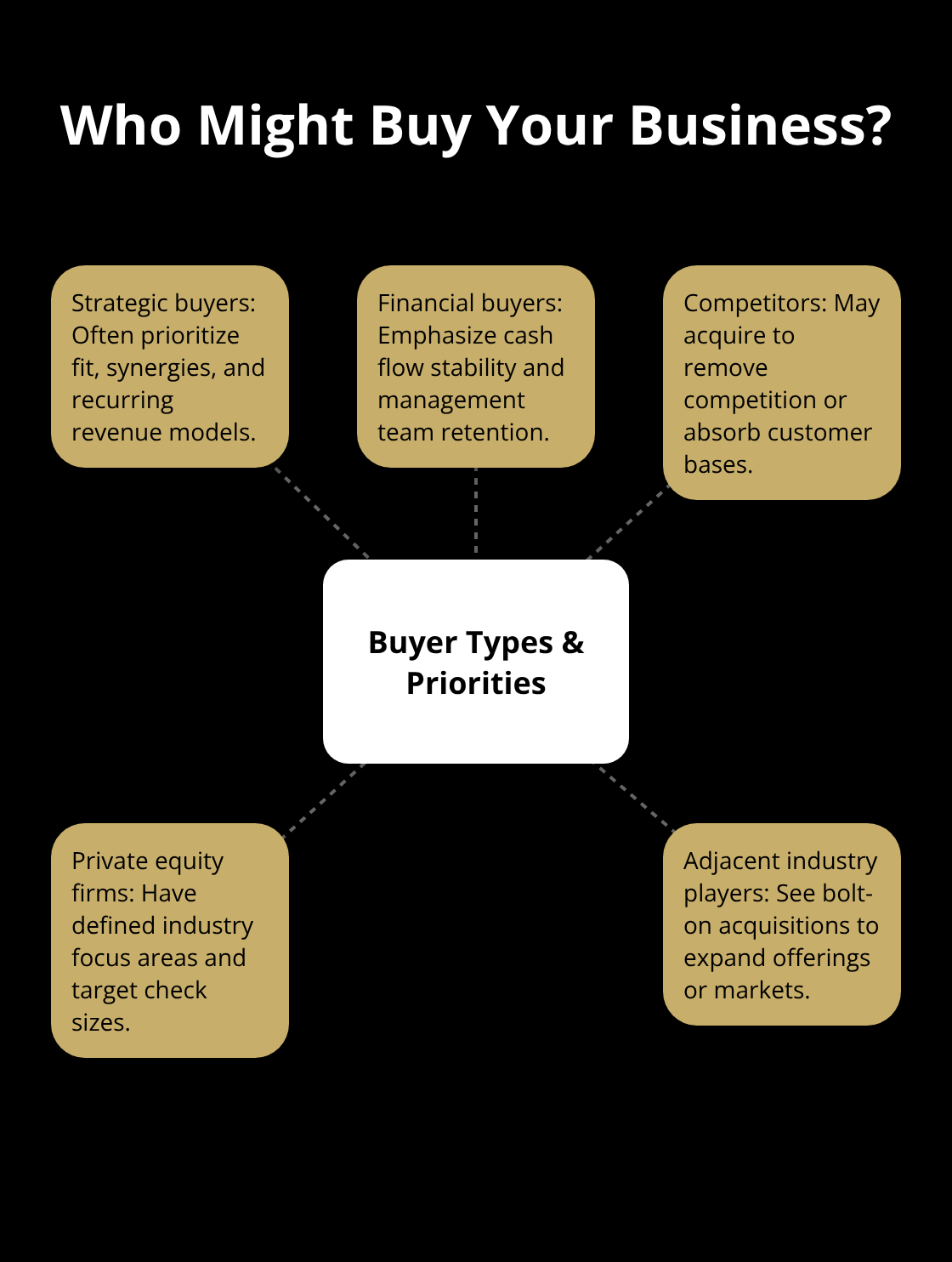
Financial buyers care more about cash flow stability and management team retention than strategic buyers do. Start mapping these buyer types now, even if you’re not selling tomorrow. Understanding who might want your business helps you build toward their priorities. If a strategic buyer wants recurring revenue, you shift toward subscription models. If they want a strong management team, you document and retain your best people. If they want clean financials, you tighten your accounting today.
The buyer landscape you map now directly shapes how you prepare your business for the market-which means your next step is making sure your operations can actually deliver what buyers expect.
What Actually Needs to Happen Before You List Your Business
Buyers evaluate your business as it will operate under their ownership, not as it exists today. This distinction matters enormously because it forces you to think like a buyer before you ever talk to one. Most owners wait until they’re actively selling to clean up operations, but that’s backwards. The time to fix operational fragility is now, while you still have runway to test changes and prove they work. Sellers who spend six months documenting processes right before sale scramble to show buyers that operations don’t depend entirely on the owner’s presence. You need at least nine months, ideally 12, to rebuild trust in your systems.
Map Your Critical Workflows
Start by mapping every critical workflow in your business. Write down how customer onboarding actually happens, who owns each step, what happens when that person is unavailable, and what documentation exists. Most owners discover that critical processes live only in someone’s head. A buyer views this as catastrophic risk and discounts your valuation accordingly.
Create written standard operating procedures for anything a buyer would consider essential. This doesn’t mean 200-page manuals-a one-page SOP for each critical process works fine, but it must be detailed enough that someone unfamiliar with your business can follow it. Test these procedures by having different team members execute them. If the process breaks when your best person isn’t running it, the procedure isn’t clear enough. This testing phase takes time, which is why you can’t start this two months before sale.
Clean Up Your Financial Records
A buyer’s accountant will spend weeks analyzing your books, and every inconsistency raises red flags. If your revenue recognition is sloppy, if you’ve mixed personal and business expenses, if your tax filings don’t align with your accounting records, a buyer assumes you’re hiding something. Even if you’re not, the friction costs money through valuation discounts or deal delays.
Pull your last three years of tax returns and P&L statements today. Have your accountant compare them line by line. Any material differences need explanation and correction now, not during buyer due diligence. Similarly, review your organizational structure and legal compliance. Do you have proper documentation for all company decisions? Are your contracts transferable to a new owner, or do they terminate upon change of control? Are there any undisclosed liabilities or pending legal issues? Buyers conduct thorough background checks, and surprises discovered during due diligence tank deals or crater valuations.
Strengthen Your Management Team
If you’re the only person who understands the business, you’re not a business owner-you’re a highly paid employee. Buyers pay premiums for businesses that function without the founder present. Start identifying your next layer of leadership now and document what each person owns. If gaps exist, hire to fill them. This gives you time to onboard new leaders, observe how they perform, and adjust before sale.
A capable and experienced management team enhances value by reducing key-person dependency and supporting continued growth. The strength of your team becomes the foundation for everything that follows-which means your next priority is ensuring that team can actually deliver what buyers expect to find when they take over.
What Kills Most Exit Deals
Most business owners start exit planning far too late, and this single mistake cascades into everything that follows. Founders who spent a decade building value suddenly realize they need to exit in twelve months and panic. Starting exit planning within two to three years of your target sale date is non-negotiable. Industry research shows that sellers who began planning 18 to 24 months before listing achieved valuations 20 to 30 percent higher than rushed sellers.
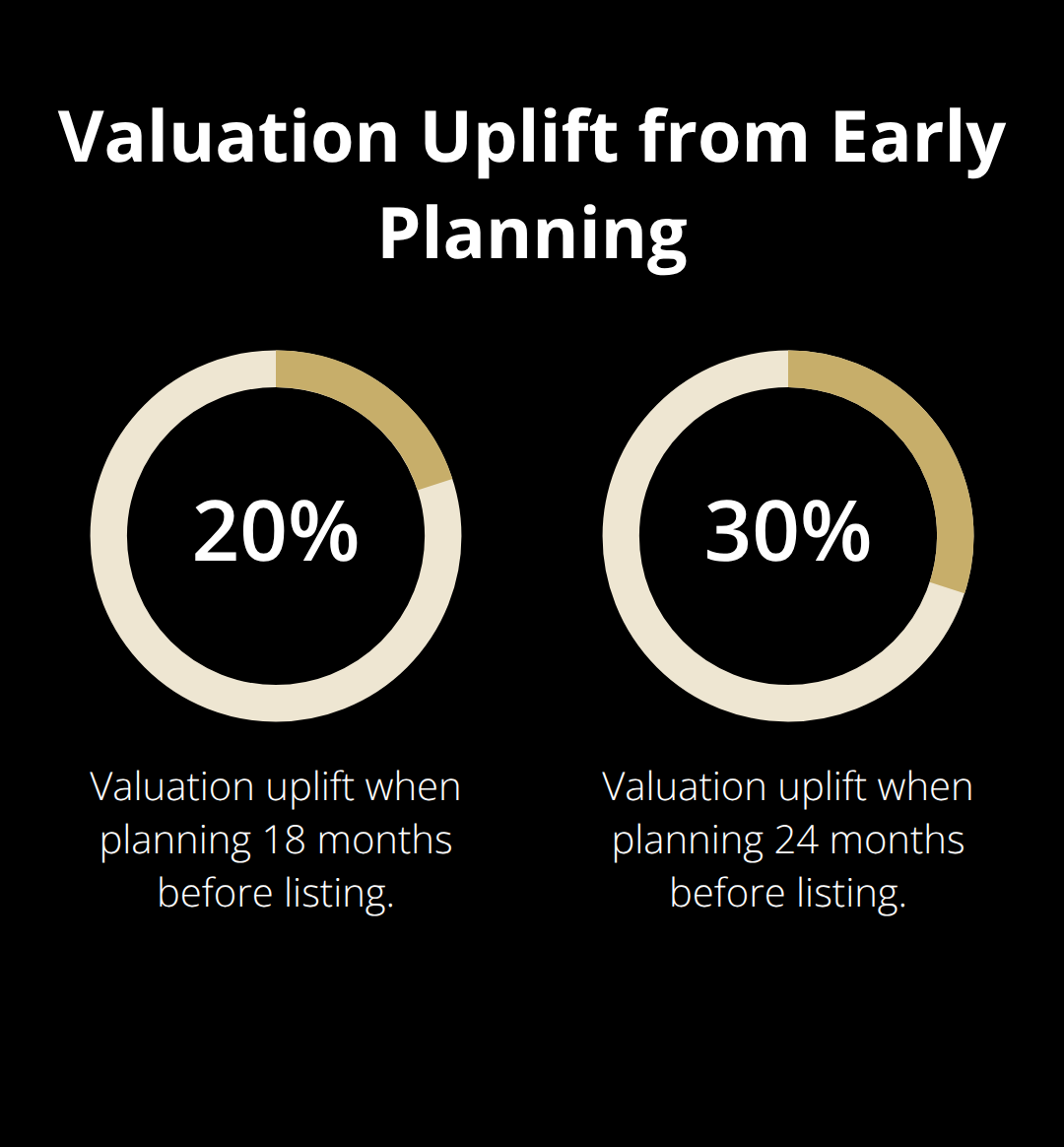
That gap isn’t small change. On a five-million-dollar business, it’s easily seven hundred thousand to one-point-five million dollars left on the table. The math is brutal because buyers sense desperation. When you need to close quickly, you lose leverage in negotiations, accept lower offers, and skip critical preparation steps that would have commanded premium pricing.
Timing Your Exit Creates Valuation Leverage
The window between planning and sale determines your negotiating position. Buyers pay premiums for sellers who control their timeline. A seller with eighteen months to close can walk away from bad offers. A seller with three months cannot. This power imbalance shows up immediately in offer terms, purchase price, and deal structure. Rushed sellers accept earn-outs, seller financing, and contingencies they would reject if they had time. Professional valuations typically cost between two thousand and fifty thousand dollars depending on business size. Skipping this step to save money typically costs hundreds of thousands in negotiation disadvantage because you enter talks without knowing your actual market value.
Overvaluation Destroys Deal Momentum
The second killer is overvaluing your business based on incomplete market research. Most owners anchor their valuation to revenue multiples they find online, then discover the real market pays significantly less. A SaaS company generating two million in annual recurring revenue might assume a 6x multiple based on industry benchmarks, landing on a twelve-million-dollar valuation. But that assumes your revenue is entirely recurring, your churn is minimal, your customer acquisition cost is low, and your team operates independently from you. In reality, most founders find their actual multiple sits between 3x and 4x because buyers discount for risk. The gap between expectation and reality costs time, emotional energy, and often results in either accepting a lower offer or pulling the business off the market in frustration.
Documentation Gaps Compress Your Price
The third catastrophic mistake is neglecting documentation and legal structure until the last moment. Buyers conduct thorough due diligence, and every gap in your documentation raises red flags that compress valuation. If your contracts contain change-of-control clauses that terminate agreements when ownership transfers, you’ve created a massive liability. If your intellectual property isn’t properly assigned to the company, a buyer assumes they’re not actually buying the core asset. If your employee agreements lack non-compete clauses, a buyer worries your best people will leave and start competing. These issues take months to resolve properly. Starting the documentation audit and legal cleanup now means you address problems while you still have time to fix them gracefully, rather than scrambling during buyer due diligence when every issue becomes a negotiation weapon against you.
Final Thoughts
Exit planning strategies work only when you start early and execute with discipline. The owners who maximize value aren’t the ones with the best businesses-they’re the ones who prepared methodically, fixed problems before buyers found them, and controlled their timeline. Starting 18 to 24 months before your target exit date gives you room to document processes, clean financials, strengthen your management team, and identify realistic buyer profiles.
Map your critical workflows today, pull your financial records for an accountant audit, and identify gaps in your management team. Know who might actually buy your business and what they value-these actions take time, but they move the needle on valuation and deal certainty. Most business owners underestimate how long this preparation takes and think they can clean up operations in three months, when reality demands far more runway.
We at Unbroker can guide you through the entire exit planning process, from initial strategy through closing. Our Full Service Business Sale charges a 6% success fee paid only when your business sells, so your interests align with ours from day one. Start planning now, execute the fundamentals, and build the business that buyers actually want to buy.