Selling a business without understanding its true value is like walking into a negotiation blindfolded. Most sellers rely on gut feeling or outdated assumptions, which costs them hundreds of thousands of dollars.
At Unbroker, we’ve seen firsthand how practical business valuation changes the outcome. When you know the real metrics buyers care about, you negotiate from strength instead of hope.
EBITDA and Revenue Multiples: The Foundation of Business Valuation
How EBITDA Multiples Work in Real Sales
EBITDA multiples are the language buyers speak when evaluating your business. EBITDA stands for earnings before interest, taxes, depreciation, and amortization, and it represents what your business actually generates in cash. When a buyer says they’re looking at a 5x EBITDA multiple, they mean they’ll pay five times your annual EBITDA as the purchase price. A software company with $200,000 in EBITDA valued at 5x sells for $1 million. The multiple itself depends entirely on your industry, growth trajectory, and how replaceable you are in the business.
SaaS companies typically command multiples between 8x and 12x EBITDA because investors expect recurring revenue and scalability. Manufacturing businesses typically sit between 4x and 6x because they’re more capital-intensive and face tighter margins. Retail operations hover around 3x to 4x due to lower barriers to entry and higher operational risk. These ranges aren’t arbitrary-they reflect what buyers actually pay in real transactions.
Industry-Specific Multiple Ranges and What They Mean
The industry you operate in determines your ceiling and floor more than anything else. A managed IT services company with strong recurring contracts and predictable churn might command 7x to 8x EBITDA, while a general contracting firm with project-based revenue might only reach 3x to 4x. Buyers pay premiums for visibility and stability.
If your revenue comes from long-term contracts with Fortune 500 companies, you’re sitting on a multiple advantage. If half your clients could leave next month, you’re not. Growth trajectory also impacts multiples dramatically-a business growing 30 percent annually commands significantly higher multiples than a flat business in the same industry.
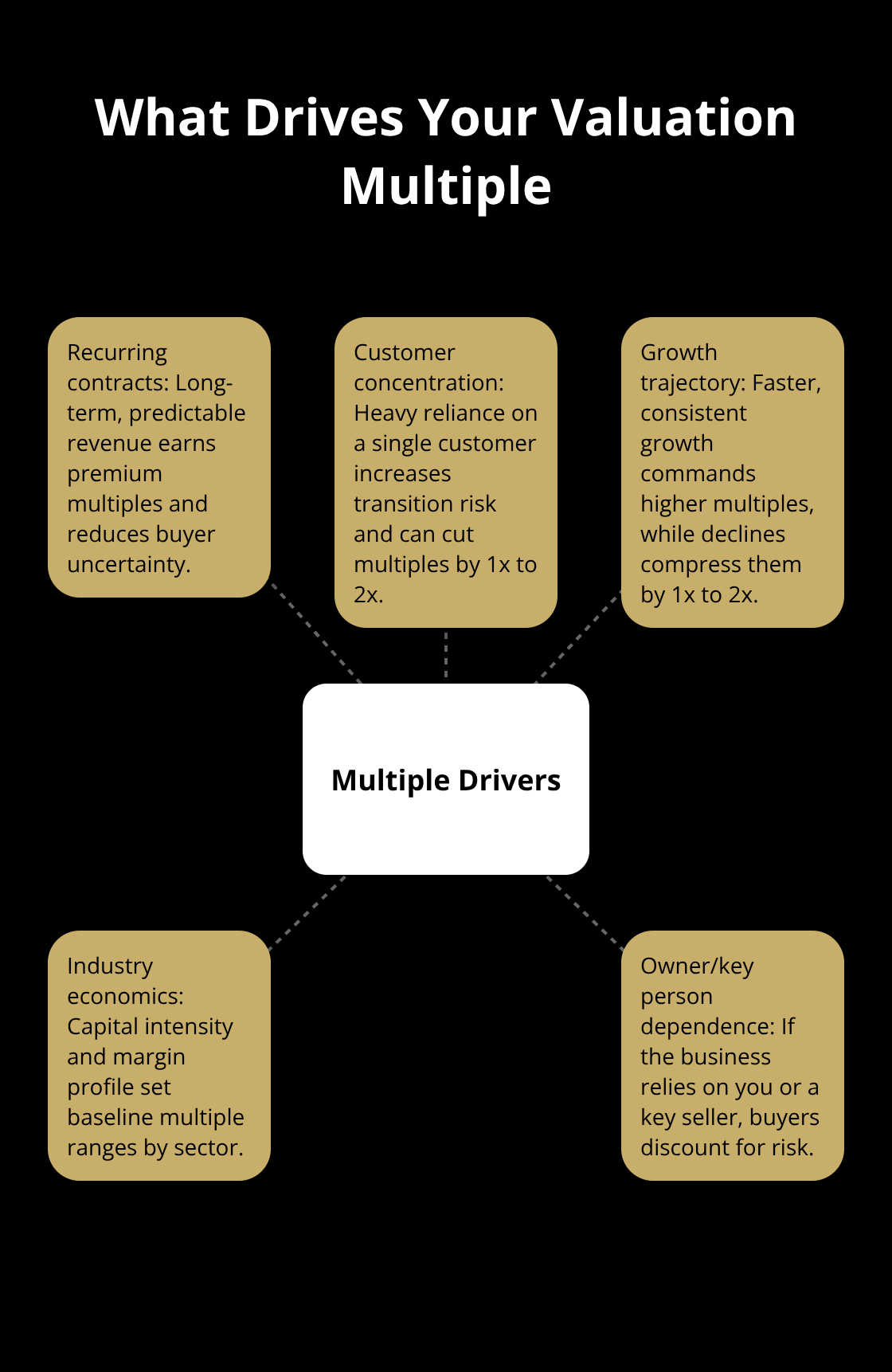
Declining businesses see multiples compressed by 1x to 2x compared to stable peers.
Customer concentration matters too. If 40 percent of revenue comes from one customer, expect buyers to reduce the multiple by 1x to 2x because they perceive transition risk. You can’t change these fundamentals in the weeks before selling, but understanding them tells you exactly where you stand and what needs attention before listing.
Common Mistakes Sellers Make When Calculating EBITDA
The mistake most sellers make is calculating EBITDA incorrectly by including personal expenses or one-time costs. If you pay yourself a $150,000 salary but a new owner could hire someone for $80,000, that $70,000 difference adds back to EBITDA. Similarly, one-time legal fees or equipment purchases don’t belong in normalized EBITDA. You need to show what a new owner would actually earn from day one.
Inflated EBITDA numbers destroy credibility instantly with sophisticated buyers. They’ve seen normalized financials hundreds of times and spot manipulation immediately. Revenue multiples provide a secondary valuation method, typically ranging from 0.5x to 3x depending on industry profitability. A high-margin SaaS business might be worth 2x to 3x revenue, while a low-margin wholesale business might only reach 0.5x to 1x revenue (these secondary metrics serve as a sanity check against EBITDA valuations).
Understanding how buyers calculate your actual earnings is only half the battle. The other half involves identifying what hidden assets and liabilities could shift your valuation significantly-sometimes by hundreds of thousands of dollars.
Hidden Assets and Liabilities That Affect Your Sale Price
Intellectual Property and Brand Value
Buyers hunt for hidden assets that generate value, and intellectual property ranks at the top of that list. Patents, trademarks, proprietary software, or unique processes can add significant value to your valuation, but only if you’ve documented and legally protected them. A recognizable brand with customer loyalty counts too, though unregistered trademarks or undocumented processes won’t move the needle because buyers can’t rely on them post-sale. Get your IP audited by a qualified attorney before listing. They’ll identify what’s actually valuable versus what’s just part of your daily operations.
Customer Contracts and Recurring Revenue Streams
Customer contracts are where real valuation gains happen. A software company with customers locked into three-year contracts at predictable monthly fees commands a much higher multiple than one selling month-to-month. Recurring revenue contracts add 1 to 2x EBITDA to the final price because they eliminate buyer uncertainty. Document contract terms, renewal rates, and customer tenure carefully. If 70 percent of your revenue renews automatically, that’s a massive selling point. If customers can cancel anytime, buyers will discount heavily.
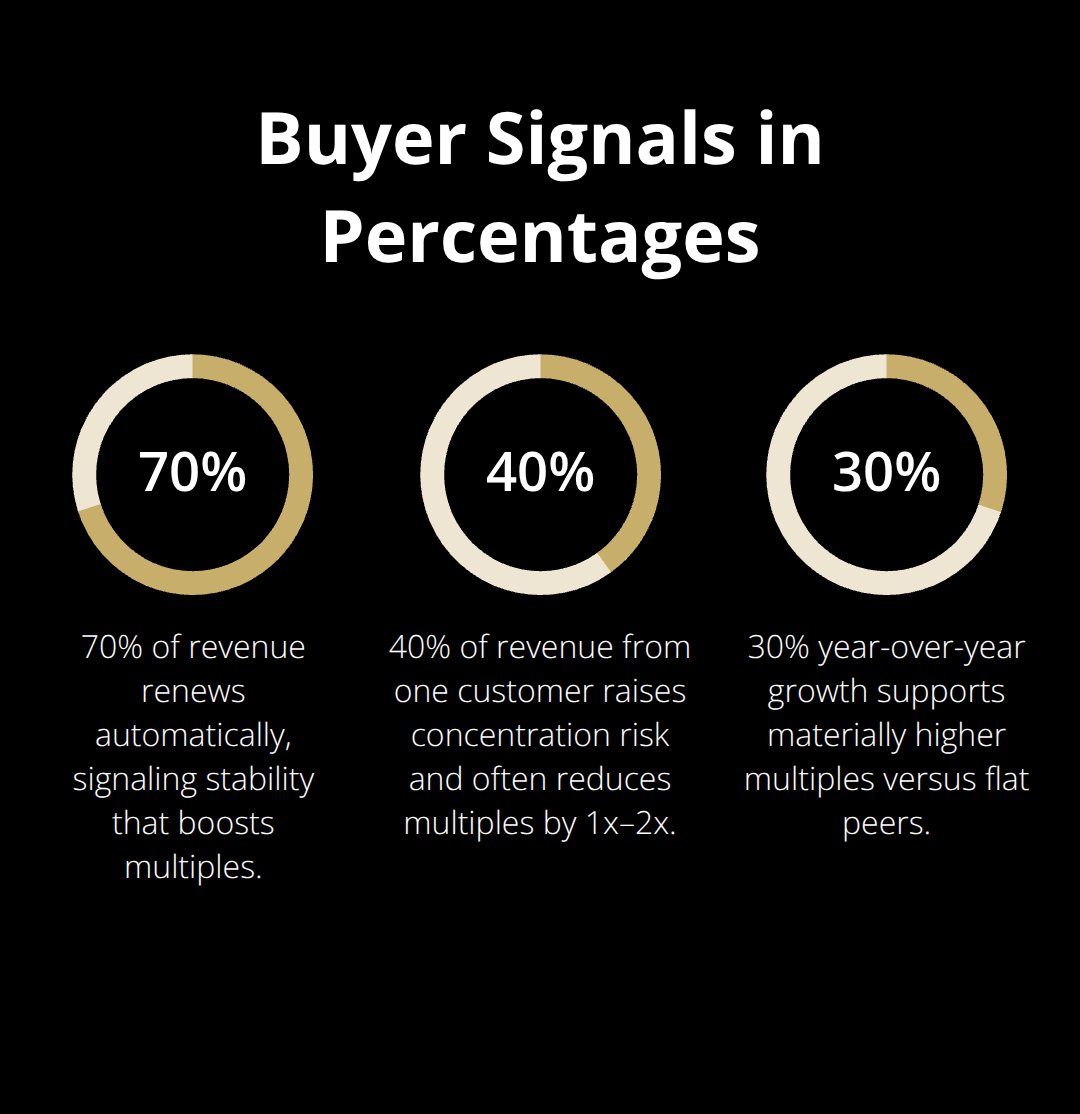
Customer concentration data matters too-show exactly how many customers you have, how long they’ve stayed, and what percentage each represents. This transparency builds confidence in your valuation and removes doubt from the buyer’s mind.
Debt and Financial Obligations
Debt reduces purchase price dollar-for-dollar in most transactions because buyers expect the seller to pay it off at closing. If you owe $300,000 on a line of credit, that amount comes directly out of your sale proceeds. This isn’t negotiable-it’s how the math works in standard deals.
Pending Lawsuits and Environmental Issues
Pending lawsuits, even small ones, trigger buyer hesitation and legal review costs that delay closing by months. Environmental issues are deal-killers-contaminated soil or compliance violations can tank valuations entirely or kill deals completely. Get a Phase I environmental assessment if your business involves manufacturing, retail with underground tanks, or real estate. Undisclosed liabilities discovered during due diligence give buyers leverage to renegotiate or walk away. The same applies to tax liens or regulatory violations. List everything problematic upfront so buyers price it in rather than using it as ammunition later.
Employee Agreements and Key Person Risk
Employee agreements matter significantly in your valuation. Non-compete clauses, key person retention, and employment contracts all affect whether a buyer can actually operate your business post-sale. If your top salesperson can leave the day after closing, that’s a major liability. Buyers will reduce the multiple by 1 to 2x if key employees aren’t locked in. Get employment agreements in writing before you list, especially for revenue-generating staff.
These hidden factors-both assets and liabilities-shape what buyers will actually pay far more than your raw EBITDA number. But identifying them is only part of the equation. You also need to present your financial records in a way that proves your valuation to skeptical buyers.
Preparing Your Financial Records for Maximum Valuation
Organize Tax Returns and Bank Statements
Buyers don’t trust what you tell them about your business-they trust what your numbers prove. The gap between what you think your business is worth and what buyers will actually pay often comes down to financial documentation. Sloppy records, missing statements, or inconsistent reporting will tank your valuation faster than any operational weakness. Your tax returns, bank statements, and profit-and-loss statements need to tell a clean, consistent story that a buyer’s accountant can verify in minutes, not weeks.
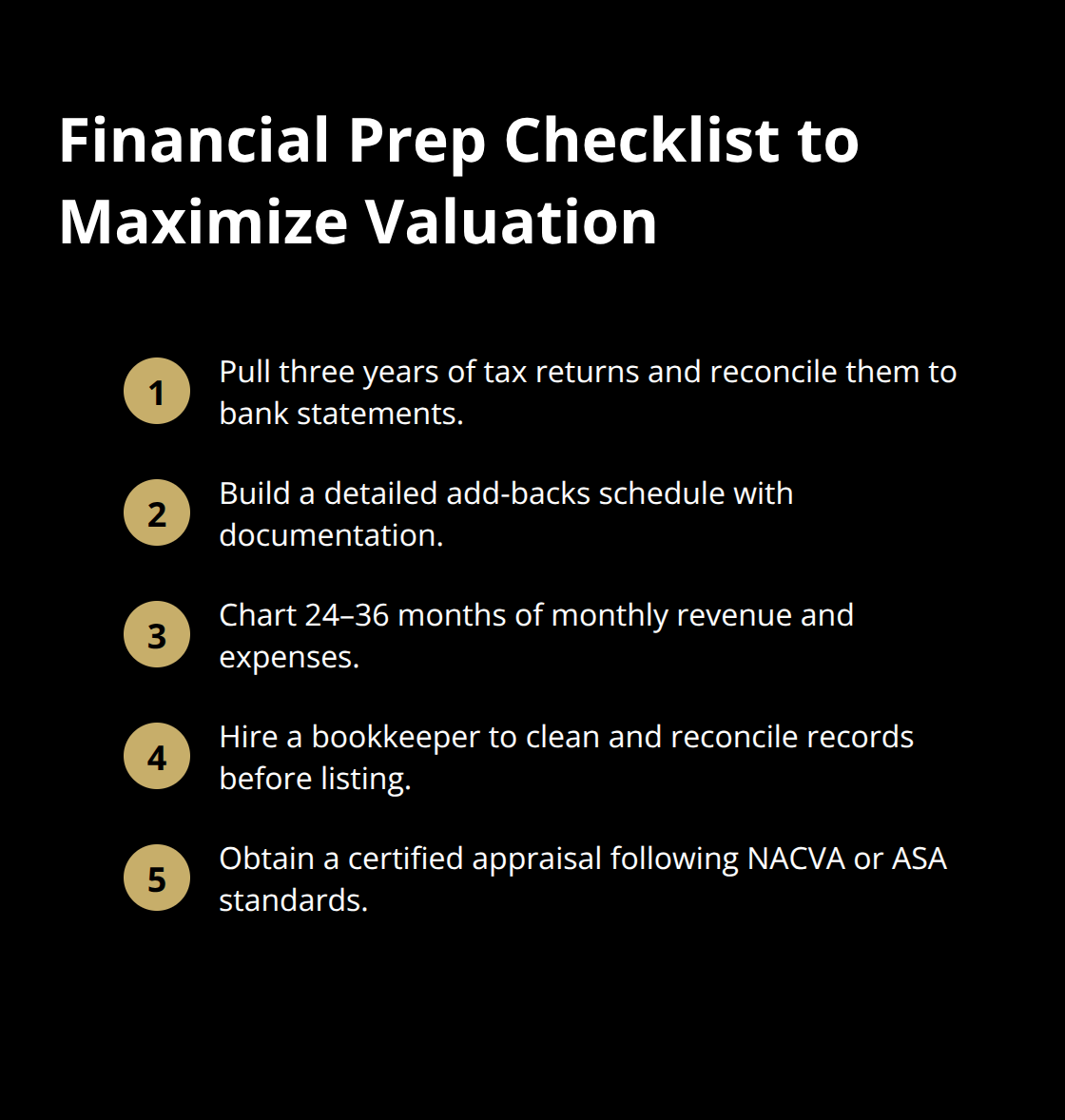
Start with three years of tax returns and compare them line-by-line to your bank statements. Discrepancies between what you reported to the IRS and what actually moved through your accounts will destroy credibility immediately. If your tax returns show $500,000 in revenue but your bank deposits average $350,000, a buyer will assume you’re either hiding income or your numbers are unreliable.
Document Add-Backs and EBITDA Adjustments
Many sellers fail to document add-backs properly-those personal expenses or one-time costs that should increase normalized EBITDA. Create a detailed spreadsheet showing every adjustment you’re making to EBITDA, with explanations and supporting documentation. A $50,000 owner salary adjustment needs proof that the market rate for your replacement is actually $50,000, not just your guess. Use salary databases like PayScale or Bureau of Labor Statistics data to back up these claims.
This transparency matters because buyers’ accountants will scrutinize every add-back. Unsupported adjustments get rejected, which lowers your final valuation.
Track Cash Flow Trends Over Time
Documenting cash flow trends matters more than a single year’s snapshot. Buyers want to see if your business is growing, flat, or declining over 24 to 36 months. Create month-by-month revenue and expense charts for the past three years so patterns become obvious-seasonal dips, growth acceleration, or margin compression all tell a story that influences the multiple a buyer will pay.
If you’ve tracked finances manually in spreadsheets or accounting software without proper reconciliation, hire a bookkeeper or accountant to clean everything up before listing. The cost of a professional cleanup (typically $2,000 to $5,000) pays for itself if it prevents a 0.5x to 1x multiple reduction during negotiations.
Get a Professional Business Appraisal
After your records are organized, obtain a professional business valuation from a certified appraiser who follows NACVA or ASA standards. This isn’t just about having a number to list-it’s about having a defensible valuation that a buyer’s due diligence team can’t easily challenge. A professional appraisal typically costs $3,000 to $8,000 depending on business complexity, but it becomes your strongest negotiating tool when a buyer questions your asking price.
The appraiser will identify which metrics matter most to your specific industry and business model, removing guesswork from your positioning strategy. This expert assessment gives you confidence in your numbers and removes doubt from buyer conversations.
Final Thoughts
Buyers care about three things: cash generation, stability, and risk. EBITDA multiples prove cash generation. Customer contracts and recurring revenue prove stability. Clean financial records and documented assets prove you’ve minimized risk. Verify your EBITDA calculation matches what your accountant would defend in court, pull three years of tax returns and bank statements side-by-side to confirm consistency, and document every add-back with real market data, not assumptions.
Identify your hidden assets-patents, trademarks, customer contracts, brand recognition-and confirm they’re legally protected and documented. Surface every liability upfront: pending lawsuits, debt obligations, key person dependencies, environmental issues. Buyers will find these anyway during due diligence, so disclosing them removes negotiating ammunition and builds trust. Your financial records are your strongest selling tool, and messy bookkeeping costs you multiples while clean records add tens of thousands to your final price.
Practical business valuation isn’t about inflating numbers or hiding problems-it’s about presenting your business accurately so buyers understand what they’re actually purchasing. We at Unbroker built our platform specifically for sellers who want transparency in the valuation and sale process, offering straightforward options with no hidden fees whether you want full-service support or expert guidance while maintaining control. Your business deserves a fair valuation backed by real metrics, not broker pressure or inflated promises.