Most business owners spend years building something valuable, then walk away without a plan. At Unbroker, we’ve seen how the right exit strategies for owners can mean the difference between a comfortable retirement and financial regret.
The good news? You don’t need to figure this out alone. This guide walks you through every option available to you.
Why Most Business Owners Never Plan Their Exit
Around 80% of business owners won’t be prepared to exit successfully, according to exit planning research. This isn’t because they lack opportunity-it’s because they treat exit planning as something to handle later, when retirement suddenly arrives. The reality is stark: only 30% of family-owned businesses survive into the second generation, according to the SBA. That statistic alone should shake any owner who assumed their life’s work would simply transfer to the next generation without intentional planning. Most owners have between 70% and 80% of their net worth tied up in their business, yet they spend more time planning a vacation than planning how to convert that equity into retirement security.
The Cost of Waiting Until the Last Minute
Owners who start exit planning less than three years before they want to sell face a compressed timeline that destroys value. A typical sale takes 9 to 18 months just to find the right buyer, then another 1 to 3.5 years of earnout periods where you’re still managing the transition. Starting with only two or three years of runway forces you into rushed decisions-accepting lower offers, settling for buyers who misalign with your values, or worse, liquidating assets at fire-sale prices. Buyers know when you’re desperate. They’ll exploit short timelines by demanding discounts, requesting lengthy earnouts, or walking away entirely because they sense instability. A business that can’t operate without you sitting in the owner’s chair becomes exponentially harder to sell. Buyers pay premiums for businesses with independent management teams and clean financial records-not for operations dependent on the founder’s daily involvement.
Why the First Five Years Matter Most
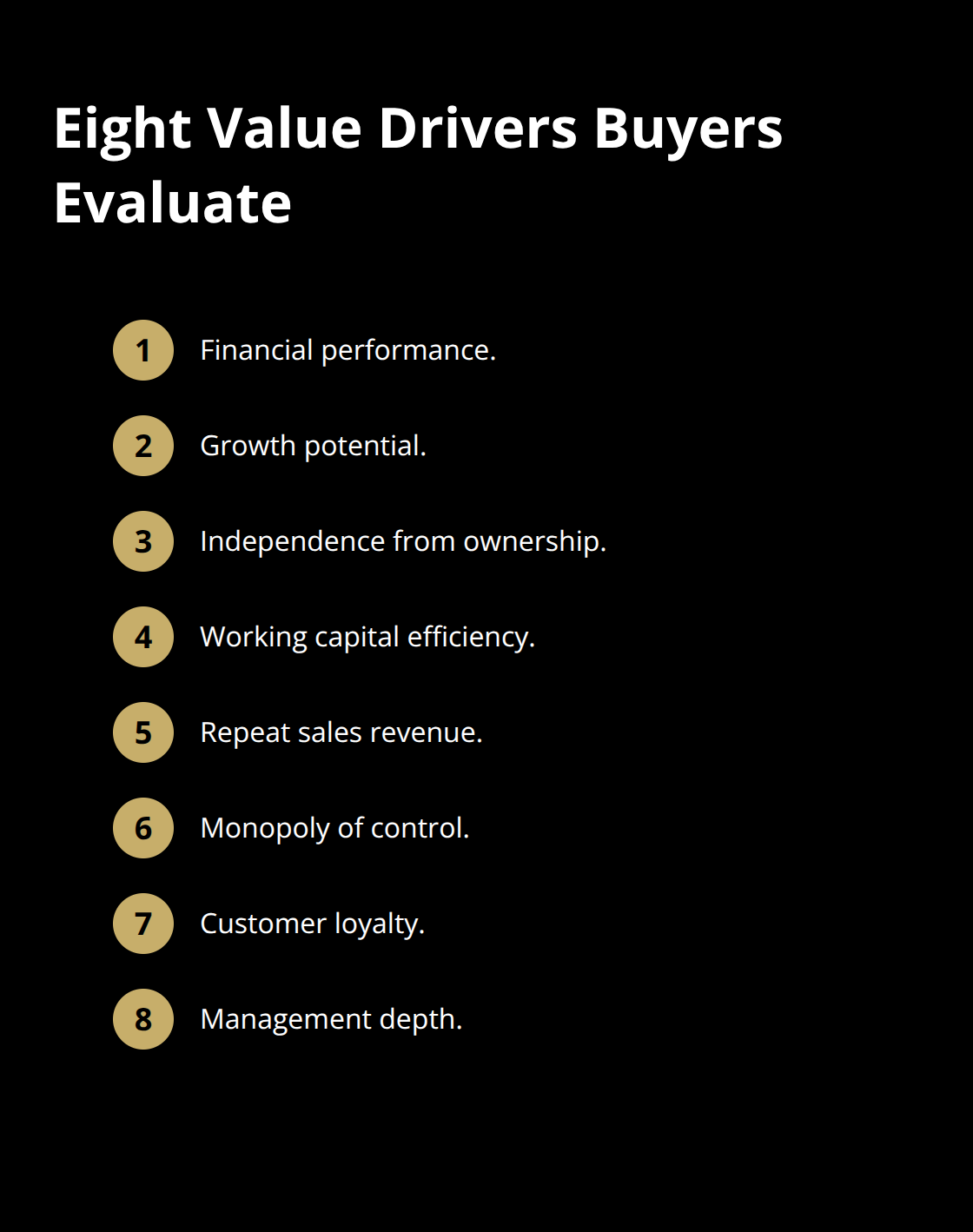
Start exit planning now, even if retirement feels distant. Five years gives you time to strengthen the eight value drivers that buyers actually evaluate: financial performance, growth potential, independence from ownership, working capital efficiency, repeat sales revenue, monopoly of control, customer loyalty, and management depth. Each of these takes time to build.
You can’t manufacture a proven management team in six months. You can’t suddenly create recurring revenue streams if your business model was transactional. You can’t clean up three years of messy financials in time for due diligence if the buyer’s accountant starts digging. Early planning also gives you flexibility. If market conditions shift, you can adjust your timeline. If personal circumstances change (health issues, family needs, burnout), you have options instead of panic. Owners who plan early typically achieve 20% to 40% higher valuations than those who rush, simply because the business itself is stronger and more attractive to serious buyers.
What Happens When You Start Now
The exit planning process typically follows three phases: discovery (about a month, including valuation and readiness assessments), a prioritized action plan, and setting 1–3 year goals focused on margin improvement and value growth. During discovery, you’ll work with an exit planning advisor and your accountant to understand where your business stands today. This phase reveals which value drivers need the most attention and which ones already work in your favor. The action plan that follows prioritizes specific steps-whether that means hiring a management team, implementing systems that reduce your daily involvement, or restructuring revenue to include more recurring contracts. These aren’t theoretical exercises. They’re concrete changes that directly impact what a buyer will pay. The final phase focuses on execution. You hit your margin targets, you build your team, you document your processes. Each quarter, you measure progress against your goals. This structured approach transforms exit planning from an overwhelming task into a manageable series of steps.
The Real Advantage of Preparation
Preparation separates owners who sell at fair value from those who accept whatever offer arrives. A well-prepared business attracts multiple buyers, which creates competition and drives price up. Buyers see a business that runs without the owner, has clean financials, and generates predictable revenue. They see lower risk. They see a smoother transition. That confidence translates directly into higher offers and better terms. The opposite is also true. A business dependent on the owner, with disorganized records and inconsistent revenue, signals risk to every potential buyer. They’ll either walk away or demand steep discounts to compensate for the work they’ll need to do post-acquisition. The difference between these two scenarios often amounts to hundreds of thousands of dollars-sometimes more. That’s not theoretical. That’s the difference between a comfortable retirement and financial stress. The path forward starts with understanding which exit strategy actually fits your goals and your business. That’s where the real work begins.
Your Four Main Exit Paths
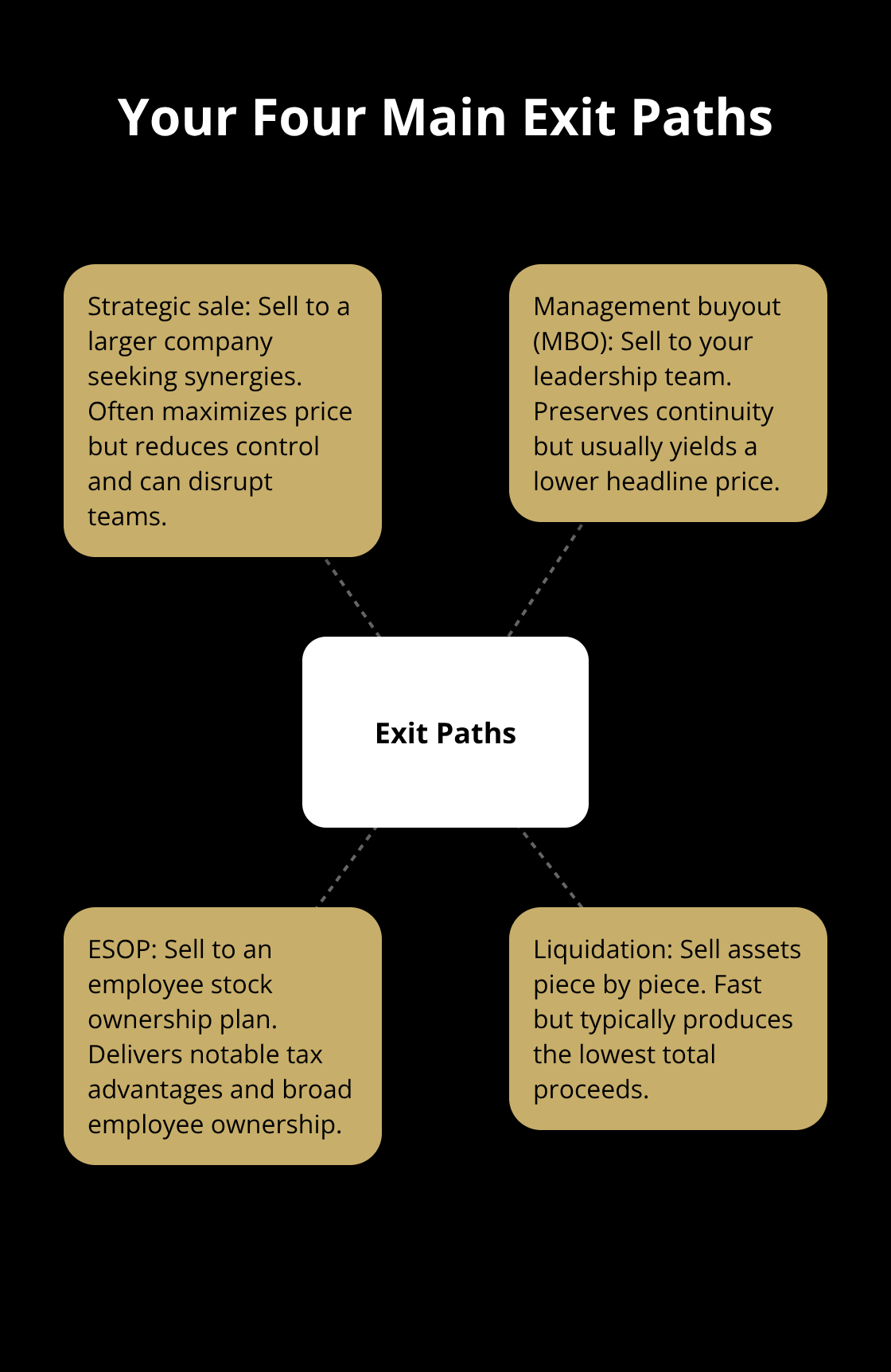
When you’re ready to exit, you face fundamentally different choices, each with distinct financial outcomes and personal implications. The path you choose shapes not just what you’ll earn, but how much control you retain during the transition and what happens to your employees afterward. Most owners assume they’ll sell to an outside buyer, but that’s only one option-and often not the best one for their specific situation. Your business, your goals, and your financial needs dictate which exit strategy actually makes sense. A sale to a strategic buyer generates different proceeds than passing the business to family. An employee stock ownership plan (ESOP) creates tax advantages that liquidation never will. Understanding these four paths means understanding which one aligns with both your retirement needs and your values about what happens after you step away.
Strategic Buyers Pay for More Than Your Revenue
Strategic buyers-typically larger companies in your industry or adjacent sectors-represent the most frequent exit route for business owners. According to the SBA, traditional third-party sales remain the most common exit strategy, with private equity firms and other investors from outside your local market increasingly active in acquisitions. These buyers pay for your business plus the value of what it brings to their operations: your customer base, your processes, your market position. Strategic buyers pay for more than revenue; they calculate a synergy premium based on the present value of future synergy benefits generated in the merged entity. That integration value can add 15% to 40% to your sale price compared to a financial buyer with no operational synergies.
However, strategic sales take time. You typically face 9 to 18 months to identify the right buyer and close the deal, then another 1 to 3.5 years of earnout periods where your compensation depends on hitting performance targets post-sale. This matters because earnout payments often fail to materialize as promised. Disputes over whether you hit your targets, disagreements about how revenue gets counted, and changes in how the acquiring company operates can all reduce what you actually receive. Work with your attorney to build earnout terms carefully, and assume you’ll fight to collect every dollar.
The advantage of a strategic sale is clear: you’re selling to someone with deep pockets and real motivation to pay fairly. The disadvantage is equally clear: you lose control, your team faces potential layoffs, and your customers might experience service disruptions during integration.
Management Buyouts and ESOPs Keep Your Legacy Alive
When your management team has the capital and capability to purchase your business, a management buyout (MBO) offers a middle path between selling to outsiders and transferring to family. Your team already understands the business, knows your customers, and can often secure financing because lenders see continuity and lower risk. Management buyouts and ESOPs keep your legacy alive; ESOPs provide real tax advantages including the ability for selling owners to defer capital gains taxes on sale proceeds if reinvested in qualified replacement property, and companies receive tax deductions for ESOP contributions.
However, ESOPs demand serious infrastructure. You need an independent ESOP trustee, ERISA compliance documentation, and careful governance planning to ensure the arrangement actually benefits employees rather than becoming a shell that concentrates control. ESOPs work best in stable, profitable businesses with strong management depth and predictable cash flow-not in startups or highly volatile operations.
The real benefit of MBOs and ESOPs is continuity. Your employees keep their jobs, often with improved ownership stakes. Your customers experience minimal disruption because the same people run the business. Your legacy survives because the company continues operating under principles you established. The financial trade-off is that management teams and employees typically can’t pay what an outside strategic buyer would offer. You’re trading maximum dollars for business continuity and employee welfare.
Family Succession Demands Honest Assessment of Capability
Passing your business to family members feels natural, but only 30% of family businesses survive to the second generation, with just 12% making it to the third generation and 3% operating into the fourth generation and beyond.

This reveals the hard truth: most families lack either the capability or the willingness to run what you’ve built. Emotional attachment clouds business decisions. Sibling rivalries emerge when one family member gets more responsibility than another. Heirs who never built a business from scratch often lack the discipline and work ethic required to maintain what they inherited.
If you’re seriously considering family succession, you need professional outside advisors-not just family discussions-to evaluate whether your intended successor actually possesses the skills to lead. This means real performance metrics, not hopes. Can they make hard hiring and firing decisions? Do they understand your financials? Have they proven they can handle stress without falling back on family relationships to solve problems?
Family transfers also create tax complexity. A formal valuation becomes essential to establish fair market value for tax purposes and to prevent disputes with the IRS. Many family transfers use installment sales where the owner finances part of the purchase, creating ongoing payments for years. This approach can work, but it means you’re betting your retirement income on your family’s ability to execute. If the business struggles post-transfer, your payments might not arrive. If family conflict erupts, collecting what you’re owed becomes impossibly complicated.
Liquidation: The Path of Last Resort
Liquidating your assets represents the fastest exit but typically yields the lowest financial return. You sell off inventory, equipment, and customer contracts individually rather than selling the business as a going concern. Liquidation destroys value because buyers purchase individual assets at wholesale prices, not at the premium you’d command for an operating business. Customer relationships and ongoing operations don’t get monetized-they simply disappear.
Liquidation makes sense only when no other option exists: your business is unprofitable, you face health crises that force immediate exit, or market conditions have deteriorated so severely that buyers won’t emerge. Even then, try to explore whether a strategic buyer might purchase your customer list or contracts before you resort to asset sales. The difference in proceeds can be substantial.
Each of these four paths requires different preparation, different timelines, and different financial outcomes. The choice you make now determines not just your retirement security, but what happens to the people and customers who depend on your business. That’s why understanding which path actually fits your situation-not which path sounds easiest-matters more than anything else in your exit planning.
Getting Your Business Ready to Sell
Buyers purchase businesses based on what they actually are right now, documented and verified. This is why most business owners fail at exit planning before they even list their business for sale. They assume their operating reality matches what they believe about their business, then face shock when buyers demand lower prices because the financials tell a different story. The fix starts with three concrete actions that separate owners who sell at fair value from those who accept discounts.
Clean Financial Records Attract Serious Buyers
Your financial records must be clean, consistent, and verifiable across at least three to five years of tax returns and monthly statements. Buyers will recast your financials, meaning their accountants will remove personal expenses you’ve embedded in the business, adjust for one-time events, and recalculate normalized EBITDA to understand what cash the business actually generates. If you’ve run personal expenses through the company-claiming meals and travel that blur the line between business and personal-your stated profitability vanishes during due diligence.
Buyers then demand steep discounts because they can’t trust your numbers. Start now by separating personal and business expenses completely. If you take a car allowance, pay yourself a clear salary, or use the business for personal travel, document it separately rather than burying it in operating expenses. Your accountant should produce monthly financial statements that show revenue, cost of goods sold, operating expenses, and EBITDA clearly. If you’ve never had monthly statements prepared, start immediately. Buyers will ask for them, and their absence signals either disorganization or hidden problems.
Build Systems That Operate Without You
Your business must operate without you making every decision. Most owners remain the single point of failure in their own companies. Customers call you for approvals. Employees wait for your direction before moving forward. Key processes exist only in your head. Buyers see this dependency and immediately discount your valuation because they’re inheriting operational risk.
To fix this, document your critical processes in writing over the next twelve months. Not vague descriptions, but step-by-step procedures that someone new could follow. Identify your top five revenue-generating or customer-retention processes, then assign ownership to specific managers or team members. Have those people execute the processes for at least three months while you observe, then step back entirely. If the business falters without you, you’ve identified your real problem. If it runs smoothly, you’ve just proved to a future buyer that the business doesn’t depend on your daily involvement. This distinction can add 20 to 30 percent to your valuation.
Address Legal and Tax Issues Before Due Diligence
Work with an attorney to review your contracts with customers, suppliers, and employees. Verify that non-compete agreements exist where they should, that intellectual property ownership is documented clearly, and that any ongoing litigation or regulatory issues are disclosed. Buyers will conduct thorough due diligence, and surprises discovered late in the process tank deals or trigger massive price reductions.
Have your tax advisor verify that you’re properly classified as an S-Corp or C-Corp for your specific situation, that your payroll tax filings are current, and that you haven’t created unexpected tax exposure through prior transactions. This preparation prevents costly disputes and keeps negotiations on track.
Commission a Professional Business Valuation
A professional business valuation from a qualified professional matters far more than an online calculator or rough multiple of revenue. A real valuation considers your normalized cash flow, growth trajectory, customer concentration, competitive position, and market comparables. This valuation becomes your anchor for negotiations and helps you understand whether your retirement goals are even realistic given your business value and your timeline.
If the gap between your business value and your retirement needs is too large, you have years to close it by improving margins, building recurring revenue, or extending your exit timeline. The valuation also reveals which value drivers need the most attention before you approach potential buyers.
Final Thoughts
Exit planning starts now, not when retirement arrives. The owners who exit successfully share one critical insight: they built their exit strategies for owners years before they actually needed to leave. They recognized that no single path works for everyone-your financial goals, your business capabilities, and your vision for what happens after you step away all shape which strategy actually fits.
Eighty percent of business owners won’t prepare adequately for exit, which means most accept lower valuations, face compressed timelines, or settle for buyers misaligned with their values. Start by cleaning your financials and building systems that operate without you. Commission a professional valuation to verify whether your business value supports your retirement goals. Then select your exit path based on facts, not assumptions. We at Unbroker help you sell your business efficiently while keeping more of what you’ve earned, whether you want hands-off support or prefer to lead the process yourself.
Your business represents decades of work and sacrifice. The right exit strategy transforms that effort into the retirement security you’ve earned.