Selling a business requires more than just listing it online. The right marketing approach can dramatically increase buyer interest and final sale price.
At Unbroker, we’ve seen firsthand how robust marketing tools separate successful exits from mediocre ones. This guide walks you through the strategies that actually work.
What Makes Your Business Attractive to Buyers Before You Even List It
Your business’s digital footprint tells potential buyers everything about its health and scalability before they meet you. A scattered online presence signals operational chaos; a cohesive one signals a well-run operation worth acquiring. Audit what exists right now. Search your business name and see what appears. Check your website’s mobile responsiveness, load speed, and whether your contact information stays consistent across Google Business Profile, LinkedIn, and industry directories. According to data from Sprout Social, 73% of consumers prefer to learn about products and services through social media, which means buyers are already looking there.
Your online channels must work together
Your LinkedIn company page should showcase your team, recent wins, and company culture with posts at least 3–5 times weekly. Your website should be professionally designed with clear descriptions of what you offer, your customer base, and your market position. If your site looks outdated or broken, fix it now-don’t wait. Canva makes creating professional graphics and landing pages simple even if you lack design skills. Semrush reveals which keywords your competitors rank for, helping you identify content gaps that attract qualified buyer attention.
Financial transparency builds buyer confidence
Buyers want to see clean, documented proof of revenue and growth. Organize your financial records into a clear dashboard showing monthly or quarterly revenue trends, customer acquisition costs, and profit margins for at least the past three years. Tools like Google Analytics 4 provide event-based tracking across platforms, letting you show exactly how marketing activities drive revenue-this attribution matters enormously during due diligence. Document your customer base size, retention rates, and lifetime value; if you lose customers, that’s a red flag buyers will spot anyway, so address it now. An essential business valuation checklist helps ensure you’ve captured all key financial factors before listing.
Social proof accelerates buyer decisions
Create case studies or testimonials from your top customers that demonstrate real business impact. These aren’t generic praise-they’re specific examples like how a customer increased efficiency by 40% using your product or saved $50,000 annually. Your marketing materials should weave these metrics throughout. A one-page executive summary that leads with your strongest numbers sets the tone for everything that follows and positions you to move into the next critical phase of reaching the right buyers through the right channels.
How to Reach Serious Buyers Across the Right Channels
Most business sellers make a critical mistake: they list their business in one or two marketplaces and hope qualified buyers show up. That approach leaves money on the table. Serious buyers shop across multiple platforms, and each platform attracts different buyer profiles. BizBuySell, Flippa, Empire Flippers, and industry-specific marketplaces all have distinct audiences. A software business might sell faster on Flippa, while a service-based operation gains traction on BizBuySell.
Identify where your ideal buyer searches
The first actionable step is to audit where your ideal buyer spends time researching acquisitions. If you’re selling a digital marketing agency, LinkedIn is where agency buyers actively search for targets. If you’re selling an e-commerce store, Flippa and specialized marketplaces dominate. Once you identify the right platforms, optimize each listing differently. Don’t copy-paste the same description everywhere. Tailor headlines, emphasize metrics buyers care about on that specific platform, and use platform-native tools to highlight growth trajectories. Include your revenue breakdown, customer concentration, and marketing channel performance because buyers want to understand exactly where money comes from and how repeatable it is.
Use targeted advertising to reach acquisition decision-makers
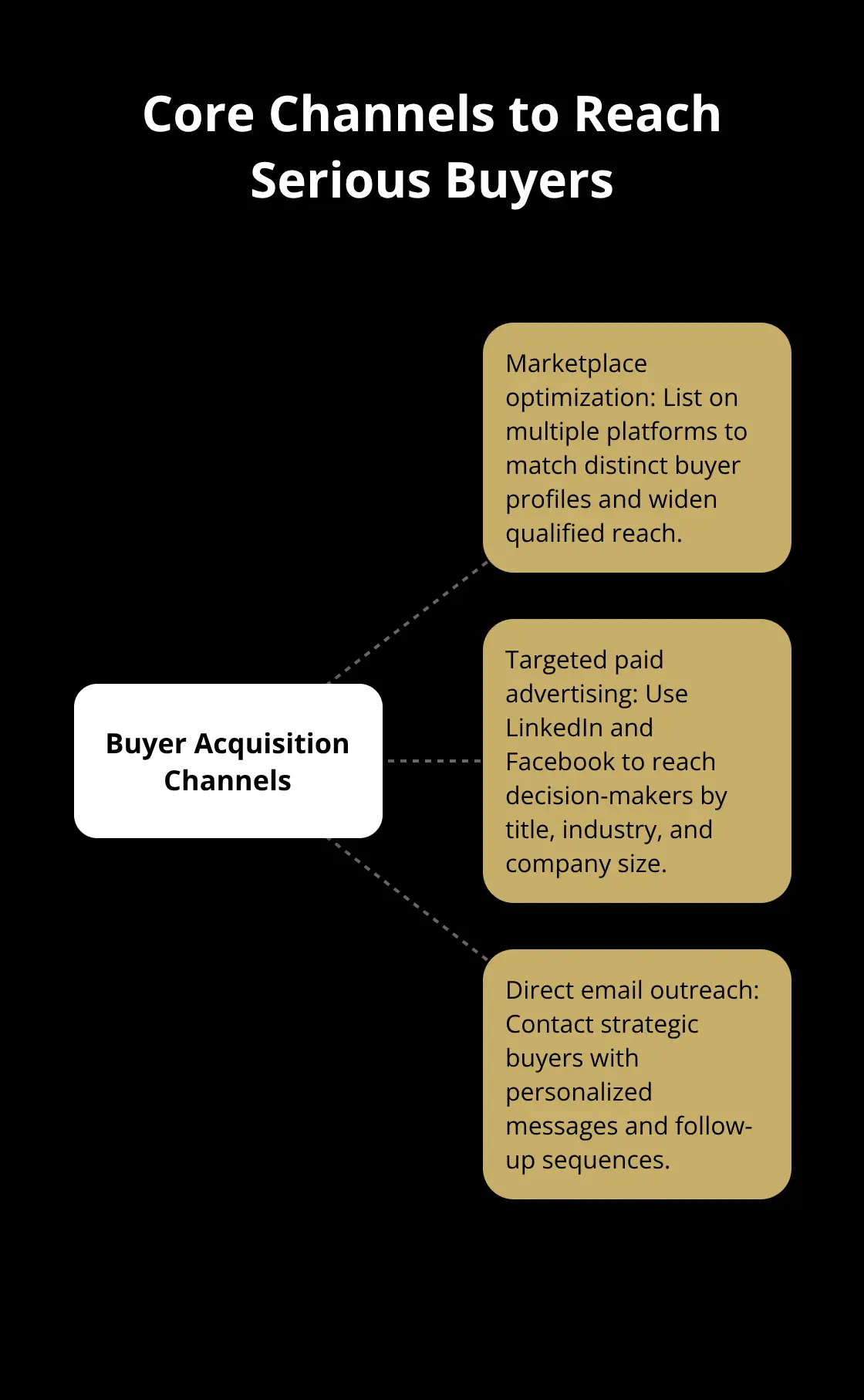
Professional marketing tools that distribute your listing across multiple channels simultaneously accelerate serious inquiries far more than passive marketplace listings alone. Facebook and LinkedIn advertising let you reach business buyers with surgical precision. LinkedIn’s targeting options allow you to reach users by job title, company size, and industry, meaning you can show ads specifically to acquisition managers and business development leaders actively hunting for acquisitions. Set a realistic budget of $1,000 to $3,000 per month for three months before sale to build momentum. Your ad creative should avoid generic sales language and instead highlight financial metrics, growth rates, and competitive moats that matter to acquirers.
Execute direct outreach to strategic buyers
Email outreach remains underutilized but highly effective when executed with research. Build a list of strategic buyers-competitors looking to expand, private equity firms targeting your industry, or larger companies seeking bolt-on acquisitions. Reach qualified prospects through targeted buyer networks to connect with vetted, ready-to-engage acquisition decision-makers. Personalized emails generate better response rates, engagement, and ROI compared to generic outreach. Tools like Mailchimp segment your audience by buyer type and automate follow-up sequences while maintaining a personal touch.
The combination of marketplace optimization across multiple platforms, targeted paid advertising, and direct email outreach creates multiple pressure points that attract serious buyers willing to move fast and pay premium prices. With your buyer channels activated and your messaging refined, the next step is to position your business as the obvious choice among competing opportunities.
What Makes Your Business Stand Out to Acquisition Decision-Makers
Buyers evaluating your business compare it against competing opportunities simultaneously. They’ve already seen dozens of listings. Your job is to make them stop scrolling and focus entirely on you. This happens when you articulate exactly what makes your business defensible and why its revenue repeats reliably. Most sellers describe what they do rather than proving why their market position resists replication. You need to show your competitive moat in concrete terms. If you maintain customer retention rates above 85%, that’s a moat. If your brand commands premium pricing 20% higher than competitors, that’s a moat. If referrals drive your customer acquisition rather than paid advertising, your business scales without proportional spending increases. Document these advantages with specific numbers from your financial records and analytics tools. Semrush and Google Analytics 4 reveal which channels attract your most profitable customers and which segments retain longest. Present this analysis directly in your executive summary so buyers immediately understand why your business outcompetes others they’re considering.
Customer Stories Outweigh Generic Claims
Case studies from real customers carry far more weight than statements like “we deliver great results.” When a customer tells a specific story about solving a concrete problem with your product, buyers believe it because an independent source validates it. Collect three to five detailed customer stories that showcase different customer types, industries, or use cases. Each story should include the customer’s initial challenge, the specific solution you provided, and measurable outcomes (revenue increase, cost savings, efficiency gains). Nielsen research shows that 84% of people trust recommendations from people they know more than traditional advertising. Your case studies function as recommendations from real users. Organize these stories into a one-page format per story with the customer’s name, role, company, problem statement, and results. Video testimonials work even better than written case studies because buyers hear genuine emotion and conviction in a customer’s voice. A 60-second video of a satisfied customer explaining how you solved their problem creates immediate emotional connection and trust.
Revenue Visibility Determines Valuation Premium
Buyers pay multiples of revenue based partly on how clearly they project future growth. If your business shows consistent month-over-month or year-over-year growth, that justifies a higher valuation multiple. If growth appears erratic or unexplained, buyers assume it’s unsustainable and discount accordingly. Present your growth story visually using dashboards that show revenue trends, customer growth, and marketing channel performance over the past three years. Show which channels produce your most profitable customers and which retain longest. If you’ve successfully scaled one marketing channel, buyers see a playbook they can replicate to grow the business further post-acquisition. Most acquisition decision-makers focus on whether the business can grow 20% to 30% annually under new ownership. Demonstrate this is possible by showing your historical growth rate and explaining which levers remain untapped. Perhaps you’ve only tested LinkedIn advertising when Facebook and Google remain unexplored. Perhaps you’ve focused on one geographic market when expansion opportunities exist. State explicitly what growth runway remains ahead so buyers visualize the value they’ll unlock after acquisition.
Competitive Advantages Attract Premium Offers
Articulate what makes your business harder to replicate than competitors. High customer retention, brand premium pricing, or referral-driven growth all signal defensibility. Buyers pay more for businesses that generate revenue through repeatable, low-cost channels. If your marketing engine runs primarily on word-of-mouth or existing customer relationships, that’s worth significant premium because new owners inherit those advantages without rebuilding from scratch. Contrast this with businesses dependent on paid advertising-those require continuous spending to maintain revenue. Show buyers exactly which revenue streams require minimal ongoing investment and which ones scale efficiently. This distinction directly impacts how much they’ll pay and how confident they feel about post-acquisition growth.
Growth Runway Visibility Justifies Higher Multiples
Buyers evaluate not just current performance but future potential. If you’ve penetrated only 30% of your addressable market, that’s runway. If you’ve tested only one sales channel when three others exist, that’s runway. If you operate in one geography when expansion opportunities exist, that’s runway. Explicitly map these opportunities in your marketing materials so buyers see the growth story you’ve built and the growth story they can build. This visibility justifies premium valuations because acquisition decision-makers calculate returns based on post-acquisition growth potential, not just current revenue.
Final Thoughts
Marketing your business strategically before sale directly determines how many qualified buyers engage and what price they’ll offer. You build financial transparency through dashboards, establish credibility with customer stories, and position your competitive advantages so buyers immediately understand why your business deserves a premium valuation. Robust marketing tools available today make this execution straightforward-Google Analytics 4 tracks exactly how your marketing drives revenue, Semrush reveals competitive gaps you can fill, and Canva lets you create polished materials without hiring agencies.
Your business’s growth runway matters enormously to acquisition decision-makers. Buyers pay more when they see untapped opportunities: unexplored marketing channels, geographic expansion potential, or customer segments you haven’t penetrated. You document these explicitly so buyers visualize the value they’ll unlock post-acquisition.
The sellers who achieve premium valuations treat the pre-sale period as a marketing campaign. They audit their online presence, organize financial records into clear dashboards, collect customer testimonials, and articulate their competitive moat in concrete terms. Unbroker connects you with qualified buyers and provides the support you need to execute this strategy effectively.