Selling a business is one of the biggest financial decisions you’ll make. Most owners wait too long to start planning, which costs them money and creates unnecessary stress.
Exit planning basics aren’t complicated, but they do require focus. We at Unbroker help business owners understand what buyers actually want and how to position your company for maximum value.
What Exit Planning Really Does
Exit planning isn’t about abandoning your business tomorrow-it’s about building the infrastructure that lets you leave on your terms. According to the Exit Planning Institute, 75% of business owners plan to exit within ten years, yet most never take a single concrete step to prepare. That gap between intention and action costs owners significant money. A business without an exit plan typically sells for less because buyers see operational risk, unclear processes, and dependency on the owner. Exit planning changes this by forcing you to document how your business actually runs, identify which customers matter most, and prove the operation can survive without you.

The moment you start planning is the moment you stop being a business owner who happens to have a company and start being a business that can function independently. This shift in perspective determines whether a buyer sees a sustainable asset or a risky bet.
Why Most Owners Wait Too Long
The biggest mistake business owners make is treating exit planning as something for later. Waiting until you’re ready to sell means you’re starting from a weakened position. The Business Enterprise Institute recommends spending time preparing your business for sale, and that timeline isn’t arbitrary-it reflects how long meaningful improvements take. If you have only six months before approaching buyers, you can’t restructure your customer contracts, build management depth, or clean up financial inconsistencies. A multi-year head start lets you diversify your customer base so no single client represents more than 15% of revenue, a threshold that significantly impacts valuation. It gives you time to document standard operating procedures, reduce your personal involvement in day-to-day operations, and prove the business generates consistent cash flow without you making every decision. Owners who start early also have time to fix problems-collecting past-due receivables, writing off unrecoverable amounts, and reconciling personal loans mixed into business finances-which speeds due diligence and prevents deal delays.
The Real Cost of Misconceptions
Many owners believe selling is a quick transaction where a buyer shows up, makes an offer, and the deal closes within weeks. The reality is different. Most deals take ninety to one hundred twenty days from signing the letter of intent to closing, and that’s after months of marketing and buyer qualification. Another common misconception is that your business’s value is whatever you decide it’s worth. Buyers calculate value based on revenue trends, profitability margins, customer retention rates, and how much cash the business generates-not emotional attachment to what you’ve built. The Exit Planning Institute data shows that 74% of small businesses under $500,000 had no exit planning, which explains why many owners discover their company is worth far less than expected when they finally approach buyers. Exit planning forces you to separate your personal identity from your business identity and see it through a buyer’s eyes. That perspective shift alone changes how you make operational decisions and where you invest your time and resources over the years ahead.
What Buyers Actually See
When a buyer evaluates your business, they assess three core areas: financial performance, operational stability, and growth potential. Financial performance means they review your last three years of profit and loss statements, balance sheets, and cash flow reports to verify the numbers you claim. Operational stability reveals whether your business depends entirely on you or whether systems and people can run it without your constant involvement.
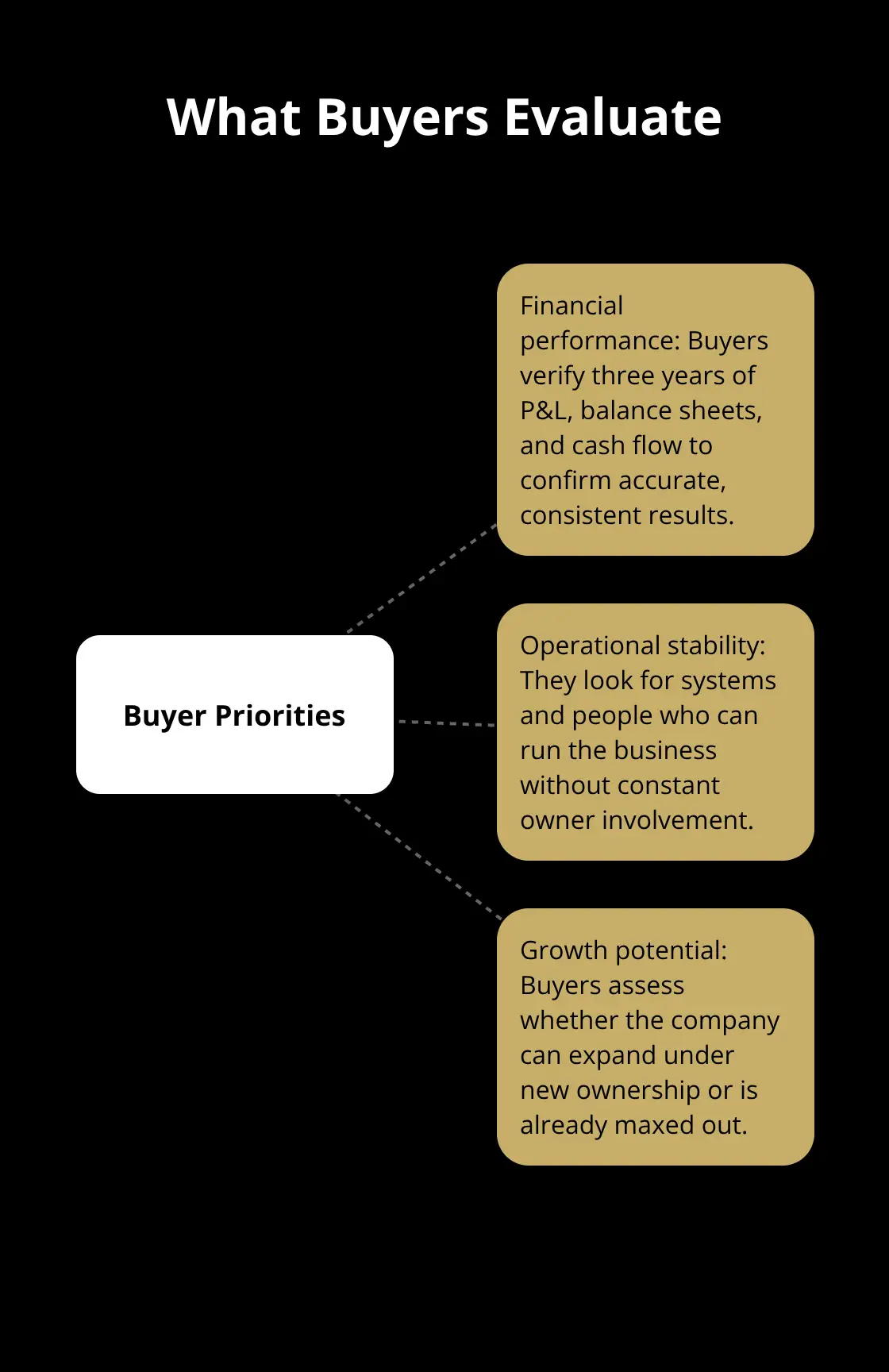
Growth potential shows them whether the business can expand under new ownership or whether it’s already maxed out. Owners who plan ahead address these areas systematically, which means they collect receivables, document processes, and build a management team that doesn’t revolve around them. This preparation makes the difference between a buyer offering a multiple based on risk (lower price) and a multiple based on confidence (higher price).
The Path Forward
Understanding what exit planning actually accomplishes sets the foundation for the specific metrics and preparation steps that follow. The next section examines the exact metrics buyers use to value your business and how you can influence those numbers before you ever talk to a potential buyer.
Key Metrics Buyers Look At
Buyers assess your business based on specific financial and operational metrics, not on what you think it’s worth or how hard you’ve worked to build it. Three metrics directly determine their offer price: revenue growth and profitability trends, customer concentration and retention, and operational documentation and systems. Understanding what drives these evaluations helps you make strategic decisions years before you approach potential buyers.
Revenue Growth and Profitability Trends
Buyers examine your past three years of profit and loss statements, balance sheets, and cash flow reports to verify the numbers you claim. They want to see consistent or improving revenue, not flat or declining sales, because revenue stability signals market demand and operational competence. More importantly, they scrutinize your profit margins and how much cash the business actually generates after expenses.
A business generating $2 million in revenue with 15% net profit margins attracts far more interest than one with $2 million in revenue and 5% margins, even though both have identical sales figures. The Exit Planning Institute found that owners with three years of clean financial statements experience faster due diligence and fewer valuation disputes. This means you need to collect past-due receivables, write off unrecoverable amounts, and reconcile any personal expenses mixed into business finances now, not later.
Buyers calculate what they call EBITDA-earnings before interest, taxes, depreciation, and amortization-to determine how much cash your business produces. A buyer might pay five to seven times your EBITDA, so a business generating $200,000 in EBITDA could sell for $1 million to $1.4 million. Improving profitability by even 5% through expense reduction directly increases your valuation by the same percentage. If your books show loans to yourself, personal vehicle expenses, or other owner draws that shouldn’t be there, fix them before approaching buyers.
Customer Concentration and Retention
Buyers fear that customers only stay because of you, not because they’re genuinely loyal to your business. If your top customer represents more than 15% of revenue, most buyers immediately discount your valuation because they worry that customer will leave after you do. The best time to fix this is years before you sell, not months before you approach potential buyers.
Start diversifying your customer base now and document why customers actually stay-whether it’s service quality, product innovation, or long-term contracts. This documentation becomes critical during due diligence when buyers contact your largest customers to verify they’ll remain after the transition. Customers who feel personally connected only to you create risk in a buyer’s mind. Customers who value your business’s systems, team, and offerings create confidence.
Operational Documentation and Systems
Buyers need proof that your business runs on documented processes, not on your personal knowledge and relationships. Standard operating procedures for critical functions, clear organizational charts, and written decision-making frameworks all signal that the business can operate without you making every choice. This is where many owners lose significant value.
A business where you personally handle sales, finances, and operations appears completely dependent on you and commands a lower multiple. A business with documented systems, trained staff, and clear handoff procedures commands a premium. Start documenting now, delegate responsibilities to your team, and prove through consistent results that the business functions independently. When buyers see that your team can execute without constant owner involvement, they gain confidence in the business’s future under new ownership.
How These Metrics Connect to Your Sale Price
Each metric influences the multiple a buyer offers. Strong revenue growth and profitability trends support higher multiples. Diversified customer bases with documented retention reasons support higher multiples. Operational systems that function independently support higher multiples. Owners who address all three metrics systematically position themselves for significantly better offers than those who ignore them until the last moment.
The next section examines the specific preparation steps you can take now to strengthen each of these metrics before you ever talk to a potential buyer.
Preparing Your Business for Sale
Clean Financial Records First
Financial records are the first thing buyers examine, and most owners underestimate how much work this requires. You need clean financial records with three years of accurate profit and loss statements, balance sheets, and cash flow reports that tell a consistent story. This doesn’t mean your numbers need to look perfect-it means they need to be verifiable and honest.
Start now by collecting past-due receivables from customers who owe you money; buyers will assume these amounts are uncollectible if you haven’t pursued them aggressively. Write off amounts you know won’t be recovered instead of carrying them as assets on your balance sheet. Reconcile any personal loans you’ve made to the business or business funds you’ve used personally. If your business finances are mixed with personal expenses-vehicle costs, meals, travel-separate them completely or remove the personal items from your books.

The Exit Planning Institute found that owners with three years of audited or reviewed financial statements experience significantly faster due diligence. This matters because every month a deal takes longer costs you opportunity cost and keeps the business in limbo.
Maximize Your EBITDA and Valuation
Beyond clean books, calculate your actual EBITDA and understand what EBITDA multiple buyers in your industry typically pay. The multiple will depend on the size of your company, its profitability, its growth prospects, and the industry in which it works. Knowing this number before you talk to buyers prevents you from accepting lowball offers or pricing yourself out of the market.
Expense reduction directly impacts valuation-a 5% cut to operating costs increases EBITDA by the same percentage, which translates directly to sale price. Review your expenses from the last two years and identify what’s truly necessary. Consolidate vendors, eliminate subscriptions you’re not using, and cut overhead that doesn’t generate revenue. This isn’t about operating lean forever; it’s about showing buyers that your business produces maximum cash relative to its size.
Build Operational Independence
Buyers will ask whether the business survives if you disappear tomorrow, and your answer determines their confidence level. Document your standard operating procedures for every critical function-sales, customer service, finances, operations, product delivery. These don’t need to be elaborate manuals; they need to be clear enough that someone unfamiliar with your business can execute the work.
Create an organizational chart showing every role, who fills it, and what that person’s responsibilities are. Identify your top twenty customers and document why they work with you-is it a long-term contract, a specific service they can’t get elsewhere, a relationship with your team, or pricing they value? The goal is proving that customers stay because of what your business offers, not because of personal relationships with you.
During due diligence, buyers will contact your largest customers to verify they’ll remain after the transition. Customers who express loyalty to your systems and team create confidence. Customers who say they’ll only work with you create fear. Start this conversation with your team now. Delegate decision-making authority so your business doesn’t grind to a halt if you take two weeks off. Bring your management team into strategic planning so they understand the direction and can execute without waiting for your approval. When buyers see that your team functions independently and consistently delivers results, they gain confidence in the business’s future.
Address Operational Vulnerabilities
Identify the operational vulnerabilities that scare buyers and fix them before they become negotiation points. If your revenue depends on a single supplier, diversify. If your business has significant debt, develop a plan to reduce it or ensure the buyer understands the terms. If you have pending lawsuits, customer complaints, or regulatory issues, address them now rather than hoping they disappear.
Buyers conduct thorough due diligence and will find these problems anyway-discovering them yourself first and fixing them demonstrates good faith and prevents last-minute deal complications. These steps transform your business from an owner-dependent operation into a scalable asset that buyers see as a sustainable investment rather than a risky bet.
Final Thoughts
Exit planning basics come down to one reality: the work you do today determines the price you receive tomorrow. Owners who start early, document their operations, and clean their finances position themselves for significantly better outcomes than those who wait until they’re ready to sell. The metrics buyers examine-revenue trends, customer diversification, operational independence-aren’t mysterious or complicated, and they’re within your control.
Your timeline shapes your next steps. If you’re years away from selling, focus on building operational systems that don’t depend on you and diversifying your customer base. If you’re within two to three years of a potential exit, accelerate these efforts and assemble your advisory team. If you’re ready to move forward now, professional guidance helps you navigate valuation, buyer qualification, and deal structure.
We at Unbroker help business owners move from planning to action through transparent, low-cost options for selling your business without the high brokerage fees that traditional brokers charge. Whether you want hands-off support or prefer to lead the process yourself with expert guidance, you have options that fit your situation and budget. Exit planning positions your business so that when you decide to move forward, you negotiate from strength, not desperation.