Most business owners selling their company have no idea what their business is actually worth. A professional valuation report changes that, giving you concrete numbers instead of guesses.
At Unbroker, we’ve seen how valuation report insights transform the entire sale process. Buyers take you seriously when you have data backing your asking price, and you negotiate from a position of strength instead of hope.
What Drives Buyer Confidence in Your Valuation
A valuation report isn’t just a number on a page. It’s the foundation that separates serious sellers from those hoping for the best. When you present a professionally prepared valuation, buyers immediately shift their perception of you. They see someone who understands their business, has done the homework, and isn’t playing games with inflated expectations. According to data from Pepperdine University’s Private Capital Markets Project, businesses with documented valuations sell faster than those without formal valuation documentation. That speed difference translates directly to money in your pocket, especially in markets where conditions shift quarterly.
The metrics that actually matter to buyers
Buyers don’t care about vanity metrics. They care about cash flow, customer concentration, revenue stability, and growth trajectory. EBITDA multiple drives most negotiations in the mid-market. If your industry typically trades at 4.5x EBITDA and your business sits at 3.8x, that gap tells a story about where improvements can happen before sale. Customer retention rates matter enormously. A SaaS company losing 20% of customers annually looks fundamentally different from one with 85% retention, even if both have identical revenue. Valuation reports that break down these specifics give you negotiating power because they show exactly where value exists and where it doesn’t. Revenue quality matters more than revenue size-recurring revenue from long-term contracts beats one-time sales every single time in buyer calculations.
Why accuracy stops deals from falling apart
Overvaluing your business creates a specific problem. The buyer’s own valuation expert will catch the inflated number, and suddenly you’re negotiating downward from an artificially high starting point. You’ve already anchored expectations too high.
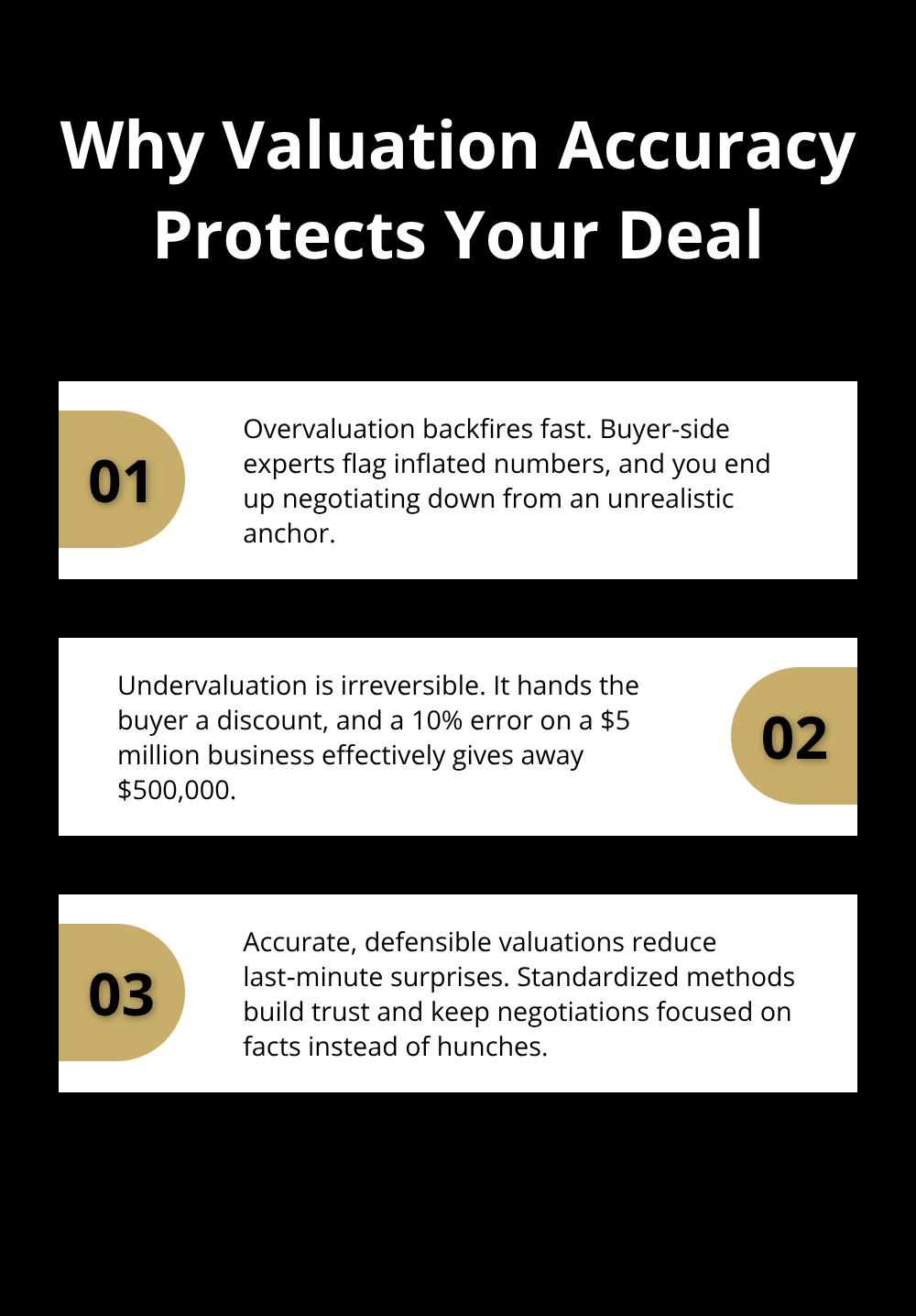
Undervaluing leaves money on the table permanently. A 10% valuation error on a $5 million business costs $500,000. Accurate valuations prevent post-sale disputes that can tank deals in their final weeks. When a buyer’s accountant reviews your numbers and finds surprises, that’s when deals collapse or renegotiations happen. Professional valuations eliminate those surprises (using standardized methodologies that buyers recognize and trust).
Moving from valuation to action
Your valuation report now sits in hand. The real work begins when you translate those insights into concrete improvements or negotiating strategies. Understanding what buyers value most positions you to either strengthen weak areas before listing or leverage your strengths during negotiations. The next section walks through the specific valuation methods that produce these insights and how to select the right approach for your particular business situation.
Which Valuation Method Works for Your Business
The valuation method you select directly impacts the number you’ll defend in negotiations. Most business owners fail to realize that different methods can produce wildly different valuations for the identical company. A revenue-multiple approach might value your business at $3.2 million while an asset-based method puts it at $2.8 million. The gap exists because each method answers a different question about what your business is worth.
Revenue-based approaches and their limitations
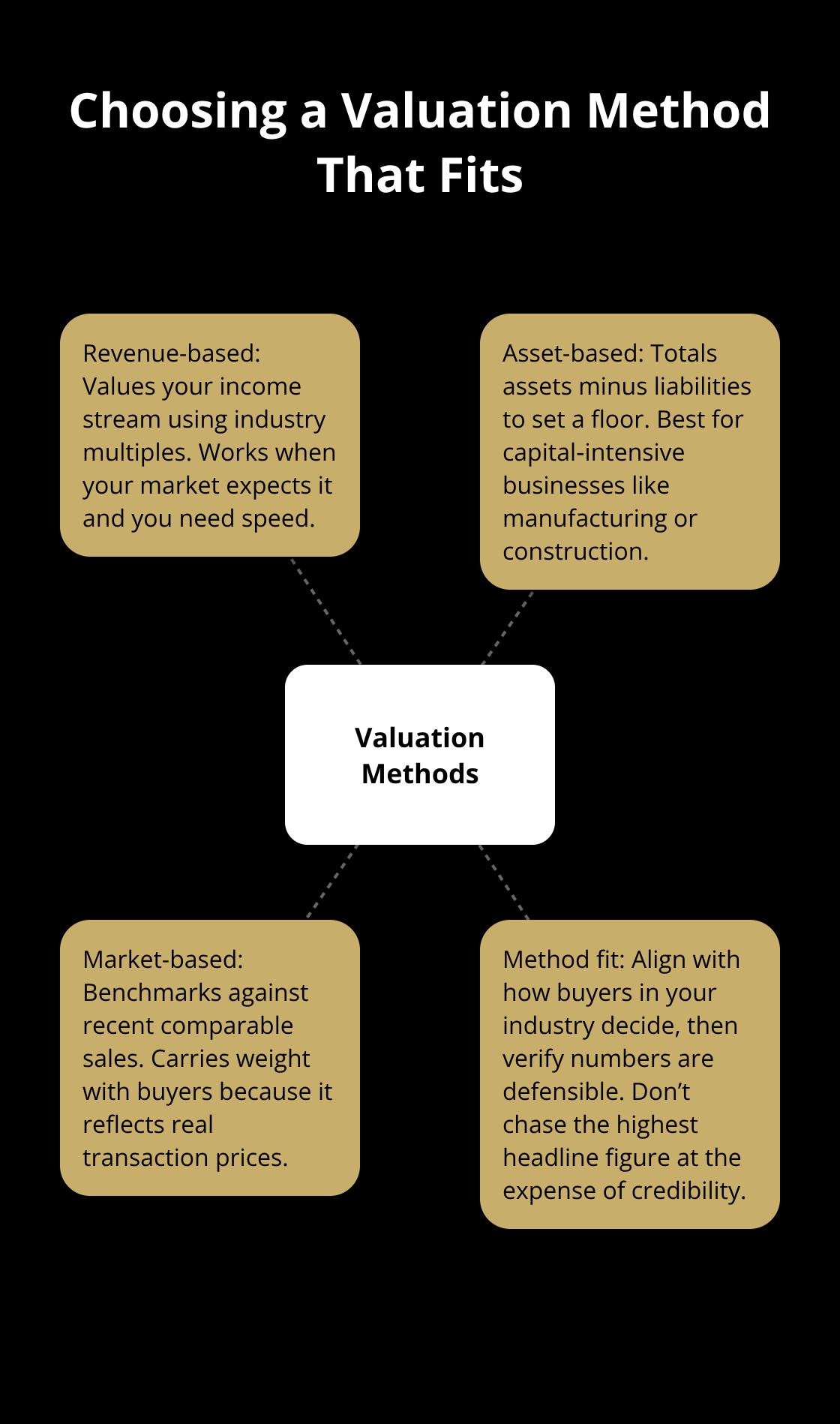
Revenue-based approaches focus on what your income stream is worth to a buyer. These methods multiply your EBITDA or revenue by an industry-specific multiple. SaaS companies typically trade at 8-12x revenue according to recent market data, while traditional service businesses sit closer to 3-4x EBITDA. The advantage here is simplicity and speed.
The disadvantage matters enormously: revenue multiples ignore profitability differences. A company with $2 million in revenue and 5% margins looks identical to one with 35% margins when you multiply only the top line. This approach works well when buyers in your industry expect it, but it can mask profitability problems that sophisticated purchasers will catch immediately.
Asset-based valuations for capital-intensive businesses
Asset-based valuations add up what your business owns minus what it owes. Equipment, inventory, intellectual property, and real estate become your valuation floor. This method protects you when you sell a capital-intensive business like manufacturing or construction.
However, asset-based valuations undervalue service and software businesses. Their real value sits in customer relationships and recurring revenue, not physical assets. You’ll find this approach produces artificially low numbers for knowledge-based companies, which can hurt your negotiating position significantly.
Market-based methods and real transaction data
Market-based methods examine what similar businesses actually sold for recently. If three comparable companies in your industry sold in the past 18 months, their transaction prices become your benchmark. This approach carries real weight because buyers understand it-they’re literally paying what the market decided similar assets cost.
The challenge is that market-based methods require comparable transaction data. Most business sales happen privately without public disclosure, so you work with incomplete information. Access to transaction data across your network helps identify real market comparables for your specific situation.
Selecting the right method for your industry
Tech and SaaS companies almost always use revenue multiples because that’s what venture capital and strategic buyers expect. Manufacturing businesses lean toward asset-based methods combined with EBITDA multiples. Service businesses work best with market comparables if recent sales exist in your niche.
Don’t select a method because it produces the highest number. Buyers will spot an inflated methodology immediately and discount your credibility. Instead, select the method that reflects how actual buyers in your industry make decisions, then verify your numbers are defensible within that framework. Once you’ve identified the right valuation method and confirmed your numbers, the next step involves identifying which specific areas of your business either strengthen or weaken your position before you list it for sale.
Transform Your Valuation Into Competitive Advantage
Identify and Address Weak Points Before Listing
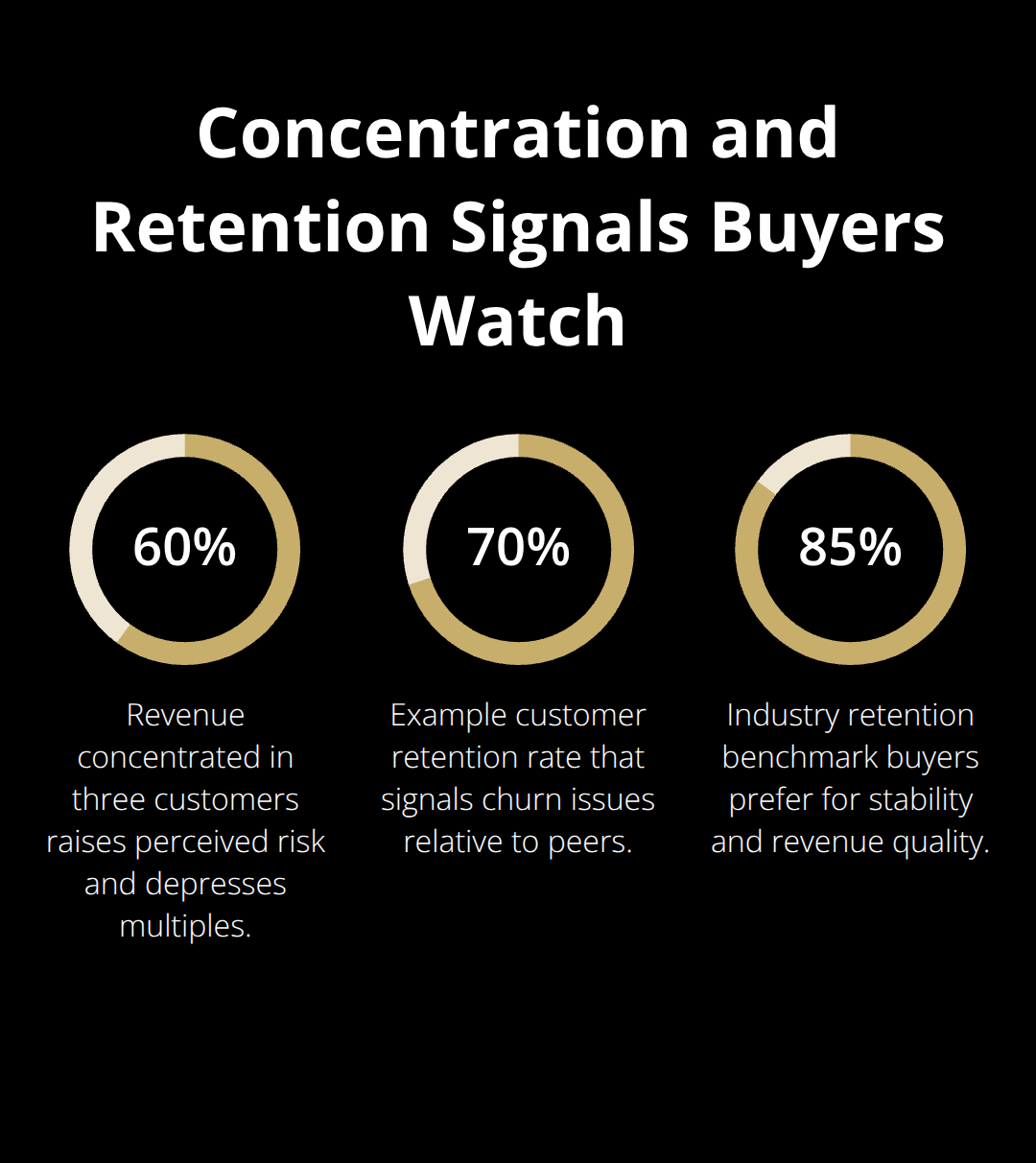
Your valuation report reveals exactly where your business stands against buyer expectations. The gap between that number and market reality is where your real work starts. Buyers scrutinize financial statements, customer concentration, and revenue quality before making offers. If your valuation uncovers that 60% of revenue comes from three customers, that concentration risk tanks your multiple immediately. Smart sellers use this insight to diversify before listing or prepare explanations that reduce buyer anxiety.
A manufacturing business improved its valuation by 15% within six months by addressing inventory turnover issues the valuation flagged. The report showed inventory sitting longer than industry average, which tied up cash and signaled operational inefficiency. Management implemented better inventory management systems and reduced carrying costs. When they eventually listed, buyers saw a leaner operation worth substantially more. Your valuation identifies these exact friction points-customer churn, payment collection delays, or contract terms that expire soon all appear in the analysis.
Address the fixable issues before listing. If your customer retention rate sits at 70% while industry average is 85%, that gap costs you real money in the valuation. Some problems take months to fix properly, which is why starting early matters. However, don’t chase perfection. A business with minor weaknesses but strong core fundamentals sells faster than one delayed waiting for marginal improvements.
Use Valuation Data as Negotiating Evidence
When negotiations start, your valuation becomes your evidence. Buyers will present their own valuation, and that number frequently differs from yours. Professional documentation prevents this from becoming a shouting match about arbitrary figures. A buyer claiming your business is worth 3.5x EBITDA when market comparables show 4.8x for similar companies puts you in a weak position without data. Your valuation report, backed by standardized methodology, gives you credibility to push back effectively.
Align Your Sale Timing With Market Conditions
Timing your sale matters enormously, though not in the way most sellers think. Waiting for perfect market conditions rarely works because market conditions shift unpredictably. What matters is positioning your business at a moment when your specific metrics align with buyer appetite. If interest rate cuts make buyer financing more accessible, that’s your moment even if you’d prefer to wait longer. Conversely, if your industry faces headwinds, selling before those problems compound into lower multiples makes sense.
Your valuation captures your business at a specific point in time. If market conditions improve materially after valuation, that strengthens your negotiating position. If conditions deteriorate, your documented valuation prevents buyers from anchoring negotiations at depressed prices by claiming market weakness justifies lower offers.
Final Thoughts
A valuation report replaces guesswork with evidence and transforms how you approach your business sale. Valuation report insights drive every major decision, from identifying weak areas to timing your market entry to defending your asking price in negotiations. Buyers respond to sellers who understand their own business deeply and articulate exactly why their asking price makes sense.
The real work starts when you act on what the report reveals. Professional guidance becomes invaluable at this stage because selling a business involves legal complexity, tax implications, and buyer psychology that most owners navigate poorly alone. We at Unbroker have guided hundreds of business owners through this exact process, combining expert advisors with AI-driven buyer matching to connect you with serious purchasers.
If you haven’t had a professional valuation completed, that’s your starting point. The cost of a valuation is negligible compared to the negotiating advantage it provides, and we’re financially aligned with getting you the best possible outcome through our 6% success fee structure, paid only when your business actually sells.