Most small business owners have no idea what their company is actually worth. At Unbroker, we’ve seen this gap cost owners thousands in missed opportunities, whether they’re seeking funding, planning a sale, or making strategic decisions.
Understanding business valuation basics isn’t just for exit planning. It’s the foundation for making smarter financial choices today.
What Your Business Is Actually Worth
Business valuation is the process of determining what a company would sell for in an open market between a willing buyer and seller who both have reasonable knowledge of the facts. It’s not guesswork or what you think your business should be worth. It’s a structured analysis of your financial performance, assets, market position, and growth trajectory. The core purpose is straightforward: to establish a defensible, evidence-based number that you can use for selling, raising capital, tax planning, or making strategic decisions. Without this number, you’re operating blind when negotiating with buyers, lenders, or investors.
Why Small Business Owners Ignore Valuation Until It’s Too Late
Most small business owners never calculate their company’s actual value until they need to sell. That’s a mistake. Knowing your valuation shapes how you approach growth investments, debt decisions, and even hiring. If your business generates $500,000 in normalized EBITDA with a capitalization rate of 20%, your business value sits around $2.5 million. That single figure changes everything about how you think of your company’s future.
Valuation also exposes what’s actually driving your profit. Many owners discover they’re underpricing their services or overspending on operations that don’t move the needle. The valuation process forces you to examine three things: your financial performance, your market position relative to competitors, and the tangible and intangible assets you’ve built.
What Your EBITDA Multiple Actually Tells You
The EBITDA multiple will depend on the size of the subject company, its profitability, its growth prospects, and the industry in which it works. The difference comes down to how these factors interact. A business with strong margins and predictable growth can command higher multiples than one with rapid growth but shrinking margins. Customer concentration risk matters too-a broad, diversified customer base reduces risk and enhances value, while heavy concentration lowers valuation significantly.
How Valuation Changes Your Decisions Today
When you know your business’s value, you make better choices about reinvestment, hiring, and expansion. If you’re valued at $2 million and considering a $400,000 marketing campaign, you can now calculate whether that investment will generate sufficient returns to justify the spend.
Valuation also affects how you negotiate with buyers. Overpricing stalls deals and wastes months of your time. Underpricing leaves significant value on the table-a 10% underprice on a $5 million business costs you $500,000. Most private deals close within 10–15% of the initial asking price, which means your opening position matters enormously.
How Lenders and Investors View Your Valuation
Valuation equally influences how potential lenders or investors perceive your business. Banks and investors use valuation to determine how much capital they’re willing to extend and at what terms. A well-documented valuation signals financial maturity and reduces their perceived risk. This is where the three valuation methods-income approach, market approach, and asset-based approach-come into play, each revealing different aspects of your company’s worth and helping you build credibility with external stakeholders.
Three Ways to Value Your Business
The Income Approach: What Your Business Actually Earns
The income approach values your business based on what it actually earns. Take your normalized EBITDA and divide it by a capitalization rate, which reflects the risk level and return investors expect. A business generating $500,000 in normalized EBITDA with a 20% capitalization rate is worth roughly $2.5 million. This method works best for established businesses with predictable cash flows-most small businesses operating for three or more years fit this profile.
Accuracy in your numbers determines whether this approach helps or hurts you. Strip out one-time expenses and owner discretionary costs (personal vehicle use, family salaries above market rates, excessive travel expenses) to reveal true earning power. Without normalized earnings, your valuation misleads potential buyers who conduct their own analysis and reach different conclusions.
The Market Approach: What Actual Buyers Paid
The market approach compares your business to recently sold comparable companies in your industry. If similar businesses sold for 5x EBITDA and yours generates $300,000 in EBITDA, the market approach suggests a $1.5 million valuation. A good EBITDA multiple for a small business typically ranges from 3x to 5x, depending on industry and quality.
Truly comparable data remains scarce and often expensive to access. Small businesses rarely publish sale prices, so you’ll find comparables through industry databases, broker reports, or transaction records. The market approach grounds valuation in reality-what actual buyers paid-but requires critical judgment about which comparables match your situation. A business in a growing market with expanding margins deserves a higher multiple than a stagnant competitor, even if revenue is similar.
The Asset-Based Approach: Your Safety Floor
The asset-based approach values what you own minus what you owe. Add up your tangible assets (real estate, equipment, inventory) and subtract liabilities to get net asset value. This approach works as a floor value; it prevents you from accepting an offer below what your assets are worth. For asset-heavy businesses like manufacturing or retail, the asset-based approach often carries significant weight. For service or software businesses, it typically undervalues the company because intangible assets like client relationships, processes, and brand reputation don’t appear on a balance sheet.
Combining All Three Methods for Defensible Value
Using all three methods together produces a more defensible valuation than relying on one alone. The income approach reflects earning power, the market approach grounds you in what buyers actually pay, and the asset-based approach ensures you don’t leave money on the table. When the three methods produce different numbers-and they usually do-weight the method most relevant to your business. A cash-generating service firm should weight the income approach heavily. A real estate-intensive business should lean on asset value. The market approach provides reality-check credibility across all business types.
Each method reveals different aspects of your company’s worth. The income approach shows what your business generates. The market approach shows what similar businesses commanded in actual transactions. The asset-based approach shows your minimum acceptable price. Together, these three approaches create a range that reflects your business’s true market position. Understanding which method matters most for your situation shapes how you present your business to potential buyers and lenders in the next phase of your growth or exit strategy.
What Actually Moves Your Business Valuation
Profitability and Normalized Earnings
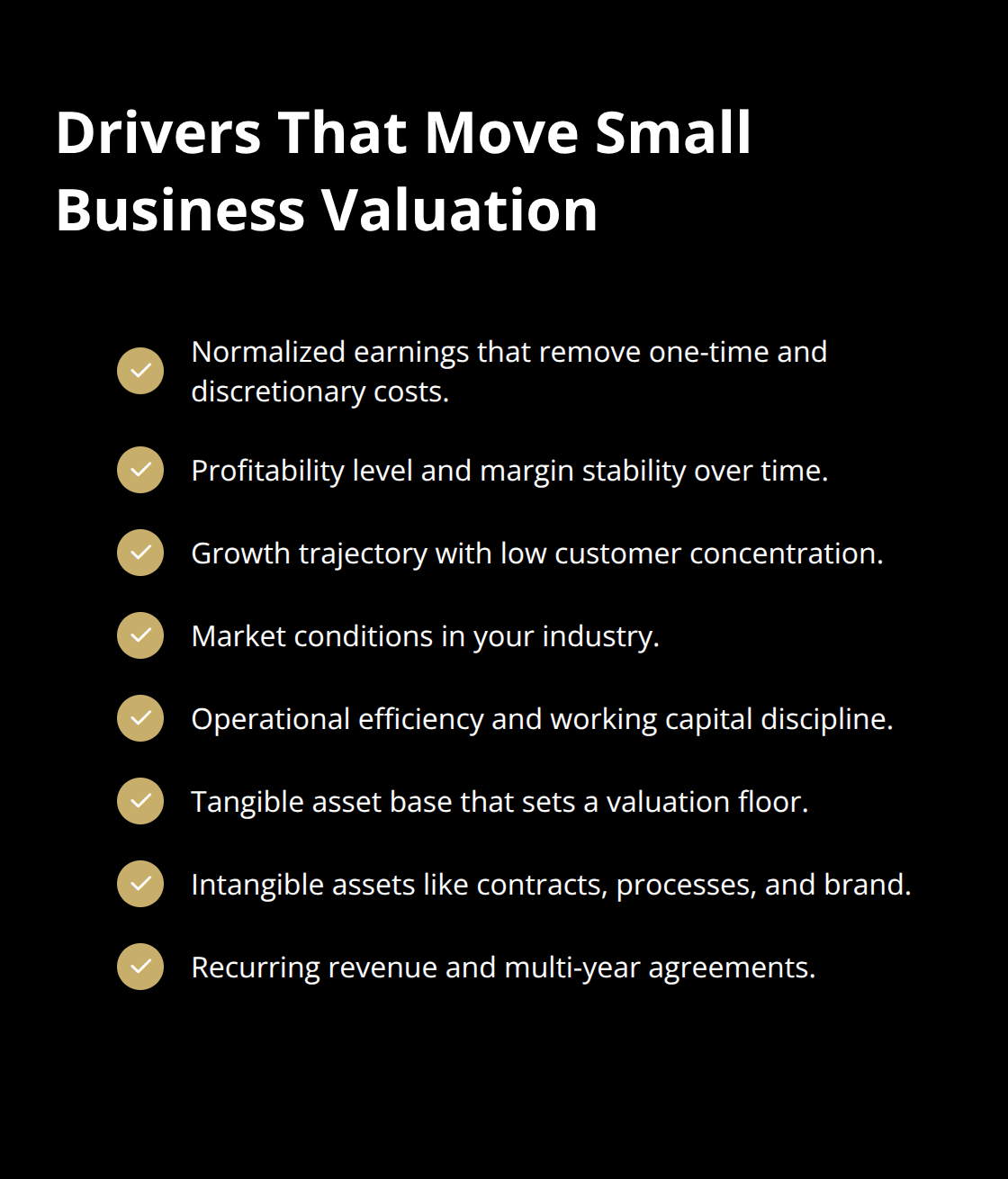
EBITDA multiples matter, but they’re not destiny. The real drivers of your valuation sit in three specific areas that most owners overlook until it’s too late. Your profitability level determines whether buyers see your business as a cash cow or a risky bet. A business that generates $500,000 in EBITDA trades at a fundamentally different multiple than one that generates $100,000, even in the same industry. The gap isn’t just about size; it’s about predictability. Buyers apply higher multiples to businesses with stable, growing profits and lower multiples to those with flat or declining earnings.
Normalized EBITDA is what matters most. Remove one-time gains, owner perks, and expense anomalies to show what a new owner would actually earn. Many small business owners shock themselves when they calculate true earnings. A business that looks profitable at the top line often shrinks dramatically when you remove the owner’s inflated salary, the company car that’s really personal use, or the consulting contract paid to a family member. Buyers will normalize these items anyway during due diligence, so you might as well do it first.
Growth Trajectory and Customer Concentration
Your growth trajectory reshapes valuation significantly. A business with flat $300,000 EBITDA might command a 4x multiple, but the same business with EBITDA growing 15% annually could justify 5.5x or 6x. Customer concentration is equally brutal. If your top five customers represent 60% of revenue, expect a significant valuation haircut. Buyers see concentration as risk; they worry the customer relationship depends on you personally and will evaporate after the sale. Diversification across dozens of customers signals stability and commands premium pricing.
Market Conditions and Operational Efficiency
Market conditions and operational efficiency act as multipliers on top of profitability. Your industry’s current health matters enormously. A software services firm valued at 5x EBITDA in 2024 might fetch 3.5x in 2026 if market sentiment shifts or growth expectations decline. You can’t control macro conditions, but you can control how efficiently you run operations.
Strong working capital management signals operational maturity. If you tie up cash in excessive inventory or extend payment terms to customers without reason, that inefficiency reduces valuation. Buyers calculate how much cash they’ll need to fund operations post-purchase. A business with tight working capital requires less buyer cash and commands higher prices.
Tangible and Intangible Assets
Your asset base provides a floor under valuation. Real estate, equipment, and inventory have tangible value that appears on balance sheets. A manufacturing business with $2 million in equipment and facilities has a different valuation floor than a consulting firm with minimal tangible assets. For asset-heavy businesses, this floor matters significantly; for service businesses, intangible assets like client contracts, proprietary processes, and reputation drive the real value.
Document your client relationships carefully. If you have long-term service agreements or recurring revenue contracts, those create predictable cash flow and lower risk for buyers. A business with recurring revenue from multi-year contracts trades at higher multiples than one with project-based, one-off work. Buyers pay premiums for predictability and will reward you for contracts that lock in future cash flows.
Final Thoughts
Understanding business valuation basics transforms how you manage your company today and positions you for success tomorrow. The three valuation methods-income, market, and asset-based-each reveal different aspects of your company’s value, and combined they create a defensible range that reflects your true market position. Most owners discover that normalized EBITDA, customer diversification, and operational efficiency matter far more than they realized.
A business generating $500,000 in clean earnings with a diversified customer base and strong working capital commands dramatically higher multiples than one with inflated owner compensation and concentrated revenue. These factors sit within your control right now, and you can act on them immediately. If you plan to sell within two years, start documenting your financials and building recurring revenue contracts that signal stability to buyers.
We at Unbroker help business owners navigate valuation and the sale process with transparent pricing and expert support. Whether you want hands-off selling or prefer to lead the process yourself, Unbroker offers flexible options designed to eliminate confusion and high fees. Your business’s value is real.