Small business owners are facing real pressure right now. Rising interest rates, inflation, and talent shortages are forcing many to reconsider their timeline for selling.
At Unbroker, we’ve seen how these small business trends are reshaping the market. Strategic buyers are more active than ever, and the businesses that prepare now will have the strongest negotiating position when it’s time to exit.
Why Rising Costs Are Pushing Owners to Sell Now
The math is brutal right now. Interest rates have climbed to their highest levels in over two decades, making borrowing expensive for both business owners and potential buyers. The Federal Reserve’s aggressive rate hikes have created a situation where credit becomes scarcer and more costly, directly impacting a small business owner’s ability to invest in growth or refinance existing debt. For owners carrying business loans or lines of credit, monthly payments have jumped significantly. A business that borrowed at 3% in 2021 now faces rates between 7% and 9%, depending on creditworthiness and loan type. This isn’t a minor inconvenience-it eats into cash flow at a time when every dollar matters.
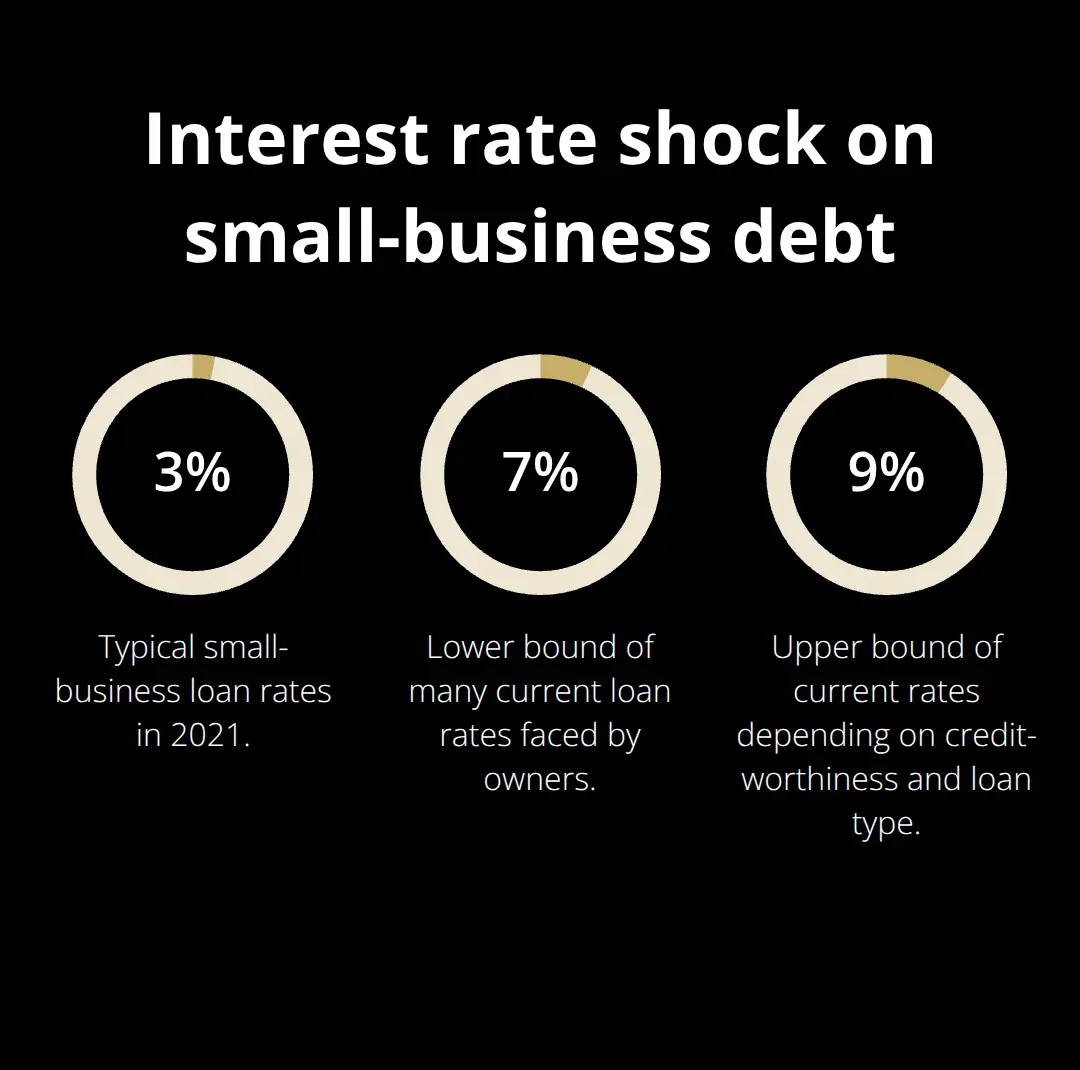
Many owners realize that holding on until conditions improve might cost them more than selling today, even at a lower valuation. The window for favorable exit terms narrows, and savvy owners move forward rather than wait for rates to drop.
Inflation Squeezes Margins Across Industries
Inflation’s effect on small business operating margins and profitability hits operating costs everywhere. Labor costs have surged dramatically, with wage inflation running 4% to 5% annually in many sectors as competition for talent intensifies. According to the Bureau of Labor Statistics, average hourly wages for private-sector workers have climbed steadily, forcing small businesses to either raise prices or accept thinner margins. Rent, utilities, supplies, and shipping have all become more expensive. A manufacturing business that once paid $50,000 annually for materials now pays $62,000 for the same inputs. Service businesses face similar pressures through higher labor costs. The challenge compounds because many owners can’t fully pass these costs to customers without losing market share. Buyers know this too-they see declining margins and factor that into their offers. Owners who exit now, before margins compress further, capture better valuations than those who wait for inflation to ease. The competitive landscape also matters: if your competitors struggle with the same cost pressures, your exit timing becomes even more strategic.
Talent Shortages Drain Resources and Leadership Attention
Finding and keeping good people has become one of the biggest headaches for small business owners. Wage competition is fierce, and the cost of employee turnover expenses drains both cash and leadership bandwidth. The average cost to replace a terminated employee is about 50 percent of that employee’s annual salary. For a business with 10 to 20 employees, this translates to tens of thousands of dollars lost to turnover alone. Beyond the financial hit, constant hiring cycles pull owners away from strategic work. You end up spending time on recruitment, onboarding, and management instead of growing the business or preparing it for sale. This owner dependency-where the founder remains deeply involved in day-to-day operations-is exactly what lowers a business’s valuation. Buyers want businesses that run without the founder’s constant involvement. The talent shortage actually creates urgency: if your business bleeds good people and you’re exhausted from managing that chaos, exiting sooner means you avoid years of frustration. A business that’s hard to staff today will be hard to sell tomorrow unless you fix the underlying systems and culture first.
Strategic Buyers Capitalize on Market Weakness
These pressures don’t affect all buyers equally. Strategic buyers and private equity firms actually thrive in environments where small business owners face financial stress. They have access to capital, operational expertise, and the ability to absorb higher interest costs. When you’re squeezed by rising rates and inflation, a buyer with deep pockets looks increasingly attractive. They can refinance debt at better terms, consolidate operations to cut costs, and leverage their scale to negotiate better supplier deals. This dynamic shifts the negotiating power in their favor-unless you prepare your business to appeal to multiple buyer types. Owners who strengthen their financial position, document their operations, and reduce owner dependency position themselves to negotiate from strength rather than desperation. The businesses that attract the highest offers are those that solve problems for buyers, not those that need rescuing.
Strategic Buyer Interest in Acquiring Small Businesses
Private equity firms have shifted their focus aggressively toward the lower-middle market, where small business owners operate. These firms deploy capital into acquisitions ranging from $5 million to $50 million in revenue without waiting for perfect conditions. They see owners struggling with rising costs and talent shortages as genuine opportunities. PE buyers target businesses that generate $500,000 to $2 million in annual profit, then apply cost-cutting strategies and management expertise to boost returns. What this means for you is straightforward: if you’re thinking about selling, PE buyers are actively hunting right now. They move fast, they have money available, and they’re less sensitive to your current margin pressures because they know how to fix them. The catch is that they’ll discount your valuation based on those exact problems. A business that hasn’t addressed its operational inefficiencies will sell for less to a PE buyer than one that has already tightened its systems.
Consolidation Reshapes Specific Sectors
Consolidation waves hit hard in home services, staffing, software, and professional services. Roll-up strategies accelerate rapidly in fragmented markets. A consolidator in the HVAC space might acquire 15 regional operators over three years, standardizing processes and cutting overhead across the entire network. These buyers pay premiums for businesses that fit their consolidation thesis because the acquisition solves a specific problem: geographic expansion, customer base growth, or operational standardization. The advantage for you is that consolidators value predictability and clean operations over growth rate. They want a business that runs consistently, with documented processes and reliable cash flow. If your industry is consolidating, your exit window is actually wider than you think-consolidators need inventory, and they’ll pay fairly for bolt-on acquisitions that meet their criteria. The downside is clear: if you wait too long, consolidation may pass your business by, and you’ll be left competing against a consolidated competitor with better margins and scale.
Cash Flow Quality Trumps Growth Hype
Valuation multiples have shifted dramatically in recent years. Buyers no longer chase revenue growth at any cost-they focus on cash flow quality and margin stability instead. A business generating $1 million in annual profit with predictable revenue commands a higher multiple today than a business with volatile cash flow. This shift changes how you should prepare for sale. Strengthen your recurring revenue streams, reduce customer concentration risk, and document your operational systems rather than chasing top-line growth. A software company with 70 percent annual recurring revenue retention and a documented customer onboarding process attracts multiple bidders and commands a higher offer than one with volatile revenue and founder-dependent relationships. Buyers price in the cost of fixing your business post-acquisition. If they have to rebuild your systems, replace key staff, or reconstruct customer relationships, they’ll discount your offer accordingly. The owner who invests in operational cleanup before selling captures that value instead of handing it to the buyer at a discount.
What Buyers Actually Value in Today’s Market
Strategic buyers and PE firms evaluate businesses through a specific lens shaped by current market conditions. They assess whether your business can operate independently without you making daily decisions. They examine your customer retention rates, your supplier relationships, and your team’s ability to execute without founder involvement. A business with strong systems, documented processes, and capable leadership attracts higher offers because buyers see lower integration risk and faster path to profitability. They also look at your financial documentation closely. Clean books, accurate revenue recognition, and transparent expense tracking reduce due diligence friction and speed up the sale process. Buyers trust what they can verify, and sloppy financial records signal operational chaos that they’ll price into their offer as a discount.
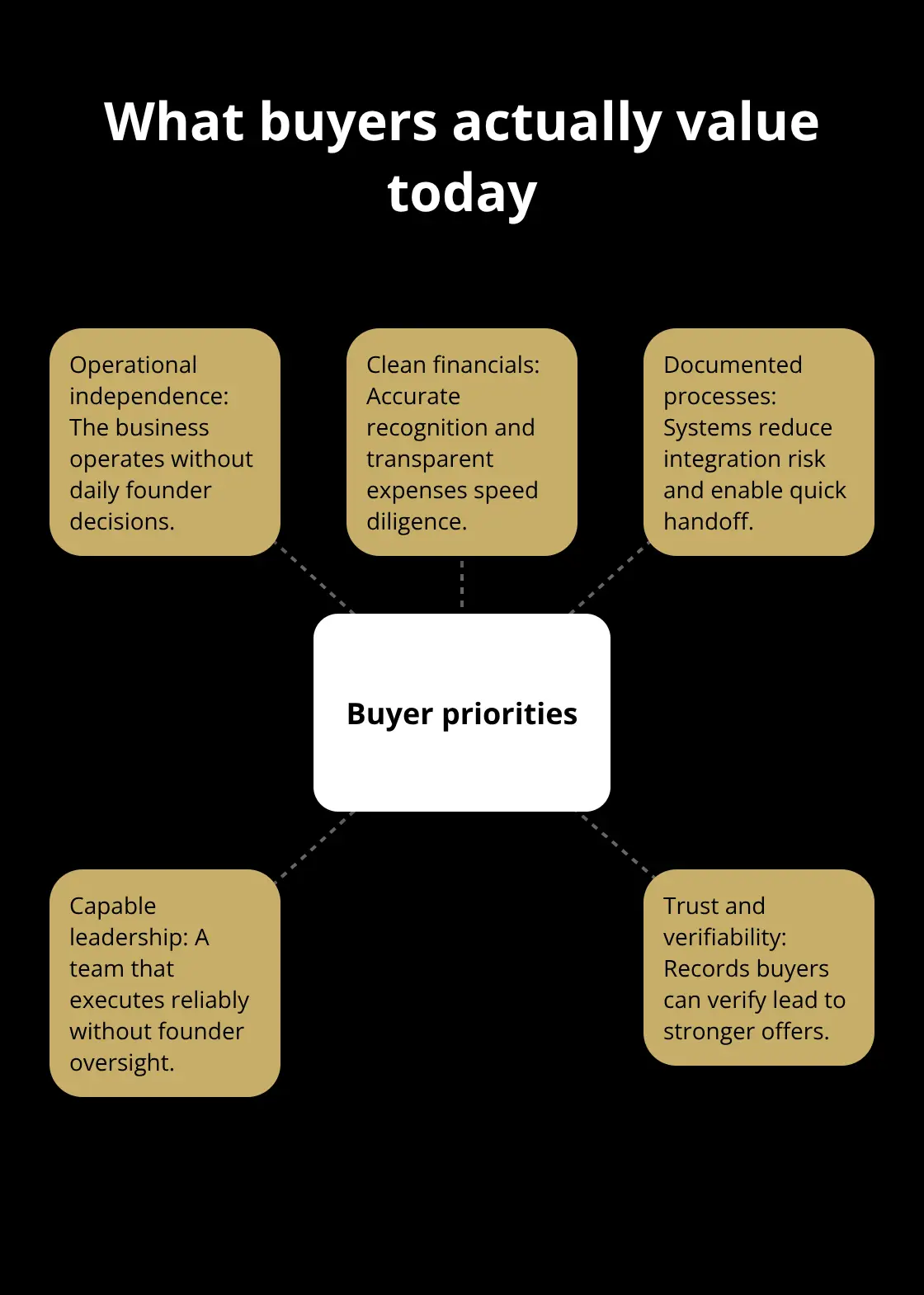
The businesses that command premium valuations are those that solve buyer problems immediately upon acquisition-they generate predictable cash flow, operate independently, and require minimal post-sale restructuring.
What Buyers Need to See Before Making an Offer
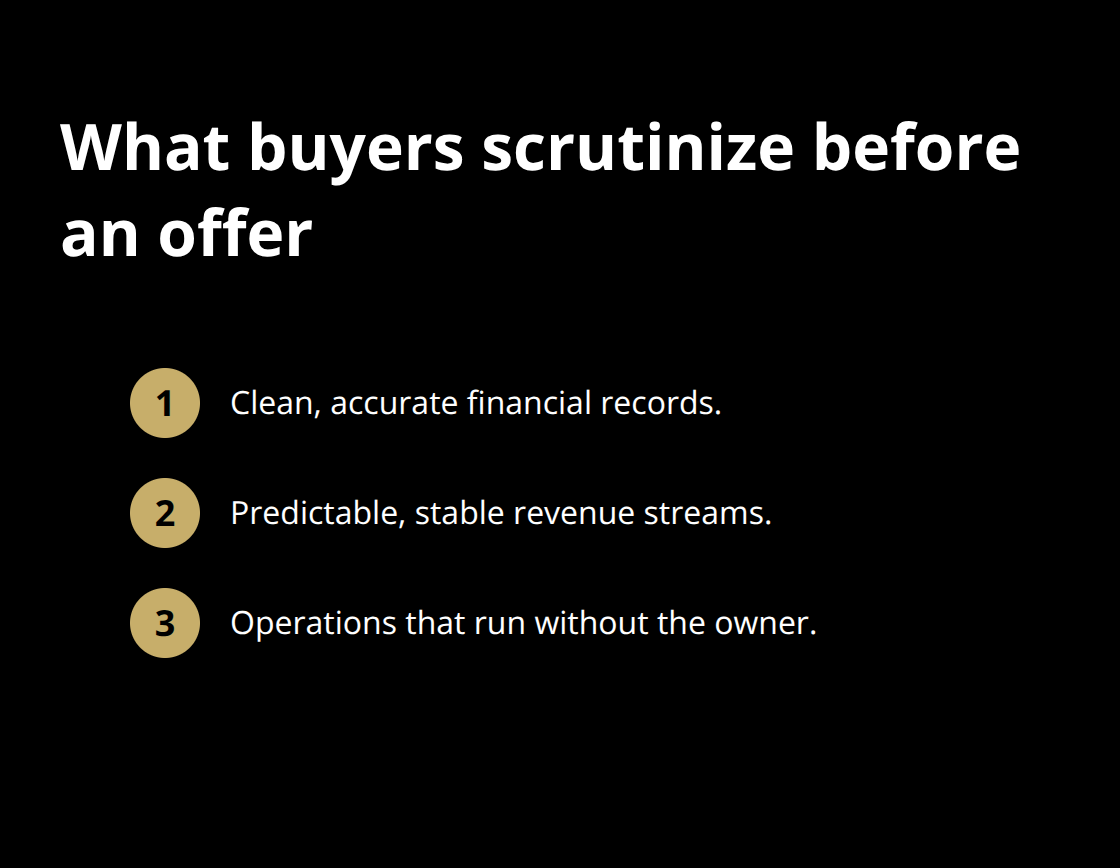
Buyers today scrutinize three things before committing capital: your financial records, your revenue stability, and whether the business survives without you running it daily. Get these wrong and your valuation drops immediately. Get them right and you attract competitive bidding.
Clean Financial Records Stop Buyers Cold
Start with your financial documentation because this is where most owners stumble. Sloppy accounting, commingled personal and business expenses, or inconsistent revenue recognition terrify buyers. A business with tax returns that don’t match bank statements or QuickBooks records that contradict actual cash flow signals operational chaos. Buyers factor in the cost of forensic accounting and financial reconstruction, then deduct that from their offer.
The fix is straightforward but requires discipline. Hire an accountant to audit your last three years of records and reconcile everything to your bank statements. Document your revenue recognition policy explicitly. If you’ve expensed items inconsistently, normalize them now. Clean financial records reduce due diligence friction, speed up the sales process, and protect your valuation. During the due diligence process, acquirers will examine a company’s financial records, sales processes, customer contracts, and revenue streams.
Predictable Revenue Attracts Multiple Buyers
Recurring revenue dramatically boosts business valuation because it creates predictable cash flow, lowers risk for buyers, and supports higher valuation multiples. A service company with 70 percent of revenue locked into annual contracts commands a higher multiple than one with transactional, project-based income. Buyers see recurring revenue as lower risk because it provides cash flow visibility.
If your business generates revenue sporadically or depends on winning new customers constantly, start building recurring models now. Software companies with subscription models, service businesses with retainer agreements, or product companies with maintenance contracts all attract premium valuations. Convert one-time sales into ongoing relationships. A pest control company that shifts from one-time treatments to annual contracts increases its valuation multiple substantially. A consulting firm that moves clients from project work to retainer arrangements creates stability that buyers prize. The effort required is significant but worth it-you need to rebuild customer relationships, restructure pricing, and potentially retrain your sales team. The payoff is a business that’s worth more and easier to sell because buyers see predictable cash flow rather than revenue uncertainty.
Systems and Leadership Replace Your Daily Involvement
Owner dependency is the biggest valuation killer. A business where customers trust only you, where employees need your approval for decisions, or where critical processes live only in your head sells for far less than one with documented systems and capable leadership. Buyers pay for businesses they can operate immediately post-acquisition without your involvement.
Start documenting your processes now. Write standard operating procedures for your core functions. Create decision-making frameworks so your team knows what authority they have without running decisions up to you. Hire or promote a capable operations manager or business manager who can execute without you. This person needs to understand your business deeply enough to make decisions and solve problems independently. The investment is real in both time and money, but it directly increases your exit valuation. A business with a proven leadership team that executes consistently attracts multiple buyers and commands higher offers than one dependent on founder involvement.
Test this by taking a two-week vacation where you’re completely unavailable. If the business stalls, you have work to do. If it runs smoothly, you’ve built something buyers actually want.
Final Thoughts
The small business trends reshaping exits right now demand action. Rising costs, active strategic buyers, and a market that rewards operational excellence create a window where owners who act now negotiate from strength rather than desperation. Clean financials, predictable revenue, and independent leadership directly increase your valuation and speed the sale process.
Traditional brokers charge 10 percent or more of your sale price, which eats into proceeds you’ve earned over years of hard work. Transparent platforms shift power back to business owners by eliminating hidden fees and providing direct access to buyer networks. You see exactly what you pay upfront and what support you receive in return, which lets you compare options and make decisions based on facts rather than broker promises.
Start by auditing your financial records, documenting your operations, and assessing your owner dependency-these three actions directly increase your valuation. We at Unbroker built our platform to help you capture the value you’ve built without surrendering it to unnecessary fees, whether you choose full-service support or prefer to manage the process yourself with expert guidance. Explore your options with Unbroker to see how a modern platform can simplify your exit.