Selling a business during a market downturn feels like watching your company’s value slip away. We at Unbroker know that sale depression is real-valuations can drop 20-40% when economic conditions weaken, and most sellers aren’t prepared for it.
The good news? Your exit doesn’t have to suffer. Strategic preparation and smart positioning can help you recover lost value, even when buyers are cautious.
How Recessions Reshape Business Values and Buyer Behavior
Recession Impact on Valuations and Multiples
Economic recessions hit buyer confidence hard, and the numbers prove it. When GDP contracts for two consecutive quarters, as defined by the National Bureau of Economic Research, acquisition activity doesn’t just slow-it collapses. Fewer buyers enter the market, and those who remain become ruthlessly selective about price. The 2020 downturn saw 244 firms file for bankruptcy, the highest count since 2009, signaling to potential acquirers that risk premiums spike during weak economies.
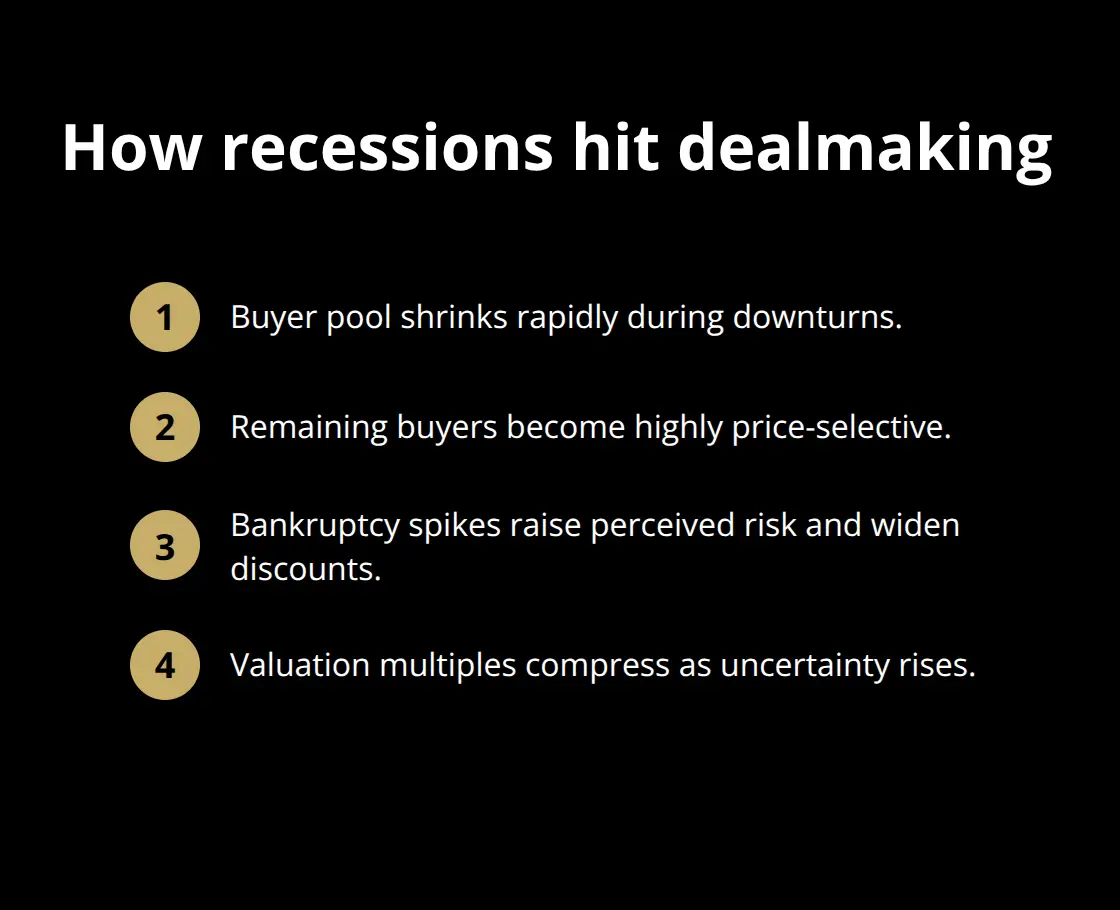
This risk aversion translates directly into lower multiples. A business generating $5 million in EBITDA might command a 6x multiple in a healthy market, but that same business could face a 4x multiple or lower when uncertainty dominates buyer sentiment. The gap isn’t theoretical-it’s the difference between a $30 million valuation and $20 million. J.P. Morgan’s 2026 Leaders Outlook found that 49% of business leaders cite uncertain economic conditions as their top challenge, which means buyers are pricing in protection against further deterioration.
Industry-Specific Valuation Pressures
This defensive posture extends across industries, but some sectors face steeper discounts than others. Energy, retail, and consumer services historically absorb the deepest cuts because their revenue models depend on discretionary spending and consumer confidence. A restaurant group or fuel distributor faces different headwinds than a software company with subscription revenue, so your industry position matters enormously when pricing for sale.
Timing Your Exit: Lessons from Past Downturns
Timeline patterns reveal why timing your exit matters. The 2008 financial crisis compressed M&A activity significantly in 2009, with deal volumes recovering gradually through 2010 and 2011. During that period, sellers who held out for pre-crisis valuations watched their businesses deteriorate further as cash flow tightened and buyer pools shrunk. Conversely, sellers who accepted realistic market pricing in 2009 often found better conditions by 2010 as the first wave of distressed acquisitions cleared the market.
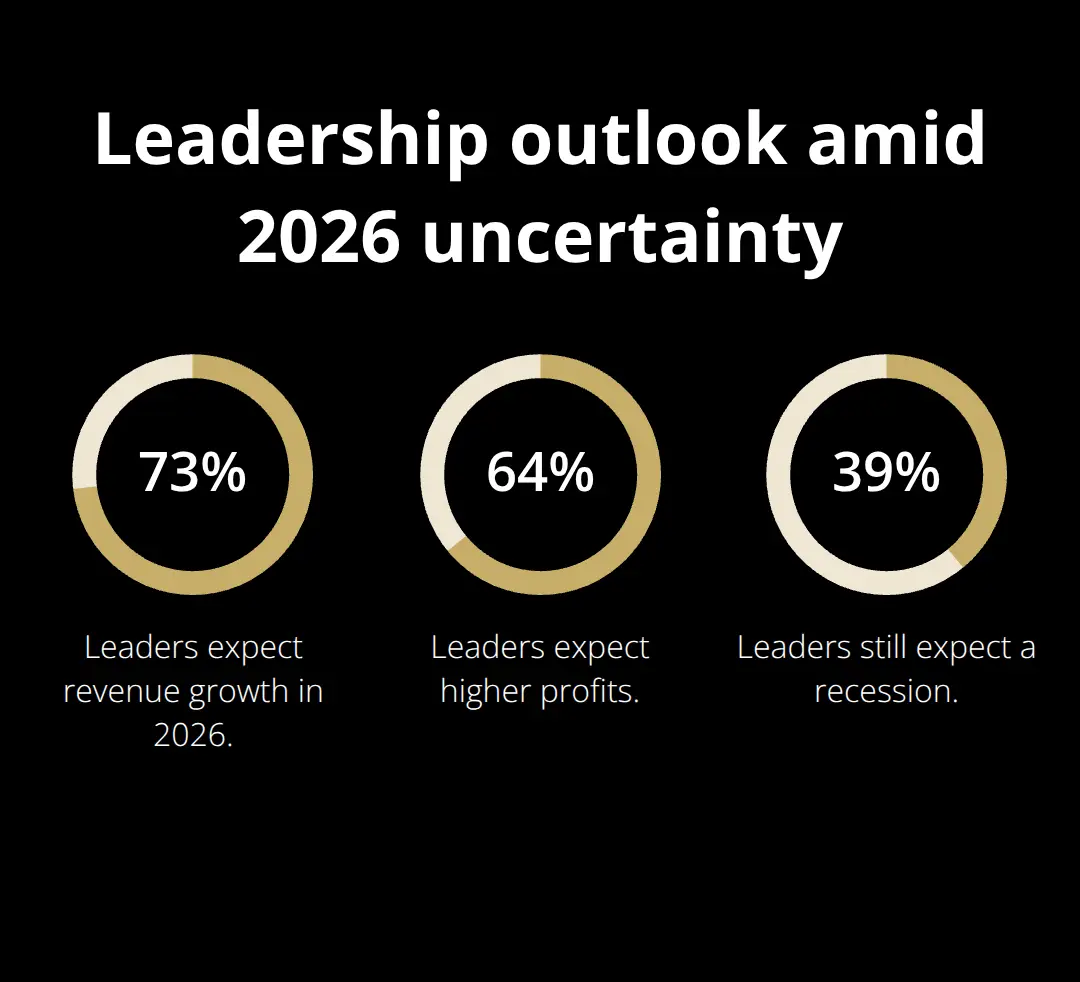
The 2020 pandemic downturn followed a different pattern-volatility was severe but brief, with deal activity rebounding faster than in 2008. This variation matters because it shows that no two downturns behave identically. The J.P. Morgan data indicates 73% of leaders expect revenue growth in 2026 and 64% expect higher profits, suggesting this environment may avoid a severe contraction. However, 39% still expect a recession, so preparation now protects you against that scenario.
Credit Availability and Buyer Financing Constraints
Tighter credit availability during downturns amplifies pricing pressure because buyers struggle to finance acquisitions, forcing them to demand larger equity contributions from sellers or push prices down to reduce their borrowing needs. If you sell when capital is abundant, buyer financing flows freely. Sell when credit tightens, and you’re negotiating with buyers whose lenders impose stricter covenants and higher rates, making them less willing to pay premium prices. Understanding these financing dynamics helps you position your business strategically when market conditions shift, which directly influences the strategies you should adopt before listing.
What Really Moves the Needle on Your Sale Price in a Weak Economy
Interest Rates Control Your Buyer’s Purchasing Power
Interest rates and credit availability act as the primary lever controlling buyer purchasing power during downturns. When the Federal Reserve raises rates before a slowdown, acquisition financing becomes expensive and restrictive. Buyers face higher borrowing costs, stricter debt covenants, and smaller loan amounts relative to purchase price, forcing them to negotiate lower prices or walk away entirely. According to J.P. Morgan’s 2026 Leaders Outlook, 49% of business leaders identify uncertain economic conditions as their biggest challenge, and that uncertainty directly influences how aggressively lenders will finance deals. A business worth $10 million at 5% interest rates may only justify $7 million in financing at 8% rates, assuming the buyer’s lender maintains the same leverage multiples. This gap forces you to absorb the difference through lower sale price or seller financing, neither of which favors your exit. Conversely, if the Federal Reserve cuts rates during a downturn, refinancing becomes cheaper and deal activity picks up. The timing of rate cuts relative to your sale date can swing your valuation by 10-15%, so monitoring Federal Reserve policy and economic forecasts matters more than most sellers realize.
Fewer Buyers Means Less Competition for Your Business
Fewer buyers enter the market during downturns because financial investors and strategic acquirers both retreat to safer ground. Financial investors depend on leverage and exit multiples to generate returns, both of which compress when valuations fall and credit tightens. Strategic buyers face their own margin pressures and cash constraints, making large acquisitions lower priority than operational efficiency. This contraction is not gradual-it’s sharp. M&A deal volume drop during recessions shows how quickly the market contracts when financial conditions tighten. Fewer buyers means less competition for your business, and less competition means lower prices. A business in a competitive auction environment might attract three or four qualified bidders pushing price upward. That same business in a downturn might attract only one or two serious buyers, giving them enormous negotiating leverage. Your strategy must shift from creating a bidding war to positioning your business as the most attractive option among a smaller field. This means emphasizing stability, cash flow predictability, and operational efficiency over growth narratives that buyers discount heavily during uncertain times.
Cash Flow Quality Determines Buyer Interest and Price
Buyers scrutinize cash flow stability more intensely during downturns because they price in margin compression and revenue volatility. A business with predictable subscription revenue and low customer concentration faces higher multiples than one dependent on project-based work or concentrated customer relationships. J.P. Morgan data shows 73% of leaders expect revenue growth in 2026 and 64% expect higher profits, but that aggregate optimism masks significant variation by business model. Subscription revenue models create confidence that survives economic weakness because customers lock in long-term commitments. A software company with 90% of revenue from annual contracts will command a premium over a consulting firm with one-off engagements, even if both show identical current earnings. Profitability trends matter equally. If your EBITDA margins have compressed from 25% to 18% over the past two years, buyers will assume further deterioration and apply steeper discounts. If you’ve held margins steady or improved them despite slower revenue growth, you signal operational discipline that justifies higher multiples. Before listing, audit your customer concentration, contract duration, and margin trends. If 40% of revenue comes from three customers, buyers will demand a 20-30% valuation discount to account for customer loss risk. If you’ve maintained or expanded margins while competitors struggled, that operational performance becomes your most powerful negotiating tool when you move forward with positioning your business for sale.
How to Strengthen Your Business Before Buyers Come Calling
Waiting until you list your business to improve its financial health costs you money. Buyers scrutinize financial statements, customer contracts, and operational metrics with intensity that increases during downturns, so the work you do now directly influences the price you’ll receive six to twelve months from now.
Fix Your Margins Before You List
Start by examining your EBITDA margins ruthlessly. If margins have fallen 3-5 percentage points over the past two years, buyers will assume that trend continues and apply steeper discounts to offset expected deterioration. The counter-move is aggressive cost management without sacrificing the operational capabilities that drive future growth. This means identifying which costs are truly fixed versus variable, automating processes that consume labor without adding customer value, and cutting discretionary spending that doesn’t protect your competitive position.
Vendavo’s 2025 Pricing, Selling, and Profit Optimization Report found that 83% of companies using dynamic pricing saw improved accuracy and profitability, suggesting that your pricing strategy itself may be leaving money on the table. If you’ve relied on static pricing or cost-plus approaches, shifting toward value-based pricing or segmented pricing by customer type can recover 5-10% in margin without reducing volume. A global industrial supplier recovered significant margin by transitioning from cost-based pricing across 200,000 SKUs to value-based pricing aligned with customer segment economics. Test this approach on your highest-value customer segments first, then expand if results hold.
Reduce Customer Concentration Risk
Customer concentration represents the second critical issue buyers examine. If 30% or more of your revenue flows from three customers, buyers will demand a 20-30% valuation haircut because losing one major account would devastate profitability. Spend the next six months deliberately diversifying your customer base and extending contract terms with existing customers where possible. If you can shift from month-to-month contracts to annual agreements, that contract visibility alone improves your valuation significantly.
Tighten Working Capital Management
Audit your working capital efficiency immediately. Unpaid invoices and tighter liquidity during economic weakness squeeze cash flow, reducing the defensibility of your asking price. Tightening your days sales outstanding from 45 to 35 days frees up cash while signaling operational discipline buyers reward during downturns.
Target Strategic Buyers, Not Financial Investors
Strategic buyer selection requires abandoning the assumption that the highest bidder will emerge from open auction dynamics. During downturns, competitive tension disappears because fewer buyers participate, so your energy should shift toward identifying strategic acquirers whose business models create synergies with yours. A strategic buyer gains value from combining operations, eliminating duplicate functions, cross-selling to expanded customer bases, or acquiring capabilities that strengthen their competitive position.
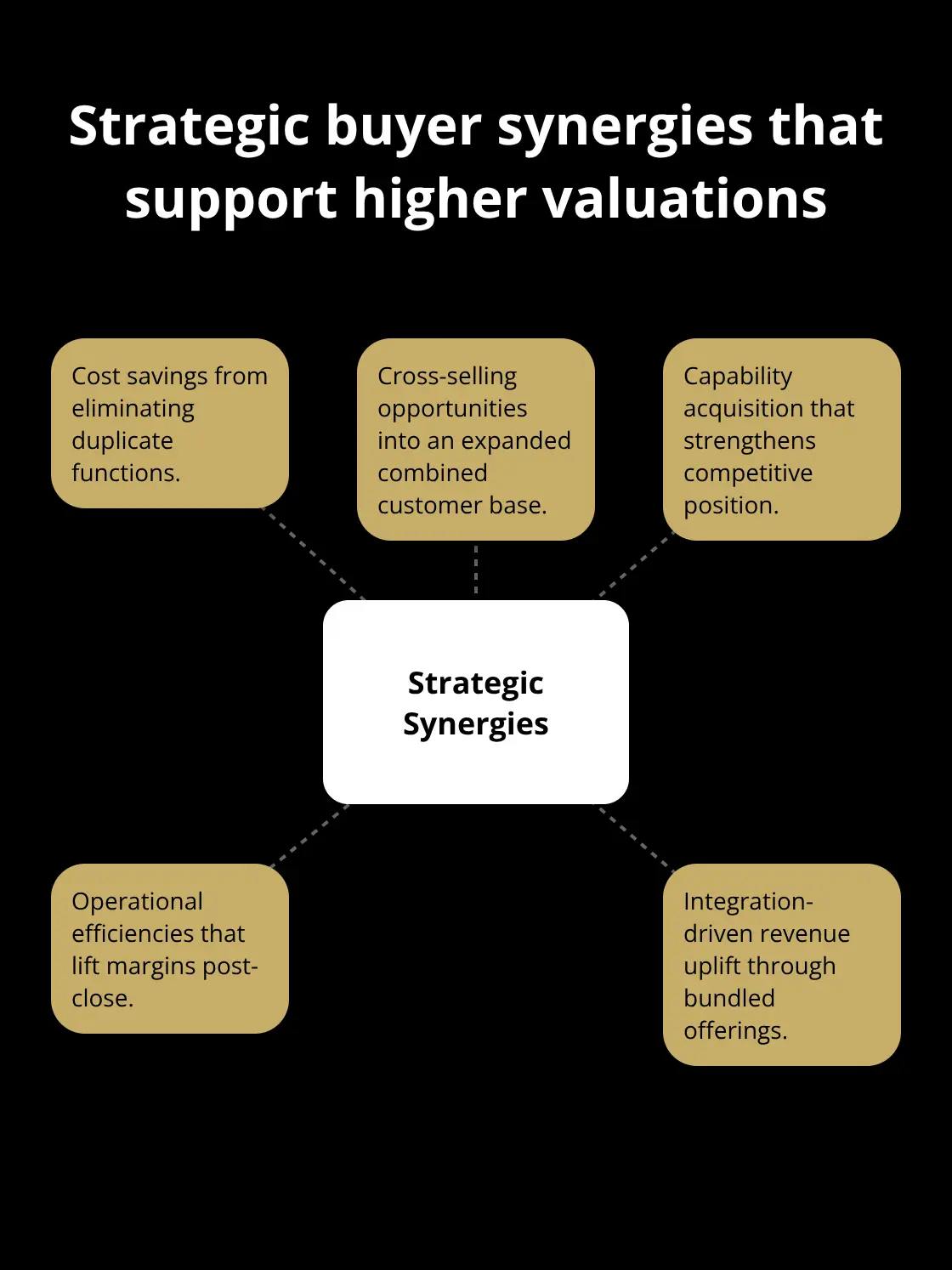
Strategic buyer synergies allow strategic buyers to justify paying prices closer to pre-downturn levels because they’re not just buying your cash flows-they’re buying cost savings and revenue opportunities.
Financial investors, by contrast, depend entirely on EBITDA multiples to generate returns, so they’re the first to retreat when multiples compress and the last to pay premium prices. In a downturn environment, financial investors become your competition rather than your target.
Position Your Business for Strategic Synergies
This distinction matters enormously for how you position your business. For a strategic buyer, emphasize operational efficiency gains, customer overlap opportunities, and cost structure improvements they could capture post-acquisition. Highlight which of your customers align with theirs, which products or services complement their offerings, and where duplicate functions could be eliminated. For a financial buyer, the pitch must focus on EBITDA stability, margin resilience, and cash flow predictability-factors that justify valuation multiples in uncertain environments.
Marketing and positioning shift from broad outreach to targeted identification of the three to five strategic acquirers most likely to value your business. J.P. Morgan’s 2026 Leaders Outlook found that 39% of business leaders plan M&A activity and 49% are considering strategic partnerships, indicating that strategic buyer appetite remains robust even amid economic uncertainty. Your marketing materials should speak directly to the synergies these specific buyers would capture. A business offering complementary products to a larger player’s customer base should lead with that customer overlap. A company with operational excellence in a sector where the acquirer struggles should emphasize those capabilities. This targeted approach requires more preparation than broad marketing, but it generates far superior results because you’re not competing against the broader market-you’re competing against the absence of alternative buyers.
Final Thoughts
Market downturns compress business valuations, but they don’t eliminate your exit opportunity. The sale depression you face during economic weakness stems from predictable forces: fewer buyers, tighter financing, and risk-averse multiples. Understanding these dynamics shifts your mindset from hoping for pre-downturn prices to strategically positioning your business to capture maximum value in the current environment.
The work starts now, not when you list. Improve your EBITDA margins by 2-3 percentage points, reduce customer concentration below 30%, and tighten working capital management-these actions directly influence the price buyers will offer six to twelve months from now. Strategic acquirers remain active even when financial investors retreat, and they’ll pay closer to fair value because they capture synergies financial buyers cannot.
Timing your exit requires balancing two competing forces: the cost of waiting against the benefit of additional preparation. Unbroker offers a modern platform for selling businesses with transparent pricing and AI-driven buyer matching, eliminating the guesswork from finding the right acquirer and negotiating fair terms during uncertain markets.